
War in Middle East – Latest
March 1, 2026 10:41 am
05:44 p.m.: Pope Leo voices ‘deep concern’ over Iran escalation
Pope Leo XIV voiced concern on Sunday about developments in the Middle East and Iran, urging the parties involved to stop what he called a “spiral of violence” before it becomes an “irreparable abyss.”
“Stability and peace are not built with mutual threats, nor with weapons, which sow destruction, pain, and death, but only through a reasonable, authentic, and responsible dialogue,” the pope said March 1. He appealed for diplomacy to “recover its role” and for the common good of peoples who long for peaceful coexistence “founded on justice.”
The pontiff added: “Let us continue to pray for peace.”
Leo also appealed for peace in the conflict between Pakistan and Afghanistan, calling for an urgent return to dialogue. He asked Catholics to pray that concord may prevail in conflicts around the world, saying: “Only peace, a gift of God, can heal the wounds between peoples.”
The pope also said he was close to the people of Brazil’s state of Minas Gerais following severe flooding, offering prayers for victims, families who have lost their homes, and those engaged in rescue operations.
Earlier, before reciting the Angelus, the pope reflected on Sunday’s Gospel account of the Transfiguration, describing Christ as the living wisdom who fulfills the Law and the Prophets. He said the Transfiguration anticipates the light of Easter—death and resurrection, darkness and new light—shining, he said, upon bodies “scourged by violence,” “crucified by suffering,” and “abandoned in misery.”
Pope Leo said the Lord “transfigures the wounds of history,” illuminating minds and hearts with a surprising revelation of salvation. He added that grasping this mystery requires time: time of silence to listen to the Word, and time of conversion to savor the Lord’s companionship.
05:29 p.m.: Middle East crisis could impact Sri Lanka’s economy – Prof. Tudor Weerasinghe
Political analyst Professor Tudor Weerasinghe today (01) outlined the potential impact of the ongoing crisis in the Middle East on Sri Lanka.
Addressing a media briefing on the matter, Prof. Weerasinghe noted that global daily oil production stands at approximately 100 million barrels, with around 20% originating from the Middle East region. Any disruption to this supply, he warned, could lead to significant shifts in the global economy, particularly through rising oil and gas prices.
Elaborating further, Prof. Weerasinghe stated that Sri Lanka’s exports could also be affected.
“We export a significant volume of tea to Iran. We also export to Arab countries. Under these circumstances, the conflict situation could disrupt those activities. Already, many international flights between countries have been cancelled. This situation could have a decisive impact not only on the global economy and trade, but also on international relations,” Prof. Tudor Weerasinghe added.
05:12 p.m.: Alireza Arafi appointed to Iran’s Leadership Council
Iran has appointed Alireza Arafi as the jurist member of its temporary Leadership Council following the death of Supreme Leader Ayatollah Ali Khamenei in US-Israeli strikes, according to state media.
The appointment occurred on Sunday, as reported by the ISNA news agency. Arafi, a cleric and member of the Guardian Council, joins President Masoud Pezeshkian and Chief Justice Gholamhossein Mohseni Ejei on the council, which handles the supreme leader’s duties until the Assembly of Experts selects a successor.
State media repeated the announcement, noting Arafi’s role in the interim body.
In Tehran, some residents celebrated with cheers, music, whistles, and fireworks shortly after 11 pm local time on Saturday, even before official confirmation of Khamenei’s death. Videos verified by news agency AFP showed these scenes, though large crowds did not form due to fears stemming from a recent crackdown on anti-government protests in January.
Others mourned in central Tehran, gathering in Enghelab Square dressed in black, some weeping, chanting “death to America” and “death to Israel,” while waving Iranian flags and holding Khamenei’s photos. State television declared a 40-day mourning period and seven public holidays, stating that Khamenei’s path would continue with increased vigour.
Iran President Pezeshkian described the killing as a “declaration of war against Muslims” by the US and Israel. The Revolutionary Guards earlier vowed to punish those responsible.
US President Donald Trump announced Khamenei’s death on Truth Social late Saturday, calling him “one of the most evil people in History” and suggesting it offered Iranians a chance to reclaim their country.
Israeli Prime Minister Benjamin Netanyahu urged Iranians to overthrow the regime, describing Khamenei as a “cruel tyrant” who spread terror, oppressed his people, and sought Israel’s destruction over more than three decades.
Reza Pahlavi, son of Iran’s late shah, stated on X that Khamenei’s death marked the end of the Islamic Republic, soon to be discarded in history.
04:52 p.m.: One killed and 11 injured at Dubai and Abu Dhabi airports as Iran strikes region
One person has been killed and 11 injured at airports in Dubai and Abu Dhabi, as Iran launched attacks across the Middle East in response to a massive and ongoing attack against it by the US and Israel.
Authorities in Abu Dhabi confirmed a drone targeting Zayed International Airport (AUH) was intercepted, leading to “falling debris”, killing one person and injuring seven.
Dubai International Airport (DXB) - the world’s busiest by passenger traffic - was damaged in an “incident” that injured four staff, according to authorities.
Thousands of flights have been grounded to and from the region, in one of the most serious disruptions to global travel since the Covid-19 pandemic.
Retaliatory strikes from Iran continued on Sunday with explosions heard in Doha, Dubai and Manama.
Iran has used ballistic missiles and drones to launch wide-scale attacks on US allies and assets across the Gulf, after its supreme leader was killed in the ongoing US-Israel air offensive launched on Saturday morning.
Qatar, Bahrain, Jordan and Kuwait - all home to US military bases - said they had intercepted missiles fired towards them, but falling debris appeared to have caused widespread damage.
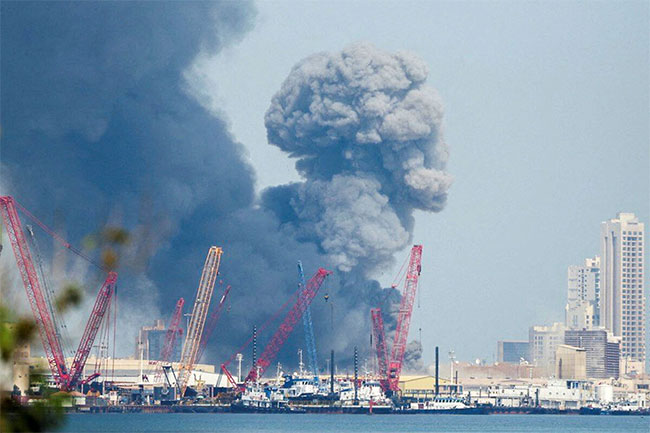
Also in Dubai, debris from an “aerial interception” caused a fire in a berth at the Jebel Ali deep sea port - the world’s ninth busiest.
On the Palm Jumeirah, Dubai’s luxury man-made archipelago, the five-star Fairmont The Palm hotel was struck by a large explosion. Video verified by the BBC shows a fire raging as black smoke rises into the sky.
Authorities also confirmed debris from an intercepted drone had caused a “minor fire” on the outer facade of the five-star Burj Al Arab hotel.
In Bahrain, the interior ministry said the airport was damaged after being targeted by a drone. There were unconfirmed reports of continuing attacks on Sunday morning.
On Saturday, Iran’s Islamic Revolutionary Guard Corps (IRGC) said they had struck the headquarters of the US Navy’s Fifth Fleet, located in Bahrain’s capital Manama. Huge plumes of black smoke were seen rising from an area near the base.
Meanwhile, Oman’s state news agency reported Duqm commercial port was targeted by two drones, injuring one worker.
04:24 p.m.: Russian President Vladimir Putin says the killing of Khamenei is ‘cynical’ murder
Russian President Vladimir Putin said on Sunday that the killing of Iranian Supreme Leader Ayatollah Ali Khamenei and members of his family was “cynical” murder that violated all the norms of human morality and international law.
“Please accept my deep condolences in connection with the murder of the Supreme Leader of the Islamic Republic of Iran, Seyed Ali Khamenei, and members of his family, committed in cynical violation of all norms of human morality and international law,” Putin said in a note to Iranian counterpart Masoud Pezeshkian released by the Kremlin.
Khamenei was killed on Saturday, aged 86, Iranian state media announced, in air strikes by Israel and the United States.
“In our country, Ayatollah Khamenei will be remembered as an outstanding statesman who made a huge personal contribution to the development of friendly Russian-Iranian relations and bringing them to the level of a comprehensive strategic partnership,” Putin said.
“I ask you to convey my most sincere sympathy and support to the family and friends of the Supreme Leader, the government and the entire people of Iran.”
04:16 p.m.: Two Israelis killed, 120 injured in missile attack - IDF
Two Israelis have been killed and over 120 injured in the two days since Operation Roaring Lion began, the Israel Defense Forces has confirmed.
The first fatality occured when a missile hit an older residential building whose designated protected spaces are public shelters instead of built-in safe rooms.
Magen David Adom (MDA), Israel’s emergency medical service, said that the woman, who was initially in critical condition, succumbed to her injuries a few hours after the attack.
“Paramedics have confirmed the death of a woman in her 40s,” after an Iranian missile hit the Tel Aviv city center, according to a senior officer in a video shared by the army.
Marina Bleive, a 68-year-old Tel Aviv resident, suffocated on her way to the shelter on Sunday morning.
Her daughter Aya told Ynet: “I started walking, I went outside. [Marina] told me, ‘Go, I’ll come.’ I turned around and saw that she had stopped, and she shouted, ‘Go, don’t wait for me’… I kept walking, and then the neighbor called me and said that my mom was sitting on the bench and was choking.”
Evacuation, building damage after the strike
Following the direct strike on Tel Aviv, over 200 residents were evacuated from the area and housed in three hotels nearby.
40 buildings in the area have been inspected so far, with only one being declared unfit for habitation.
Of the 40 buildings, 29 sustained property damage without significant structural impact, and 10 suffered minor damage.
The Home Front Command said Iran has launched several hundred missiles towards Israel and other countries in the region, sending a continuous stream of missiles rather than the organized waves of 20-30 missiles that were seen during Operation Rising Lion, last June.
04:00 p.m.: OPEC+ debates oil output boost as war disrupts shipments
OPEC+ will consider a larger-than-expected oil output increase on Sunday, two OPEC+ sources said after the U.S.-Israeli war on OPEC+ member Iran and Tehran’s retaliation led to shipment disruptions in the Middle East.
OPEC+ has a history of raising oil output to cushion disruptions but analysts said the group currently has very little spare capacity to meaningfully add to supply, except for its leader Saudi Arabia and the United Arab Emirates.
Riyadh has been raising oil production and exports in recent weeks in preparation for U.S. strikes on Iran, sources have told Reuters.
Oil, gas and other shipments from the Middle East via the Strait of Hormuz have come to a halt since Saturday after shipowners received a warning from Iran saying the area was closed for navigation.
OPEC+ will debate a production hike of 411,000 barrels per day or more at a meeting on Sunday, sources told Reuters, larger than the original expectations of 137,000 bpd.
Oil prices jumped on Friday to $73 per barrel, the highest level since July, on fears of a wider conflict in the Middle East and supply disruptions through Hormuz, the world’s most important oil route amounting to over 20% of global oil transit.
Middle East leaders have warned Washington that a war on Iran could lead to oil prices jumping to over $100 per barrel, said veteran OPEC analyst Helima Croft from RBC. Analysts from Barclays also said prices could rise to $100.
Croft said the market impact from any large OPEC output increase will be limited due to a lack of actual production capabilities outside Saudi Arabia.
The meeting on Sunday will start at 1100 GMT and will involve only eight members of OPEC+ - Saudi Arabia, Russia, the UAE, Kazakhstan, Kuwait, Iraq, Algeria and Oman. OPEC+ groups the Organization of the Petroleum Exporting Countries and allies like Russia but most production changes in the past years have been done by the eight members.
The eight members raised production quotas by about 2.9 million bpd from April through December 2025, roughly 3% of global demand, before pausing increases for January to March 2026 due to seasonal weakness.
03:26 p.m.: No Sri Lankans in Israel harmed in Iran attacks: Ambassador
No Sri Lankans have been known to be harmed in Israel following retaliatory attacks launched by Iran, the Ambassador of Sri Lanka to Israel, Nimal Bandara has confirmed to Ada Derana.
Ambassador Nimal Bandara said Israel banned public gatherings, shut schools and workplaces and moved hospital patients to underground facilities on Saturday as Tehran launched missiles towards Israel in retaliation for a joint U.S.-Israeli attack on Iran.
Defence Minister Israel Katz also declared a state of emergency across the country, warning the public of Iranian missile and drone attacks.
The military ordered the public to follow emergency guidance while urging residents against non-essential travel so as to allow security and emergency vehicles to move freely, Ambassador Nimal Bandara.
The Ambassador said he expects the situation to be brought under control in two days.
Ambassador Nimal Bandara said since the Ben Gurion Airport remains closed, Sri Lanka hoping to leave Israel and those hoping to arrive in the country will be required to postpone their travel plans.
He said the Embassy is taking all measures to educate the Sri Lankans in Israel on all safety measures and other protocols.
02:40 p.m.: Oil tanker attacked near coast of Oman
An oil tanker was attacked about five nautical miles off the coast of Masandam in Oman, the country’s maritime security center said Sunday.
Four people were injured and the whole crew of 20 people was evacuated, it said. The vessel was called “Skylight” and flew the flag of Palau, a small island nation in the western Pacific.
The maritime security center said the rescues were carried out by the Omani navy and military, “reflecting the national readiness to deal with maritime incidents.”
Oman had played a key role in mediating the recent talks between Iran and the United States, which aimed to reach a new nuclear deal.
02:38 p.m.: Iran’s Khamenei ‘will not be mourned,’ says Australian PM Albanese
Australian Prime Minister Anthony Albanese says that Iran’s Supreme Leader Ayatollah Ali Khamenei “will not be mourned,” as state media in the Islamic Republic confirms he has been killed.
“Ayatollah Ali Khamenei was responsible for the regime’s ballistic missile and nuclear program, support for armed proxies and its brutal acts of violence and intimidation against its own people,” Albanese tells reporters.
“He was responsible for orchestrating attacks on Australian soil. His passing will not be mourned.”
02:30 p.m.: Israel targets “heart of Tehran” in new wave of strikes
The Israeli Air Force has carried out a new wave of strikes on the Iranian capital Tehran, according to the Israeli Defense Forces (IDF).
“For the first time since the start of Operation ‘Roaring Lion’: The IDF is striking targets that belong to the Iranian terror regime in the heart of Tehran,” a statement said, a day after joint attacks with the US killed Iran’s supreme leader.
“Over the past day, the Israeli Air force conducted large-scale strikes in order to establish aerial superiority and to pave the path to Tehran.”
Reports from Tehran say there were explosions in multiple areas of the city Sunday morning.
Images posted on social media purported to show large clouds of dense smoke rising from several parts of Tehran.
02:27 p.m.: Senior Iranian official says no US warships can enter Persian Gulf
No US warships would be allowed to enter the Persian Gulf Moshen Rezaei, a former top Islamic Revolutionary Guard Corps commander and senior Iranian official, said Sunday.
Rezaei’s pronouncement came in a Telegram post from the state-run Fars News Agency.
The US Navy amassed what President Donald Trump has called an “armada” of ships in the region before Saturday’s attack on Iran. In the days leading up to the strikes, at least a few of those US ships were in the Gulf while others were in the Arabian Sea. The exact location of US ships in the region was unknown on Sunday.
Video released by US Central Command since the strikes began showed US warships launching Tomahawk missiles as part of the strikes on Iran as well as fighter jets taking off from an aircraft carrier.
02:03 p.m.: Several senior Iranian figures killed in attack by US and Israel
A number of senior figures in Iran are known to have been killed in Saturday’s strikes on Iran.
The Israeli military has also published a list of senior Iranian officials it says were killed in Saturday’s airstrikes.
They include:
- Ayatollah Ali Khamenei, Iran’s supreme leader, who was killed on Saturday morning at his office
- Aziz Nasirzadeh, the country’s defense minister
- Ali Shamkhani, the head of the Iranian Security Council
- Mohammad Pakpour, commander of the Islamic Revolutionary Guard Corps (IRGC)
- Abdolrahim Mousavi, country’s armed forces chief of staff
- Saleh Asadi, an intelligence official
- Hossein Jabal Amelian and Reza Mozaffari-Nia, research officials
- Mohammed Shirazi, longtime defense liason
Iranian television State media has also reported that Khamenei’s daughter, son-in-law and grandchild were killed in the attack
An intelligence source and military source has told CBS News that overall around 40 Iranian officials were killed in the strikes.
01:40 p.m.: Middle East Conflict: Foreign Ministry issues emergency contact numbers
The Ministry of Foreign Affairs has issued a set of emergency contact numbers for Sri Lankans in light of the escalating conflict in the Middle East.
Accordingly, Sri Lankans residing in the Middle East can obtain information by using contact details of the missions/ posts.
01:29 p.m.: Middle East Conflict causes worst travel disruptions in years
Thousands of flights have been affected across the Middle East and beyond since the U.S. and Israeli strikes, according to data on FlightAware, a flight tracking platform.
Key transit airports including Dubai - the world’s busiest international hub - and Abu Dhabi in the UAE, and Doha in Qatar, were shut or severely restricted as much of the region’s airspace remained closed.
Dubai International Airport sustained damage during Iran’s retaliatory attacks, while airports in Abu Dhabi and Kuwait were also hit.
Dubai and neighbouring Doha sit at the crossroads of east-west air travel, funnelling long-haul traffic between Europe and Asia through tightly scheduled networks of connecting flights.
With those hubs idle, aircraft and crews remained stranded out of position, disrupting airline schedules worldwide.
“It’s the sheer volume of people and the complexity,” said UK-based aviation analyst John Strickland.
“It is not only customers, it is the crews and aircraft all over place.”
01:19 p.m.: From Pakistan to Iraq, protesters storm US Consulates over Khamenei’s death
Scores of men forced their way into the United States Consulate in Pakistan’s Karachi on Sunday, as tensions escalated in the Middle East after Iran’s Supreme Leader Ayatollah Ali Khamenei was announced.
Visuals showed police clashing with protestors on the street outside the consulate.
While protestors threw stones, police fired tear gas in an attempt to disperse them.
Another video showed scores of men inside the gate compound of the consulate, trying to break glasses of windows and doors to enter the main building.
12:50 p.m.: SL Embassy in Saudi Arabia urges Sri Lankans to remain vigilant amid evolving security situation
The Embassy of Sri Lanka in Saudi Arabia has urged Sri Lankans residing in Saudi Arabia to remain attentive and cautious in light of the evolving security situation in the Middle East.
Issuing a special notice, the Embassy advised Sri Lankans to rely solely on official sources of information.
Sri Lankans have also been requested to strictly follow instructions issued by the authorities of the Kingdom of Saudi Arabia, as well as guidance provided by the Sri Lankan Embassy in Riyadh and the Consulate General’s Office in Jeddah.
The Embassy further called on the Sri Lankans to refrain from spreading unverified information and to avoid traveling to areas where security advisories have been issued.
Sri Lankans have also been advised to keep their travel and identification documents easily accessible at all times.
To ensure the safety and welfare of Sri Lankans, the Embassy has introduced 24-hour emergency contact numbers.
Individuals can reach the Embassy via +966 54 947 7567 or +966 56 982 2700.
For WhatsApp or IMO messages, the number +966 56 975 3380 has been provided.
Information can also be obtained via email at slemb.riyadh@mfa.gov.lk
12:11 p.m.: China urges immediate ceasefire after US, Israel strike Iran
China’s ministry of foreign affairs has expressed concern over United States-Israeli strikes against Iran and called for an immediate ceasefire, urging all sides to avoid escalation and to resume dialogue and negotiation.
In a statement on Saturday (Feb 28), the ministry said Iran’s sovereignty, security and territorial integrity should be respected.
On Sunday, China’s embassy in Israel issued a notice advising Chinese citizens in Israel to evacuate to safer areas within the country as soon as possible or to leave for Egypt via the Taba border crossing.
The US and Israel launched an attack on Iran on Saturday, targeting its military capability. Iran’s Supreme Leader Ali Khamenei was killed in the operation, state media reported.
Separately, Hong Kong-based airline operator Cathay Group on Saturday suspended operations in the Middle East, citing regional tension following the strikes.
The suspension affects passenger flights to and from Dubai and Riyadh, as well as freighter services operating through Al Maktoum International Airport in Dubai, Cathay, the parent of Cathay Pacific Airways, said in a statement.
It said it is rerouting flights that typically pass over the affected area.
11:42 a.m.: Iran speaker brands US, Israel chiefs ‘filthy criminals,’ warns of retaliation
Iran’s parliament speaker on Sunday called the leaders of the United States and Israel “filthy criminals” who will face “devastating blows” for their ongoing attacks on the Islamic Republic.
Mohammad Bagher Qalibaf made the comment in a televised address.
Qalibaf is the highest-ranking official to appear on camera since the attacks began Saturday. “You have crossed our red line and must pay the price,” he said. “We will deliver such devastating blows that you yourselves will be driven to beg.”
11:16 a.m.: Sri Lanka’s fuel supply chain not from current conflict zone - CPC Chairman
There will be no delays in receiving fuel stocks ordered through April and May, the Ceylon Petroleum Corporation (CPC) stated.
Addressing a media briefing in Colombo, CPC Chairman D.J. Rajakaruna noted that Sri Lanka’s fuel supply chain is not from the current conflict zone in the Middle East. Therefore, he said the fuel supply to the Ceylon Petroleum Corporation will not be interrupted.
CPC Chairman D.J. Rajakaruna noted that the relevant fuel shipments are scheduled to arrive from India and Singapore.
“We are making this statement responsibly. Therefore, there is no point in people waiting in queues. We were not originally scheduled to distribute fuel today (01). However, due to increased public consumption, we have called all fuel distribution staff back to work. Fuel issuance has now commenced. Although tomorrow (02) is a Poya day, fuel supplies will continue,” he said.
The CPC Chairman also noted that all filling stations have been instructed not to supply fuel into cans or barrels. He warned that legal action will be taken against anyone attempting to purchase fuel in bulk containers for resale.
11:13 a.m.: Continuous fuel distribution today and tomorrow: Petroleum Tanker Owners
Despite the ongoing war in the Middle East, the Sri Lanka Petroleum Private Tanker Owners’ Association has reassured the general public that there is sufficient fuel stock for the next 37 days in Sri Lanka, urging people not to panic unnecessarily.
Speaking on the matter, D.V. Shantha Silva, an executive committee member of the association, emphasized that fuel distribution will continue as normal today, Sunday, despite the holiday, and that fuel distribution will also take place tomorrow, which is Poya Day.
Silva further clarified, “Normally, Sundays are holidays, but due to the extended weekend, the Indian Oil Corporation had already made arrangements for regular fuel distribution. Even though fuel distribution typically halts on Poya days, the Ceylon Petroleum Storage Terminals Ltd. has confirmed that fuel will be distributed tomorrow (March 2). A sufficient number of tankers have been deployed for the task. There is absolutely no need to cause unnecessary alarm regarding fuel availability.”
10:44 a.m.: Iran launches new wave of strikes against Israel, US bases
Iran has launched a new wave of missile and drone strikes targeting US military bases in the region and Israel.
Twenty-seven US bases in the region, as well as Israel’s military headquarters and a defence industries complex in Tel Aviv, were among the targets, Iranian state TV said.
Blasts were reported in Dubai, the UAE, Doha, Qatar and in Bahrain’s Manama.
An AFP journalist reported a thick black cloud of smoke over Doha after explosions were heard.
The new explosions came after a day of deadly Iranian strikes in the Emirati capital Abu Dhabi, which saw military bases and infrastructure, including airports, hit across the Gulf - except for mediator Oman.
10:39 a.m.: Khamenei’s Tehran compound heavily bombed
Iranian state media said Supreme Leader Ayatollah Ali Khamenei was killed in an airstrike targeting his compound in downtown Tehran.
Satellite photos from Airbus showed the site heavily bombed.
His death at his office “showed that he consistently stood among the people and at the forefront of his responsibilities, confronting what officials call global arrogance”, state TV said.
Cheers could be heard on Tehran’s streets after reports first emerged from Israel of the death of Khamenei, as plumes of black smoke hovered over the district where he usually resides.
The attack came weeks after Iranian authorities ruthlessly put down mass protests, killing thousands.
Iran’s Revolutionary Guards vowed “severe, decisive” punishment for Khamenei’s “murderers”.
10:35 a.m.: All SriLankan Airlines flights to Middle East cancelled today
SriLankan Airlines has announced that all flights to the Middle East scheduled for today (01) have been cancelled in response to the ongoing situation in the region.
SriLankan Airlines announced yesterday (28) that all flights departing to the Middle East from Colombo have been cancelled due to the ongoing conflict in the Middle East.
Accordingly, passengers have been requested to contact the airline’s Global Contact Centre 1979, visit http://www.srilankan.com, any SriLankan Airlines office or respective travel agent for rebooking options and further assistance.
10:35 a.m.: CPC assures adequate fuel supply; urges motorists to avoid panic buying
The Ceylon Petroleum Corporation (CPC) has confirmed that the country has adequate fuel stocks to last for more than a month.
Accordingly, motorists are urged to refrain from panic buying.
The announcement comes in the wake of reports of long fuel queues at certain fuel stations in the country.
10:34 a.m.: Iran leader Khamenei killed
Iran’s Supreme Leader Ayatollah Ali Khamenei was killed on Saturday in air strikes that pulverised his central Tehran compound.
The 86-year-old had been Iran’s supreme leader since 1989.
“Khamenei, one of the most evil people in History, is dead,” US President Donald Trump said on his Truth Social network.
Iranian state media had also reported that Khamenei’s daughter, grandchild, daughter-in-law and son-in-law were killed in the strikes.
The 36-year rule of Khamenei built Iran into a powerful anti-United States force, spreading its military sway across the Middle East, while using an iron fist to crush repeated unrest at home.
Under him, Iran and Israel also fought a shadow war for years, with Israel assassinating Tehran’s nuclear scientists and Revolutionary Guard commanders.
Urging Iranians to overthrow their clerical rulers, the US launched “major combat operations” along with Israel against Iran early on Saturday.
The US is calling the operation “Epic Fury”, while the Israelis call it “Lion’s Roar”.
US President Donald Trump said Iran’s Supreme Leader Ali Khamenei had been killed.
It came two days after US-Iranian talks on Tehran’s nuclear programme ended without a deal.
Iran launched counter-attacks throughout the Middle East in retaliation to what its foreign minister called an “unprovoked, illegal” attack by the US and Israel.
Why did the US attack Iran?
Shortly after explosions were reported in the Iranian capital on Saturday, Trump took to social media to accuse Tehran of waging an “unending campaign of bloodshed and mass murder targeting the United States”.
Trump argued Iran had rejected every opportunity to renounce its nuclear programme and claimed it was developing long-range missiles that could threaten Europe, US troops overseas, and even “soon reach the American homeland”.
He further cited the violent takeover of the US embassy in Tehran in 1979, resulting in dozens of Americans being held hostage for 444 days, as well as Iran’s proxies bombing a US Marine barracks in Beirut in 1983 that killed 241.
The US president had also pledged in January to intervene when Iranian security forces crushed protests amid an economic crisis.
In June last year, the US bombed three nuclear facilities in Iran. Trump said the US Operation Midnight Hammer had “obliterated” Iran’s nuclear programme.
Last summer’s US attacks paved the way for a ceasefire in a 12-day conflict between Iran and Israel.
Israel had launched air strikes on Iranian nuclear, military and infrastructure sites. Tehran had retaliated by firing hundreds of rockets and drones at Israel.
Is Iran’s supreme leader dead?
Yes.
Trump announced on social media that Supreme Leader Ayatollah Ali Khamenei had died, describing him as “one of the most evil people in History”.
Iranian state TV later confirmed the death of Khamenei, 86, who had ruled since 1989, and declared 40 days of mourning.
An intelligence source and a military source told the BBC’s US partner CBS that around 40 Iranian officials were also killed in the strikes.
BBC Verify obtained satellite imagery taken over Tehran that showed significant damage to part of Khamenei’s office in the Iranian capital.
Is the US at war?
In his video announcement, Trump described the US-Israel attacks on Iran as “major combat operations”.
Congress reserves the power to officially declare war, as written in Article I of the US Constitution, but it has not done so.
The Constitution does, however, give the president broad authority to engage in military action.
This grey area has been the source of much debate recently in Washington.
Reactions on Capitol Hill to the US-Israel attack on Iran have fallen largely along partisan lines. Republicans, who currently control both chambers of Congress, were mostly in support.
Kentucky Senator Lindsey Graham, who has long called for a US attack on Iran, wrote on X: “This operation is necessary and long justified.”
House Speaker Mike Johnson, a Republican, said the Trump administration had notified the “Gang of 8” - a bipartisan group of congressional leaders - ahead of the strikes.
Democrats mostly denounced the attacks, accusing Trump of launching a war without congressional approval.
Democratic Senator Tim Kaine, on the Armed Services Committee, called the conflict “Trump’s illegal war”.
Democrats renewed calls for Congress to take up a war powers resolution, like the bill that failed last year for lack of Republican support.
If another war powers resolution were introduced and passed, it could block the president’s unilateral use of force without congressional approval.
But the odds of such a bill passing appear unlikely for now.
Few Republicans have indicated they would back such a measure, except for congressman Thomas Massie and Senator Rand Paul.
Will there be US boots on the ground?
The US has about 13 military bases across the Middle East, with 30,000 to 40,000 troops normally deployed between them.
But there is no indication that US combat troops will be deployed on the ground in Iran, not least because of the low appetite among the American public for a ground invasion.
The US military has been building its presence in the Middle East for weeks and has two aircraft carriers, USS Gerald R Ford and USS Abraham Lincoln, in the region.
BBC Verify tracked a total of 12 US ships in the Middle East and a large number of US aircraft, including F-35 and F-22 fighter jets, refuelling tankers, and surveillance aircraft. But US military action has amounted to air raids so far.
Does Iran have the capability to attack the US?
The Iranian regime has always denied it wants a nuclear weapon, but it has enriched uranium to a level that has no civilian use in a nuclear power programme, says the BBC’s international editor Jeremy Bowen.
So far Israel and the US have published no evidence that it was about to build the bomb, he adds.
There have been no public reports of a pending attack on the US mainland, but local authorities have said they are on high alert.
New York City Mayor Zohran Mamdani said emergency management officials were taking “proactive steps” in “sensitive locations” out of an abundance of caution.
On the west coast, Los Angeles Mayor Karen Bass said police had stepped up patrols, although “there are no known credible threats at this time”.
How many have died?
Trump said “the lives of courageous American heroes may be lost”, although the US military said it had received no reports of combat casualties so far.
More than 200 people have been killed across Iran and more than 700 injured, according to the Red Crescent on Saturday.
The first-aid organisation said that 24 of Iran’s 31 provinces had been hit. At least 108 people have died in an explosion at a school in southern Iran, according to a local prosecutor.
One person died and at least 20 were wounded when an Iranian missile hit several buildings in central Tel Aviv, reports the Israeli newspaper Haaretz.
In counterattacks, Iran also fired drones and missiles at Bahrain, Kuwait and Qatar the UAE, all of which have a US military presence.
One person was killed in Abu Dhabi, UAE state media said.
Trump warned bombing would continue throughout the week, so the death toll may rise.
(With agencies inputs)