


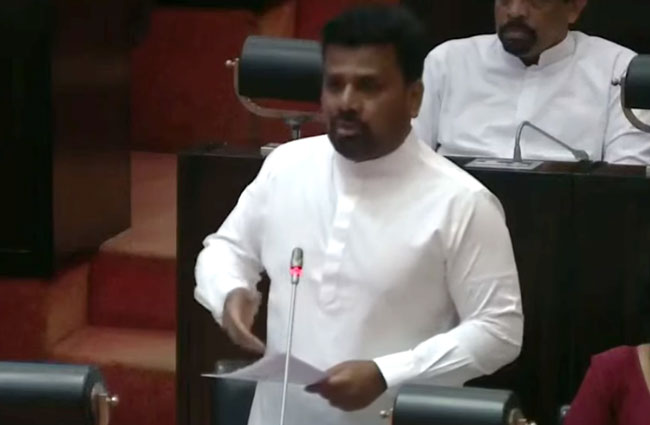
President urges swift settlement in Middle East amid worldwide economic concerns
March 3, 2026 11:41 am
President Anura Kumara Dissanayake urged all parties involved in the ongoing Middle East conflict to commit to a swift and peaceful resolution, highlighting the conflict’s repercussions on the global economy, including Sri Lanka’s.
He made the remarks addressing the parliamentary session today (03).
“Any military conflict does not create a favorable situation for any group of people. In a world where massive military technologies and weaponry are being developed, we can all understand how destructive this can be. Therefore, our position as Sri Lanka is that all parties involved in this war must, as soon as possible, make the necessary commitments and take steps toward a peaceful world.”
The President stated that the lives of people in Sri Lanka could also be significantly affected by this military situation, and the country cannot isolate itself from its consequences. He emphasized that a national program is being prepared to address the situation, which can only succeed through international commitment to peace.
Stating that the Middle East conflict could disrupt the supply of oil and gas and create major issues for Sri Lankans living abroad, the President also noted that the tourism industry, foreign remittances, and the shipping and aviation sectors would be impacted.
He added that solutions must be found for the challenges Sri Lanka will face both in the short and long term due to the conflict, and acknowledged that it is natural for the public to feel anxious given the bitter experiences of the past.
President Dissanayake further noted that societal stability cannot be achieved through words alone; it requires practical assurance that citizens will not face a crisis.
He highlighted that the current government has successfully managed many such challenges since taking office, but the Middle East situation is distinct from previous crises, with uncertainty surrounding its resolution.
The President stated that the government is constantly monitoring developments. The Central Bank of Sri Lanka has conducted a review, and a report on the potential economic impact is expected by this evening or tomorrow.
Additionally, the Ministry of Finance is preparing a report on the impact on public life, and a program is being developed to ensure the provision of essential services to citizens both abroad and at home.
“The solution to the overall crisis does not lie with individuals. The primary responsibility for finding a path out of the crisis rests with the government. Meanwhile, all members of Parliament have responsibilities that cannot be abandoned. Citizens also have a significant role to play. Our proposal is that the government, Parliament, and the people face this challenge together, guided by a single objective and plan.”
Addressing the country’s energy reserves, the President said:
“Our main issue is the capacity of our storage facilities. We do not have the capacity in our warehouses to store oil for two or three months. Our storage facilities are emptied to make room for incoming shipments and cannot remain full at all times. Excluding the IOC tanks in Trincomalee, the total storage capacity at Kolonnawa and Muthurajawela is only about 150,000 metric tons. We maintain maximum operational capacity according to the arrival schedule of ships. At one point, 103,000 metric tons were stored, with 1,800 metric tons coming from daily refining. This plan provides diesel for 33 days.
We have diesel supplies for 33 days. The total storage capacity for petrol is 106,187 metric tons. When the crisis emerged, there was a storage capacity of 136,270 metric tons. We operate from these facilities and have never maintained a separate emergency buffer stock. Accordingly, at any moment of crisis, we maintain the maximum possible reserves.
Current petrol reserves are sufficient for 27 days. Another shipment of 35,000 metric tons is expected on March 7 or March 8, which will extend reserves to approximately 40 days. Oil shipments must be scheduled according to storage depletion rates.
The daily supply of aviation fuel is approximately 1,800 metric tons, of which 1,080 metric tons are produced through daily refining, and the remainder is imported. Aviation fuel supplies are sufficient for 49 days. Ship arrivals have been scheduled: an RM Parks company ship on March 14, a Sinopec ship on March 17, an IOC ship on March 21, and a Ceylon Petroleum Corporation (CPC) ship on March 28.
The current quantity of crude oil is sufficient for 26 days. We are bringing in another ship, which will be sufficient for an additional 18 days. Therefore, we can run the crude oil refinery for 44 days. Because of this, there is no crisis regarding oil.”



