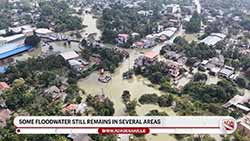

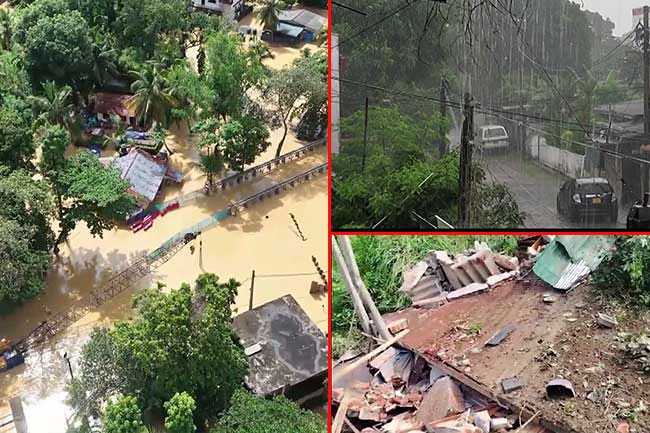
Extensive damage to roads, bridges, rail tracks and tanks due to Cyclone Ditwah, 246 roads restored
December 4, 2025 11:55 am
Widespread destruction has been reported across multiple sectors in Sri Lanka due to the recent adverse weather conditions, according to the Commissioner-General of Essential Services, B.K. Prabath Chandrakeerthi.
Issuing a statement, the Commissioner-General confirmed that assessments reveal that 1,777 tanks, 483 dams, 1,936 canals and 328 agricultural roads under the Department of Agricultural Services have been damage.
Additionally, 137,265 acres of land have been destroyed, while 305 minor irrigation channels have been affected, Chandrakeerthi stated.
Meanwhile, the Road Development Authority (RDA) has restored 246 previously obstructed roads to normal traffic flow.
However, 22 bridges within the road system have been destroyed, of which six are in the Uva Province, four in the Northern Province, four in the North-Western Province, three in the Western Province, two in the Central Province, two in the Eastern Province and one in the North-Central Province, he said.
Sri Lanka’s railway system has also been severely affected due to the impact of Cyclone Ditwah.
According to the latest assessment, out of a total network spanning 1,593 km, only 478 km of rail tracks are currently operational.
Moreover, telecommunications services have shown signs of improvement, with 91% of disrupted connections restored, Chandrakeerthi said in the statement.
However, the Nuwara Eliya District still requires further recovery efforts to reinstate full connectivity.
In the power sector, progress continues steadily, and 11,315 out of 16,178 power substations disrupted during the disaster have been reactivated.
As a result, 2,526,264 out of 3,531,841 consumer power connections, representing 72% of affected households, have been restored so far, he added.
Furthermore, the Director General of the Department of National Planning has been instructed to urgently prepare a Climate Responsive Recovery and Reconstruction Investment Plan (CRRRIP), especially for obtaining the support of development stakeholders.