
Iran says ‘guiding principles’ agreed with US at nuclear talks
February 18, 2026 09:45 am
Iran has said it has reached an understanding with the US on the main “guiding principles” to resolve their dispute over Tehran’s nuclear programme.
Speaking after indirect talks in Geneva, Iranian Foreign Minister Abbas Araghchi added that work still needed to be done. The US said “progress was made”.
Badr Albusaidi, foreign minister of mediator Oman, said the negotiations “concluded with good progress towards identifying common goals and relevant technical issues”.
The meeting followed repeated US military threats against Iran over its deadly crackdown on anti-government protests and its nuclear activities. President Donald Trump had earlier said he believed Iran wanted to make a deal.
The US and its European allies suspect that Iran is moving towards the development of a nuclear weapon, something that Tehran has always denied.
Before Tuesday’s talks at the residence of Oman’s ambassador in the Swiss city, Iran stated that it would focus on its nuclear programme and the potential lifting of economic sanctions imposed by the US.
Washington has previously indicated it wanted to discuss other issues as well, such as Iran’s missile development.
It was not immediately known what range of issues were discussed in Geneva but a US official told the BBC: “Progress was made, but there are still a lot of details to discuss. The Iranians said they would come back in the next two weeks with detailed proposals to address some of the open gaps in our positions.”
When asked about the talks in an interview with Fox News, US Vice-President JD Vance said: “In some ways, it went well; they agreed to meet afterwards. But in other ways, it was very clear that the president has set some red lines that the Iranians are not yet willing to actually acknowledge and work through.”
Framing the talks as “very important”, US President Donald Trump had earlier said he would be “indirectly” involved and suggested Tehran was motivated this time to negotiate.
“I don’t think they want the consequences of not making a deal,” Trump told reporters aboard Air Force One, adding that Iran learned the consequences of a tough posture in talks last summer when the US bombed Iranian nuclear sites.
“We could have had a deal instead of sending the B-2s in to knock out their nuclear potential. And we had to send the B-2s,” he said, referring to the stealth bombers that carried out the bombings. “I hope they’re going to be more reasonable.”
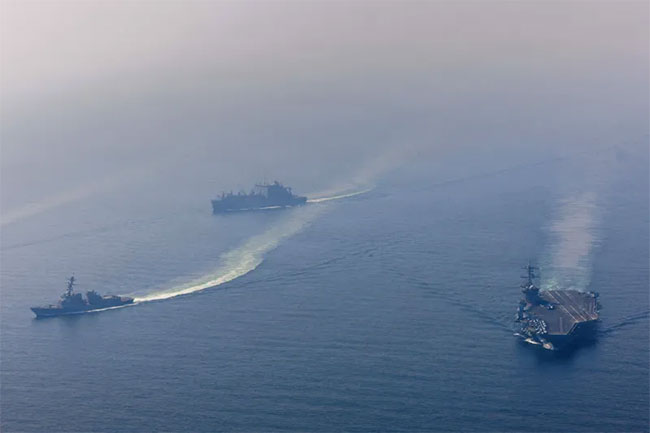
Trump’s threats come amid a US military build-up in the Middle East over the past few weeks.
BBC Verify has confirmed the location of US aircraft carrier the USS Abraham Lincoln near Iran using satellite imagery.
The US has also reportedly sent the USS Gerald R Ford, the world’s largest warship, to the Middle East, which could arrive in the region within the next three weeks.
Speaking on Tuesday, Iran’s supreme leader Ayatollah Ali Khamenei responded to Trump’s threats of military action by saying: “More dangerous than an aircraft carrier is the weapon that can send it to the bottom of the sea.
“He says the US’s army is the strongest army in the world. The ‘strongest army in the world’ may sometimes receive such a blow that it cannot get back up.”
Khamenei also accused the US of attempting to predetermine the outcome of negotiations and said that would be a “wrong and foolish thing to do”.
In addition to the Abraham Lincoln’s arrival, BBC Verify has also tracked an increase of US destroyers, combat ships and fighter jets in the region.
Iran’s Foreign Minister Abbas Araghchi met with the UN nuclear watchdog chief on Monday, saying in a post on X he was in Geneva to “achieve a fair and equitable deal”.
“What is not on the table: submission before threats,” Araghchi said.
Iran has responded to the US build-up with its own show of force. On Monday the Islamic Revolutionary Guard Corps (IRGC) launched a maritime drill in the Strait of Hormuz, located in the Gulf between Oman and Iran.
The Strait is considered a vital international waterway and oil export route from Gulf Arab states.
US Secretary of State Marco Rubio said that reaching a deal with Tehran would be “very difficult”.
“I think that there’s an opportunity here to diplomatically reach an agreement... but I don’t want to overstate it either,” Rubio said during a visit to Hungary. “It’s going to be hard.”
The first indirect talks between Iran and the US took place in Oman earlier this year, which Araqchi described afterwards as a “good beginning”.
Source: BBC
- Agencies