
US operation to ‘surge dramatically’, Hegseth says, as Israel declares next phase of war
March 6, 2026 06:56 am
US Defence Secretary Pete Hegseth warned on Thursday that US military operations in Iran are “about to surge dramatically”.
Speaking at a press conference from US Central Command, he said the mission would “advance decisively,” as the conflict in the Middle East continues to intensify.
“If you think you’ve seen something, just wait,” he told reporters.
His comments came minutes after US President Donald Trump said that the United States and Israel are “totally demolishing” Iran.
Speaking from the White House, Trump said Iran’s air force and navy are “gone”, adding that American and Israeli forces were doing “a great job.”
“Their navy is gone. 24 ships in three days, that’s a lot of ships,” the US president told reporters.
“They have no air force, they have no air defence. All of their airplanes are gone.”
He also suggested that Iranian leaders were ready to make a deal to end the fighting, but said: “We want to fight now more than they do.”
The president’s comments came as Iran’s Revolutionary Guards announced they were beginning a new wave of operations against Israel.
Iranian state media reported officials were targeting sites in central Tel Aviv, using combined missile and drone attacks, in a fresh assault against Israel.
Meanwhile, the UK stepped up its response to the growing conflict, with the prime minister announcing he would send four additional Typhoon jets to join the UK squadron in Qatar.
US Middle East commander says 30 Iranian ships destroyed
Speaking late Thursday, the head of US Central Command, Admiral Brad Cooper, said the US had struck nearly 200 targets in Iran over the past 72 hours.
He added that the US had sunk over 30 Iranian ships.
During the same press conference, US Defence Secretary Pete Hegseth said the US had “no shortage of munitions”, adding that the US mission in Iran is “advancing decisively.”
“We have only just begun to fight, and fight decisively,” he said.
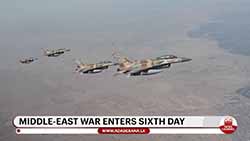
President Trump made multiple comments to the media throughout Thursday, the sixth day of fighting in the Middle East.
In an interview with Axios, Trump asserted he should be involved in choosing Iran’s next supreme leader, after the previous Ayatollah Ali Khamenei was killed during an air strike.
Trump ruled out Mojtaba Khamenei, a front-runner to replace his father, Ayatollah Ali Khamenei. Trump’s comments to the American news website renew questions about whether the US and Israel seek the overthrow of the Islamic Republic or just a change in its policies, as the conflict has appeared increasingly open-ended.
In the Axios interview, Trump derided the 56-year-old Mojtaba Khamenei, who has never been elected or appointed to a government position, as “a light weight.”
“We want someone that will bring harmony and peace to Iran,” Trump said.
UK to bolster support in the region
The UK announced it would send further military resources, including Wildcat helicopters with anti-drone capabilities, due to arrive in Cyprus on Friday.
The PM said he was “satisfied that we can keep our people safe” as he faced questions about the UK’s preparedness over the conflict, which sparked on Saturday as the US and Israel launched strikes on Iran.
Asked about criticism that the government’s approach had been marked by indecision, prevarication and a lack of preparedness, the prime minister said Britain “started pre-deploying to the region in January and February, particularly to Cyprus and Qatar”.
The newly announced resources will arrive ahead of the warship HMS Dragon, which is due to leave Portsmouth for Cyprus next week.
It comes after an Iranian-made drone was used to attack an RAF base in Cyprus, which the PM’s official spokesperson said was “likely” not launched from Iran.
The relationship between the UK and US has been strained since Starmer’s public fallout with US President Donald Trump over his refusal to allow initial US strikes on Iran from British bases.
Starmer said he respected Mr Trump’s decision, which “he considers in the national interest” of America, and insisted the “special relationship is in operation right now”.
Israel intensifies strikes on Lebanon
Israel announced on Thursday it was beginning its “next phase” of the war, warning it will involve “additional surprises”.
Earlier on Thursday, Israel escalated its own objective to obliterate the Iranian-backed militant group Hezbollah in the suburbs of the Lebanese capital Beirut.
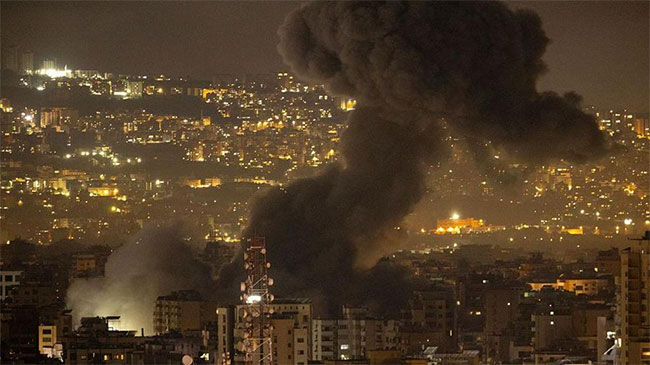
Shortly before 9pm UK time on Thursday, the Israeli military began striking the Beirut’s southern suburbs, where smoke was seen rising above the skyline.
Israel’s armed forces had issued evacuation warnings for almost half of Beirut, prompting frantic attempts of residents to leave the city, plunging it into chaos.
The number of people killed in Lebanon since a resurgence in hostilities between Israel and the Hezbollah militant group Monday has risen to 123, with 683 people wounded, the Lebanese health ministry said Thursday.
Kurdish dissident groups ‘preparing to fight’ with US support
Kurdish Iranian dissident groups based in northern Iraq are preparing for a potential cross-border military operation in Iran, and the US has asked Iraqi Kurds to support them, according to Kurdish officials.
The Kurdish groups are widely seen as the most well-organised segment of the fragmented Iranian opposition and are believed to have thousands of trained fighters.
Their entry into the war could pose a significant challenge to the embattled authorities in Tehran and could also risk pulling Iraq further into the conflict.
Khalil Nadiri, an official with the Kurdistan Freedom Party, or PAK, based in northern Iraq’s semi-autonomous Kurdish region, said on Wednesday that some of their forces had moved to areas near the Iranian border in Sulaymaniyah province and were on standby.
If the Iranian and Iraqi Kurdish groups were to join the war, it would be the first entry of a significant ground force into the battle. The Kurdish groups have battle experience from the fight against the Islamic State group.
Rising oil prices
The far-reaching conflict is causing severe disruption in the global flow of crude oil, as the Strait of Hormuz, a major shipping route through which a fifth of global oil and gas supplies pass, was caught in the middle of the conflict.
Iran controls the entire northern side of the Strait, effectively allowing it to wield the Strait as a geopolitical chokepoint.
While the strait is officially open, trade has dropped by 80 per cent since Saturday.
Iran has carried out attacks on passing ships and vowed to continue to do so, forcing many shipping companies to suspend operations in the area.
Trump, speaking from the East Room of the White House, said Thursday that “further action to reduce pressure on oil is imminent.”
“The oil seems to have pretty much stabilized. We had it very low, but I had to take this little detour,” he said.
Trump earlier this week said on social media that he ordered the U.S. development finance arm to provide political risk insurance for tankers carrying oil and other goods through the Persian Gulf.
Political risk insurance is a type of coverage intended to protect firms against financial losses caused by unstable political conditions, government actions, or violence.
Source: ITV
--Agencies