

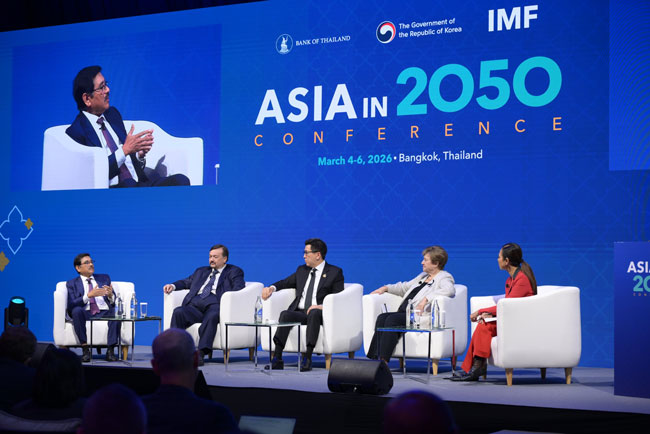
CBSL Governor shares insights on navigating economic crisis at ‘Asia in 2050’ conference
March 9, 2026 03:29 pm
The Governor of the Central Bank of Sri Lanka (CBSL), P. Nandalal Weerasinghe, participated in a high-level discussion on the Asia-Pacific’s evolving role in the global economy at the Asia in 2050 Conference held recently.
The session also featured the International Monetary Fund’s Managing Director Dr. Kristalina Georgieva, Thailand’s Deputy Prime Minister and Finance Minister Dr. Ekniti Nitithanprapas, and Malaysia’s Finance Minister Datuk Seri Amir Hamzah Azizan, according to the CBSL.
Dr. Kristalina Georgieva opened the session by reflecting on Asia’s impressive growth story over the past five decades, noting the strong foundations, innovation, and social cohesion that have underpinned the region’s success, it said.
She also pointed to emerging challenges such as ageing populations, youth unemployment, rapid technological transformation and climate risks, stressing the need for policies that promote inclusive and sustainable growth. She further reiterated the need for greater regional integration, investment in capital markets, and the strategic use of trade as a lever to boost resilience and dynamism across Asia.
During the discussion, Governor Weerasinghe shared insights from Sri Lanka’s experience in navigating one of the most severe economic and financial crises in its history.
He emphasized the importance of building strong macroeconomic and financial buffers, strengthening institutions and implementing structural reforms to restore stability.
He noted that key reforms included the establishment of an independent central bank and fiscal rules under the Public Financial Management Act.
The Governor stressed that 𝐜𝐫𝐞𝐝𝐢𝐛𝐥𝐞 𝐜𝐨𝐦𝐦𝐮𝐧𝐢𝐜𝐚𝐭𝐢𝐨𝐧 𝐰𝐢𝐭𝐡 𝐭𝐡𝐞 𝐩𝐮𝐛𝐥𝐢𝐜 was critical in securing support for difficult reforms, allowing the country to restore stability, reduce inflation, and strengthen fiscal and financial balances within a short period, the CBSL stated.
He also underscored the potential of 𝐫𝐞𝐠𝐢𝐨𝐧𝐚𝐥 𝐢𝐧𝐭𝐞𝐠𝐫𝐚𝐭𝐢𝐨𝐧, 𝐝𝐢𝐠𝐢𝐭𝐚𝐥𝐢𝐳𝐚𝐭𝐢𝐨𝐧 𝐚𝐧𝐝 𝐫𝐞𝐧𝐞𝐰𝐚𝐛𝐥𝐞 𝐞𝐧𝐞𝐫𝐠𝐲 as areas where countries like Sri Lanka can collaborate to foster resilience and shared growth.
Meanwhile, Thailand’s Deputy Prime Minister and Finance Minister Dr. Ekniti Nitithanprapas focused on the opportunities and risks posed by technological and demographic shifts, emphasizing the importance of digital infrastructure, human capital development, and international cooperation to fully harness AI and technological advancements.
Malaysia’s Finance Minister Amir Hamzah Azizan also stressed the importance of regional integration in supporting the energy transition, boosting trade and attracting investment across Asia.