
Ex-President Ranil says IRIS Dena sinking exposed ‘helplessness’ of IOR, urges stronger regional cooperation
March 12, 2026 10:03 pm
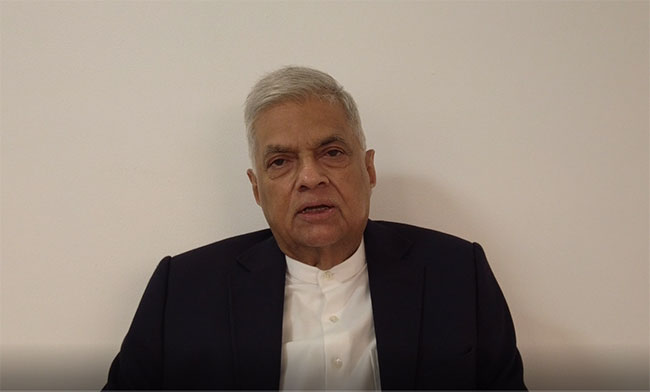
Former President Ranil Wickremesinghe has called for stronger political, economic and security cooperation among countries in the Indian Ocean region, warning that the absence of regional integration has left the area vulnerable at a time of escalating geopolitical tensions.
Issuing a video statement addressing the current global situation, Wickremesinghe pointed to the ongoing conflict involving the United States, Israel and Iran, noting that it highlights the region’s lack of coordinated response mechanisms.
“We are discussing the lack of integration in our region amidst a war in which two outside states, US and Israel are bombing a state within the region,” he said, adding that Iran was also attacking Gulf states within the same region.
Wickremesinghe cited an incident involving a US submarine sinking an Iranian frigate in regional waters and remarked that the limited response to such situations demonstrated “that we are in a helpless situation.”
Reflecting on the historical significance of the Indian Ocean, he described it as “the oldest in civilizations and in the connections between different societies,” highlighting its long-standing role in trade, culture and political relations.
However, he contrasted this with the stronger cooperation seen in other regions such as the Atlantic and Pacific, where economic integration and political dialogue have advanced through institutions including the North Atlantic Treaty Organization (NATO) and the Asia-Pacific Economic Cooperation, as well as the Regional Comprehensive Economic Partnership (RCEP).
According to Wickremesinghe, such levels of cooperation are largely absent in the Indian Ocean region. “Without this type of close cooperation and personal discussions, we will not be able to have the type of integration that we require,” he said, proposing that heads of government in the region meet at least once every two years to discuss key issues, including political affairs, maritime security, trade, economic integration, fisheries, agriculture and climate change.
Highlighting economic challenges, he noted that members of the Indian Ocean Rim Association (IORA) currently trade more with dialogue partners than with one another. He stressed the need to reduce trade barriers, improve ports and logistics, and promote modern industrialisation across the region.
Wickremesinghe further stressed about maritime safety, mentioning about the Indian Ocean Naval Symposium and the Colombo Security Conclave. He noted that while these initiatives have improved security and administrative cooperation, greater attention should be given to the political aspect.
The former President also emphasised the importance of addressing issues related to fisheries, agriculture and climate change, stating that “We have to learn to feed ourselves. We have to learn to ensure that our fisheries resources are not taken away by outsiders”.
Looking ahead, he highlighted the growing global influence of India and China, stating that relations between the two powers would have significant implications for Indian Ocean countries.
“The largest economies in the world by 2050 and beyond is going to be India and China. India and China relations therefore is the one that will matter most to the Indian Ocean countries. How do you discuss? How do you compete? How do you cooperate? This is essential,” he said.
Wickremesinghe said on one hand, we have security and growth for all in the region which he said can be used in preparing a plan for the Indian Ocean. “The other is that India and China through discussions must resolve their outlooks on the BRI.”
“And the Indian Ocean must play its role. India, as the biggest nation and one of the leading economies of the world, it will become the second largest economy, can take the lead,” the former President said.
He urged regional states to continue dialogue and cooperation, while encouraging greater engagement with East Asia, China and the United States.
Emphasising the need for continued discussion among regional nations, Wickremesinghe concluded that sustained dialogue and cooperation were essential to achieving a level of integration comparable to other oceanic regions.