
Water consumption rising amid dry weather; Public urged to consume water sparingly
March 25, 2026 08:44 pm
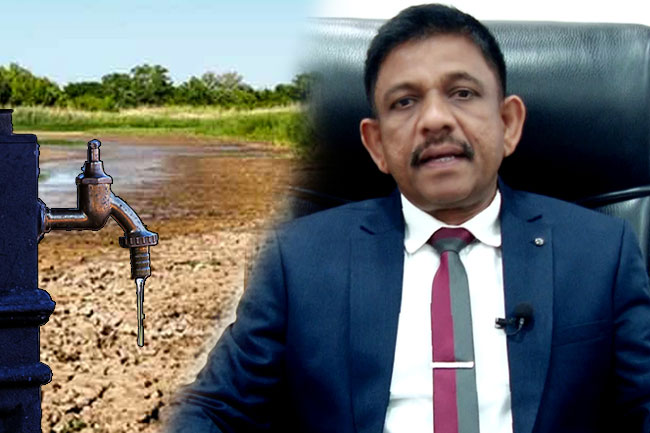
The Chairman of the National Water Supply and Drainage Board (NWSDB), Chandana Bandara, states that water consumption has increased significantly due to the prevailing dry weather.
Addressing the media, he urged the public to use water sparingly whenever possible and warned that if the current dry weather conditions persists, water distribution may have to be limited.
“With the dry weather, consumer water usage has increased. Particularly in the Colombo District of the Western Province, water treatment plants can only supply water up to a certain limit.
“At Ambatale (Water Treatment Plant, we can produce 560,000 cubic meters per day, while Labugama has a limit of 150,000 cubic meters per day.
“We do not have the capacity to produce more than that. We are producing and distributing water at maximum capacity across Sri Lanka. We are requesting the public to note that if this drought continues to intensify, there may be difficulties in supplying water due to the increasing demand day by day.
“Consume water very sparingly. We are not asking you to limit it, but rather to be frugal during domestic consumption. Minimize instances where water is wasted.
“Otherwise, the pressure may drop in high-altitude areas and at the end-points of certain pipelines when distributing. We may have to supply water under low-pressure conditions. The water levels in reservoirs are rapidly decreasing. If the drought worsens, water supply will have to be restricted,” he warned.
Meanwhile, Bandara pointed out that the saltwater intrusion into the river through estuaries has increased in almost every river.
He stated that human activities, such as sand mining, are the primary reasons for this.
He further mentioned that plans are in place to construct salinity barriers for every river to prevent saltwater intrusion into the river, and work is currently underway to construct a salinity barrier in the Kelani River.
“At the point where every river meets the sea through the estuary, it mixes with saltwater. But now, this has intensified and become a major concern. This situation has worsened due to human activities such as sand mining. Temperature and global warming also contribute to this. We are establishing salinity barriers, and currently, we are working on installing one for the Kelani River.”