
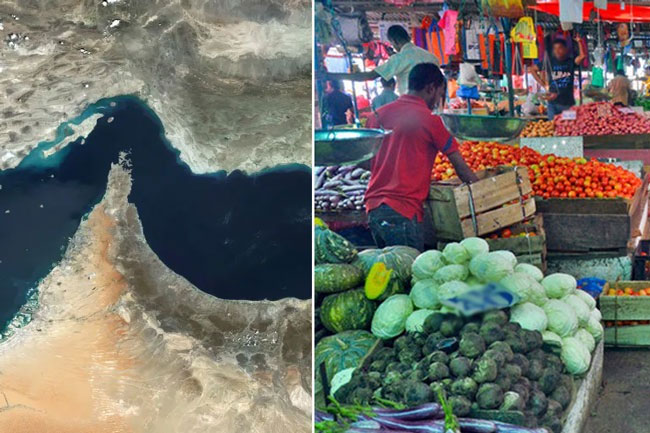
Sri Lanka among most vulnerable nations in event of Strait of Hormuz shutdown, study warns
March 28, 2026 11:42 am
Sri Lanka has been identified as one of the world’s most vulnerable nations to a sudden shutdown of the Strait of Hormuz, according to a March 2026 report by the Kiel Institute for the World Economy.
The study, titled “The Cost of Closing the Strait of Hormuz: Energy Bottlenecks and Global Food Security,” identifies Sri Lanka as the country facing the second-steepest rise in food prices globally under a short-run closure scenario.
It warns that a full closure of the Strait of Hormuz would trigger a catastrophic food security crisis for Sri Lanka, with food prices projected to soar by over 15%.
While global attention often focuses on oil prices, the study warns that for South Asian nations like Sri Lanka, the crisis would quickly evolve from an energy shortage into a dire food security emergency.
Researchers highlight a “bottleneck mechanism” that standard economic models often overlook. Because the Strait blocks one-fifth of the world’s oil and one-quarter of its liquefied natural gas (LNG), a closure triggers a lethal cascade.
The report places Sri Lanka among the countries facing the “steepest food price increases and welfare losses.” The nation’s vulnerability is driven by a “triple threat”: a heavy dependence on imported energy, a reliance on imported fertilizers, and a large agricultural sector with limited domestic alternatives.
The timing of such a disruption is particularly dangerous. If a closure occurs during the March and April planting season, the lack of nitrogen fertilizer could cause failed plantings or drastically reduced yields for an entire growing season, it says.
The study emphasizes a growing divide in global resilience. While the United States might see a negligible welfare loss of just -0.07%, countries in South Asia and sub-Saharan Africa are projected to suffer losses 10 to 20 times larger.
“The Hormuz closure is not merely an energy crisis—it is a food security crisis,” the report states, noting that for the world’s poorest, the economic impact transmits directly into the cost of putting food on the table.
To mitigate these risks, the Kiel Institute suggests that vulnerable nations should treat fertilizer security with the same urgency as oil security, potentially through strategic fertilizer reserves.