
Govt has comprehensive plan to elevate living standards of farmers – President
April 9, 2026 04:38 pm
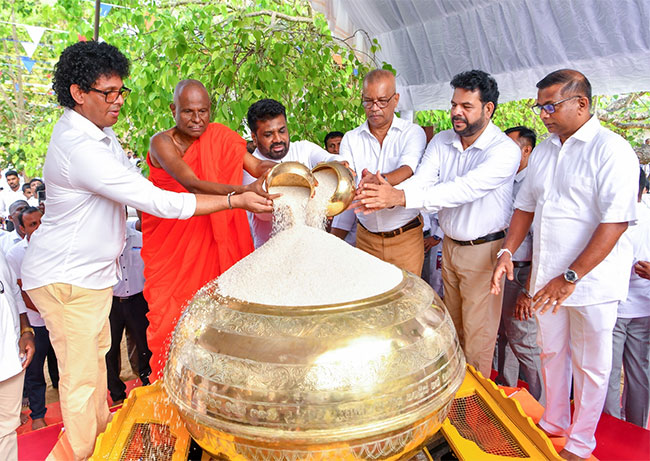
The National New Rice Festival, a traditional annual ceremony in which newly harvested rice from the Maha season is offered to the sacred Jaya Sri Maha Bodhi, was held this morning (09) under the patronage of President Anura Kumara Dissanayake, in the presence of the historic Jaya Sri Maha Bodhi in Anuradhapura.
On the guidance of the Chief Prelate of the Atamasthana, Venerable Pallegama Hemarathana Nayaka Thera, the 59th National New Rice Festival was organised under the theme “In unison, let us cultivate the land, to build a self-sufficient nation”, jointly by the Ministry of Agriculture and the Department of Agrarian Services, according to the President’s Media Division (PMD).
Farmers from across the country participated in this long-standing tradition. In accordance with customary rituals, blessings were invoked for timely rainfall and fertile fields, while prayers were also offered for the nation to achieve self-sufficiency through agriculture and to attain a prosperous economy.
President Anura Kumara Dissanayake, who attended the ceremony, first paid homage to the sacred Jaya Sri Maha Bodhi and received blessings, the PMD said.
For the traditional offering of honey to the Jaya Sri Maha Bodhi, a vessel of pure honey was presented to the President by Indigenous community leader Uruwarige Wannila Aththo.
A vessel of ghee, brought from the historic Saman Devalaya in Sabaragamuwa for the customary offering, was also presented to the President.
A commemorative volume marking the “59th National New Rice Festival” was also presented to the President. In addition, farmer leaders who had contributed to the advancement of agriculture in the country were honoured by President Anura Kumara Dissanayake.
Accordingly, Kingsley Kumara, representing minor irrigation; W. Sumith Lakshman Kumara, representing major irrigation; and H. M. Upali Dharmarathne, representing the Mahaweli scheme, received awards of recognition from the President.
The President also participated in the distribution of paddy seeds to farmers at the provincial level, the statement said.
Addressing the gathering, President Anura Kumara Dissanayake stated that regardless of the crises that may arise globally, the nation will not face a food shortage due to the immense dedication of farmers, who work tirelessly day and night, enduring sun, rain and hardship. The President also expressed special appreciation for their service.
The President further noted that the Government has a comprehensive plan to uplift the living standards of the farming community, whose lives have been built through great sacrifice, toil and perseverance. He pointed out that strategies have been formulated focusing on seven key sectors to revitalise agriculture and farming.
Accordingly, these include restructuring the country’s minor and medium-scale tank systems to ensure adequate water supply, providing agricultural inputs at fair prices, introducing modern technology to agriculture, strengthening storage, packaging and market mechanisms to minimise post-harvest losses, and ensuring fair prices for agricultural produce through government policies and planning.
The President also stated that every country has its own unique path of development and that Sri Lanka’s identity, culture and trajectory are deeply rooted in agriculture.
He further emphasised that this cultural value is reflected in the New Rice Festival, it said.
Further elaborating, President Anura Kumara Dissanayake stated:
In particular, we are aware that the origin, continuity and future of our country depend, to a great extent, on agriculture. Our technological development has been rooted in agriculture. Our economy has been strengthened over a long period through agriculture. The daily lives of our people have also been built upon agriculture.
Likewise, a significant portion of our culture is represented by activities associated with agriculture. From the very beginning of cultivation to the harvesting of crops and the celebration of the New Rice Festival, there exists a rich array of cultural practices linked to agriculture. Offerings are made while seeking blessings for favourable rainfall and weather, as well as protection from wild animals and pest infestations.
From that point onwards, at every stage of agriculture, customs and traditions have evolved alongside our culture. Ultimately, from the harvested crop, milk rice is prepared and offered at the bund of the main reservoir that provided water for cultivation, as an act of thanksgiving.
A particularly significant milestone in this process is the New Rice Festival, where the first portion of the harvest is offered to the sacred Jaya Sri Maha Bodhi. Through this meritorious act, blessings are invoked for our agriculture, farming community and the lives of our people.
This important religious observance is conducted annually under the guidance and leadership of the Chief Prelate of the Atamasthana and the Maha Sangha. Such cultural occasions reflect the identity of a nation, its cultural bonds and the foundations upon which it is built. Every country has its own unique path and our identity and cultural trajectory have been shaped by agriculture.
We have formulated our policies and plans with the objective of elevating the lives of the farming community engaged in agriculture in our country to a higher standard. We know that for a large proportion of our rural population, agriculture is the main source of income. Therefore, it is the success achieved in farming that determines whether the lives of farmers improve or not.
Through successful agriculture, it is possible to free our rural population from poverty. Accordingly, as a Government, we are formulating our policies and programmes on the basis that rural poverty must be eradicated and that a clear vision and structured plan for agriculture are essential to achieve this.
Agriculture is interconnected with several key components. We are aware that farmers in our country face numerous issues related to land. The lack of proper land ownership is a major challenge confronting them.
Therefore, under the leadership of the Minister of Agriculture, a programme has already been launched to resolve these land issues and provide permanent title deeds. When I recently visited Anuradhapura to distribute land deeds, I witnessed the tears in the eyes of the people.
For this reason, we have embarked on a strong and comprehensive programme to ensure rightful land ownership. Various initiatives have been implemented at different times, but each has encountered certain shortcomings. We are now working on a programme to resolve all such issues and provide clear and secure land titles.
Secondly, water is one of the most vital components of agriculture. No matter how much land we possess, it is of little value if we cannot ensure adequate water supply for cultivation.
We know that this region became a civilisation of reservoirs due to the extensive irrigation systems developed by our ancient ancestors and great kings. Even our villages were established as a result of this irrigation civilisation. Our forefathers and rulers constructed nearly 32,000 reservoirs.
We inherit a distinguished legacy of tanks. Unfortunately, a significant portion of these have been lost over time. Current data indicate that only around 14,000 tanks remain. Consequently, it is our primary responsibility to safeguard and preserve these remaining water bodies.
With the onset of October, the heavy rains begin. Only when this water is properly stored in our tanks can sufficient water be supplied for large-scale irrigation. Today, powerful and wealthy individuals have taken control of many tanks including the Kandy Lake, leaving them neglected and filled with silt. Our cultural heritage does not regard a tank as a mere water body; it was constructed as part of a cascade tank system.
This system was designed with long-term sustainable development in mind. While contemporary discussions focus on large-scale sustainable development projects, the true foundation of sustainability lies in our traditional tank system.
For thousands of years, this tank system has supported countless generations by providing food. For millennia, these tanks have continuously supplied the water necessary for agriculture. If an example of sustainable development is required, our tanks stand as a model.
However, today, it is our own people who are endangering this invaluable system of small and medium-sized tanks, which are crucial for sustainable development. Therefore, we have taken a firm and sustainable decision: the small and medium-scale tank system in our country must be reorganised.
Objections may arise at times, but we must approach this with strong determination, protecting this remarkable tool of sustainability. Our present responsibility is to safeguard these tanks for future generations.
In this endeavour, I, as President, along with the government, will ensure full support and protection for every measure undertaken by the Ministry of Agriculture.
Moreover, compared to the past, the area under cultivation has increased and the demand for food has risen. Therefore, rainfall alone is no longer sufficient.
In particular, in this dry zone, how can the rains falling on our central highlands be channelled to support agriculture in the North Central Province? To address this, the North Central “Maha Ela” Project has been initiated as a highly significant undertaking.
Although the project faces certain challenges, it is imperative that we complete it. At present, the canal has been cut from Eruwewa to Mahakanadarawa. Consequently, we anticipate supplying water to the Mahakanadarawa tank from the North Central Maha Ela within our first term.
Additionally, the Malwathu Oya project had come to a halt, funds have been allocated this year to recommence and complete this vital work.
We must also study and develop new agricultural applications, as it is not possible to increase the amount of land under cultivation. Therefore, we need to increase the yield obtained from the existing farmland.
New applications and techniques are required to achieve this and we believe that research can help transform these innovations into practical solutions. Consequently, it is essential that farmers have access to these applications at fair and affordable prices.
Therefore, regardless of how much the global market price of urea has increased, we have decided to supply urea for paddy cultivation at a maximum price of LKR 10,200. Furthermore, we have resolved to raise the fertiliser subsidy for paddy farmers to between LKR 25,000 and LKR 30,000 and to increase the subsidy for vegetable cultivation in small-scale from LKR 15,000 to LKR 18,000.
The recent global conflicts have caused the prices of these agricultural inputs to rise, which farmers cannot bear alone. For this reason, we are focusing attention on ensuring the availability and affordability of these essential inputs for our farmers.
Moreover, we must introduce new technology into agriculture. The younger generation is actively developing innovative tools and we must encourage and support them. Our agricultural sector currently faces significant labour challenges, making it essential to integrate modern technology with traditional practices.
Globally, land preparation, irrigation, fertiliser application and harvesting have all been increasingly transformed through technological advancements. Therefore, it is crucial that we rapidly adopt these new technologies in our agriculture to enhance productivity and efficiency.
Furthermore, it is essential to prevent the post-harvest loss of crops. This requires strengthening storage, packaging and marketing mechanisms. To address this, an institution has been established in Anuradhapura specifically to prevent post-harvest losses.
At this institution, new research and trials are being conducted, we are already reaping the benefits of its outcomes today. We must continue to move forward and to do so, new research must be actively supported and encouraged. To this end, we have developed a comprehensive programme to encourage and expand such initiatives.
A persistent challenge for our farmers is whether they receive a fair price for their harvested crops. I do not claim that this long-standing issue can be resolved overnight. However, we do have a well-considered plan in place to address and find solutions to this problem.
Accordingly, we have focused on seven key sectors, aiming to develop agriculture, enhance farming practices and improve the livelihoods of our farmers. As the political authority, we have both the desire and the determination to achieve these goals.
Both I and the Minister of Agriculture have personally engaged with the fields and tanks of villages across Anuradhapura. Likewise, our officials must actively engage in implementing these transformations efficiently and effectively.
Moreover, the support of our farming community is essential in this endeavour. Our farmers make immense sacrifices and we must extend our utmost respect and gratitude to them. Regardless of any global crisis, we have never faced a shortage of food, thanks to the tireless dedication of our farmers, who work day and night, through heat, rain and drought.
For this reason, we have a comprehensive plan to further improve the lives of our farmers, whose existence has been built through sweat, toil and perseverance. Providing them with proper housing, sustainable sources of income, mental well-being, quality education for their children and an effective healthcare system is crucial to ensuring a better social life for our farming communities. We are actively implementing measures to achieve all of this.
We call upon everyone to unite in honouring our farmers, supporting their well-being and fulfilling our shared responsibility to safeguard their lives, so that these initiatives can succeed.
A large gathering graced the occassion, including the Atamasthanadhipathi, the Chief Sanghanayake of Nuwara Kalaviya Venerable Pallegama Hemarathana Nayaka Thero, the Ruwanweli Chaityaramayadhipathi, the Chancellor of Rajarata University, Venerable Eethalawetunuwewe Gnanathilaka Thero, the Chief Judicial Sanghanayake of Lankaramadhipathi of the North Central Province Venerable Ralapanawe Dhammajothi Thero, the Maha Sangha, led by the Atamasthanadhipathi Theros, the Minister of Agriculture, Livestock, Land and Irrigation, K.D. Lalkantha, the Minister of Trade, Commerce, Food Security and Cooperative Development, Wasantha Samarasinghe, the Governor of the North Central Province, Wasantha Kumara Wimalasiri, the Deputy Minister of Agriculture and Livestock, Namal Karunaratne, the Secretary to the Ministry of Agriculture, officials of the Ministry and a large group of farmers.
--PMD--