
Sri Lanka’s strategic location affords ‘outsized importance’, but can become target for coercion – US official
February 13, 2026 06:15 pm
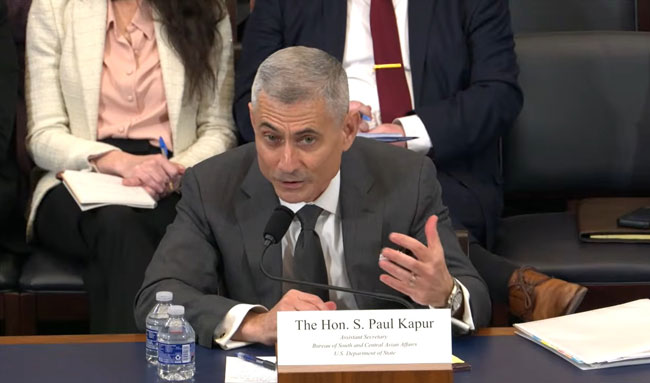
In a high-level hearing before the US House Foreign Affairs Subcommittee on South and Central Asia, a top official of the US State Department underscored the critical strategic importance of Sri Lanka to global energy security and maritime commerce.
The HFAC SCA Subcommittee Hearing on “South Asia: U.S. Foreign Policy in the Region,” outlined a comprehensive strategy to protect vital waterways from external coercion and “debt-trap diplomacy”.
The subcommittee highlighted the Indian Ocean as one of the world’s busiest maritime corridors, carrying what Subcommittee Chairman Bill Huizenga described as the “lifeblood of global commerce and energy”.
During his opening statement, the Chairman cited a critical statistic: the Indian Ocean carries more than 80% of the global seaborne oil trade and approximately 75% of the world’s energy and a vast portion of container shipping pass through these lanes.
“I believe I heard Sri Lanka has something like 75% of all the world’s energy passes within miles of it,” Huizenga said.
In response, US Assistant Secretary of State for South and Central Asian Affairs, Paul Kapur, highlighted that Sri Lanka’s geographical location gives it an “outsized importance” in the Indo-Pacific region but warned that this strategic value also makes the island nation a primary target for external coercion.
“And probably about half of the container shipping. I believe, whatever the exact number is, it’s a lot and so those slots, those sea lanes of communication are really important,” he said.
“Very important to keep them free and open for the world economy and those countries are positioned in ways that they can have actually outsized impact on trade and energy flows through there.”
“So, it’s very important that those countries are able to maintain their freedom of action and not be coerced by China by predatory lending and the kinds of things that you talked about earlier,” Kapur stressed.
He told the lawmakers that some of the ways that the US can do that is to engage these countries with financing to identify strategic infrastructure projects and not allow them all to be dominated by China. “I think which is really what China wants to do.”
“If you think about Sri Lanka and Hambantota port, they have a 99-year lease on it. Those are the kinds of dangers that we see with Chinese development schemes. So, we need to be able to offer alternatives high-quality transparent non-coercive alternatives and I think we can do that with our financing mechanisms, our technology and our private enterprise, our private business and it’s something very important to President Trump to be able to create opportunities for US business.”
A significant portion of the discussion focused on protecting smaller nations from “predatory lending” associated with Chinese infrastructure projects.
Dr. Paul Kapur declared that carefully targeted U.S. investment aims to provide “high-quality, transparent, [and] non-coercive” alternatives for critical infrastructure.
He claimed that this strategy is designed to help nations like Sri Lanka avoid the dangers of “debt-trap diplomacy” in sectors such as Ports and Maritime Infrastructure, Telecommunications Networks and Energy Portals.
Assistant Secretary Kapur outlined the Trump Administration’s “America First” approach, emphasizing that the U.S. must work with “likeminded partners” to prevent any single hostile power from dominating the subcontinental landmass and exerting leverage over the world economy.
To safeguard these “borders and waterways against encroaching powers,” the U.S. is intensifying defense cooperation. This includes military sales, transfers, and joint exercises intended to help partners build “strategic capacity”—allowing them to protect their own sovereignty while contributing to regional stability.
While the hearing focused heavily on security and trade, it also addressed diplomatic shifts in the region. Ranking Member Kamlager-Dove noted that in December 2025, the Trump administration took the “unprecedented step” of recalling career ambassadors in Sri Lanka and Nepal, which she argued weakened U.S. diplomatic leadership in these key states.
Despite these concerns, the administration maintained that its engagement seeks to help partners “better integrate into the world economy” without sacrificing their autonomy.
“Helping our partners to help themselves makes the United States safer, stronger, and more prosperous,” Kapur concluded.