






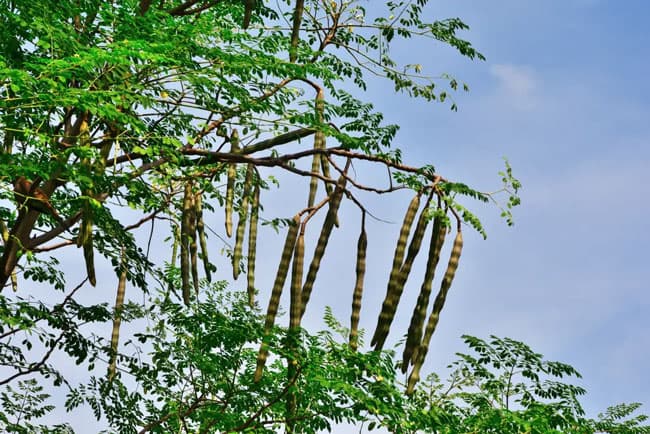


The moringa tree, known as the ‘‘miracle tree’’, is one of the most nutrient-dense plants on the planet and is prized for its healing qualities.
It also has another huge benefit, according to new research: it’s excellent at removing microplastics from water.
A team of scientists from Brazil and the United Kingdom found extracts of seeds from these fast-growing trees are just as effective at removing microplastics from drinking water as commonly-used chemicals, according to their findings published in April.
Moringa trees have been used to purify water for millennia, with evidence of their use by ancient Greeks, Romans and Egyptians, said Adriano Gonçalves dos Reis, a study author and a professor at the Institute of Science and Technology of São Paulo State University.
He and his colleagues have been studying the tree’s seeds for a decade, specifically the role they can play as a ‘‘coagulant’’, a substance which causes tiny particles in water to stick together so they can be filtered out. Given growing concerns over microplastics in drinking water, they decided to look at the moringa’s potential for removing them.
Microplastics are tiny fragments, that can be as small as 1/25,000th of an inch (1 micrometer) and are a pernicious part of the plastic pollution crisis.
They have been found everywhere, from deep oceans to towering mountains. They contaminate our food and water — a 2024 study found microplastics in 83% of tap water tested around the world — and have made their way into our bodies, including our brains, reproductive organs and cardiovascular systems.
Scientists are still trying to unravel their impacts on human health, but animal research has linked them to reproductive problems and hormone disruption.
For their study, the researchers focused specifically on PVC microplastics, as these are among the most hazardous and are prevalent in drinking water, Gonçalves dos Reis said.
They tested microplastics with a mean size of 18.8 micrometers — about a quarter of the thickness of the average human hair — and found the seed extracts were 98.5% effective at removing them from tap water when used in filtration systems.
This efficiency is roughly comparable to a commonly-used chemical coagulant aluminum sulfate, known as alum. Moringa seeds performed even better than alum in more alkaline water, the scientists found.
A big advantage of using the seeds compared to alum is that they are renewable, biodegradable, don’t create large amounts of sludge and have fewer toxicity concerns, said Gonçalves dos Reis. Aluminum can be toxic at high levels and has been linked to neurodegenerative diseases.
Matthew Campen, distinguished professor of pharmaceutical sciences at the University of New Mexico Health Sciences Center, who was not involved in the research, said using a natural product to replace an aluminum-based filtration system ‘‘may offer a cheaper and more sustainable solution to removal of PVC microplastics.’’
It would also avoid the need for aluminum mining, he added, which can have negative environmental consequences.
There are limitations, however. One moringa seed can treat about 10 liters of water, the scientists found. ‘‘While this is promising,’’ Gonçalves dos Reis said, ‘‘it would require a very large quantity of seeds for large urban treatment plants handling high flows.’’ The technique may be most useful for small communities or places where chemical coagulants are difficult to access, he added.
Another potential issue is that as more seeds are used, it could mean more organic residue is left in the water, which would need to be removed.
More research is needed to understand how the moringa seed extracts degrade, what happens to the captured PVC, and how scalable and cost-effective the method will be, Campden said.
It will also be critical to see if the moringa works with other types of microplastics, as well as nanoplastics, he added. Nanoplastics are the very smallest particles, about 1,000th the average width of a human hair, and are most likely to get inside the human body.
Gonçalves dos Reis said he is confident moringa seeds will be effective for different plastics and this is the focus of the groups’ future research.
Identifying solutions for microplastics now is exceptionally valuable, Campen said. Humans are exposed to increasing levels of microplastics and nanoplastics, he added, and this trend ‘‘is unlikely to change for many decades to come.’’
Source: CNN
--Agencies