






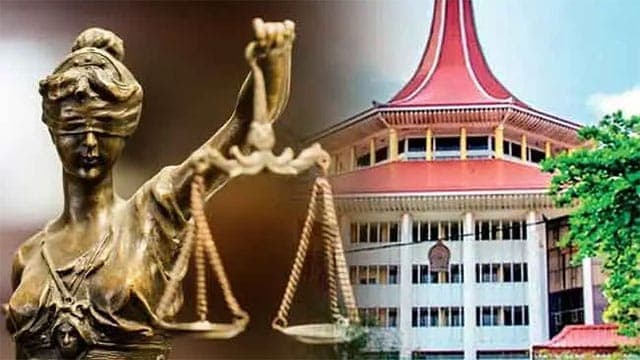


The Supreme Court today (20) commenced hearing 25 petitions challenging the government’s proposed Protection of the State from Terrorism Bill, with petitioners raising concerns over judicial independence, executive powers and fundamental rights.
The petitions were taken up before a three-judge bench comprising Chief Justice Preethi Padman Surasena and Justices Achala Wengappuli and Sampath Abeykoon.
Appearing for the Attorney General, Additional Solicitor General Nerin Pulle informed the court that 25 petitions had been filed challenging the proposed legislation and that the relevant information had been reported to the Speaker’s Office.
Attorney Hijaz Hezbollah, representing several petitioners, argued that the Bill would undermine judicial authority by restricting magistrates’ powers to release suspects without the Attorney General’s consent.
He further challenged Clauses 27 and 28, which deal with detention orders, arguing that they would allow individuals to be detained without a court order. He also claimed that Clause 59 would grant the President excessive powers, potentially violating Articles 3 and 4 of the Constitution.
Hezbollah also raised concerns over provisions that would extend arrest powers beyond the police to the armed forces and the Coast Guard.
When the Chief Justice questioned what was wrong with granting such powers, the lawyer responded that the provisions could lead to abuses of authority, arguing that the proposed Bill could allow uniformed officers to make arrests without the existing safeguards.
He also said the legislation would empower the Secretary to the Ministry of Defence to restrict citizens from entering certain areas.
The lawyer requested the court to determine that the disputed provisions would require approval by a two-thirds majority in Parliament and at a referendum before they could be enacted.
Meanwhile, President’s Counsel Ali Sabry, appearing for former minister and Professor G.L. Peiris acknowledged the importance of national security but stressed that measures taken to protect the State must not violate the rights of innocent citizens.
Citing the Vavunathivu police killings that occurred before the 2019 Easter Sunday attacks, Sabry said two Tamil youths had been arrested and detained in connection with the incident, but subsequent investigations linked the killings to a group associated with the Easter Sunday attacks.
He argued that the proposed legislation could permit a person to be detained for one year and subsequently remanded for a further year, raising concerns over consistency with the Bail Act.
Sabry also challenged Clause 51, which he said could empower the executive to prohibit meetings, press conferences and other activities deemed to pose a threat to national security.
Responding to a question from the Chief Justice on how such concerns could be addressed, Sabry said the authority to make these decisions should rest with magistrates rather than the executive.
He cited a protest near the Presidential Secretariat as an example of how the police had sought a magistrate’s orders to resolve a public order issue.
Additional Solicitor General Nerin Pulle, meanwhile, told the court that the government did not intend to curtail freedom of expression through the proposed legislation.
President’s Counsel M.A. Sumanthiran, appearing for several other petitioners, argued that the Bill amounted to a continuation of the existing Prevention of Terrorism Act and would further restrict personal liberty and judicial authority, potentially infringing constitutionally guaranteed fundamental rights.
The Supreme Court hearing is continuing.