






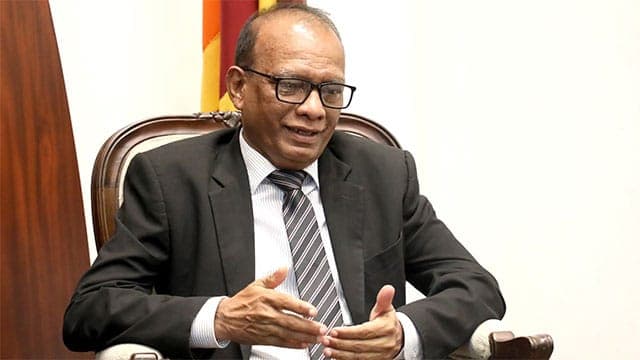


Minister of Energy Anura Karunathilaka says Sri Lanka may exceed its 70% renewable electricity target by 2030, as soaring fossil fuel import costs intensify pressure to shift towards cleaner energy sources.
Sri Lanka is determined to accelerate its transition to renewable energy amid soaring global oil prices, but faces significant technical, financial and social challenges, Energy Minister Anura Karunathilaka has told AFP.
“There are some wake-up calls... pushing us to move more to renewable energy,” the Minister said, adding that maximising renewable energy generation would be a key government policy priority in the coming years.
Sri Lanka, which depends entirely on imports to meet its oil and gas requirements, has been severely affected by rising energy costs following the US-Israeli war with Iran and disruptions to shipping through the strategically important Strait of Hormuz.
Higher fuel, gas and electricity prices, along with rationing and rising inflation, have placed additional pressure on an economy still recovering from its worst-ever economic crisis in 2022.
According to the Energy Ministry, the government has at times spent up to 30% of its foreign exchange reserves in a single month to finance fossil fuel imports, highlighting the economic burden of the country's dependence on imported energy.
Sri Lanka's existing energy policy targets generating 70% of its electricity from renewable sources by 2030, compared with approximately 60% currently. Hydropower accounts for about 40% of the country's electricity generation.
“We will probably have to go beyond 70 percent,” Karunathilaka said.
Minister Karunathilaka said the government planned to strengthen the national transmission network by adding five major transmission lines from 2027 to improve the capacity and stability of the electricity grid.
The rapid growth of rooftop solar installations has also created challenges, with electricity generation sometimes exceeding demand during daylight hours.
A six-hour islandwide blackout earlier this month followed a disruption to the national grid, with excess solar power generation cited as a possible contributing factor.
The Minister said certain solar power plants sometimes had to be temporarily curtailed to maintain grid stability, stressing that such measures did not indicate a lack of government support for solar energy.
The government aims to increase solar power generation capacity to nearly 4,400 megawatts by 2029, representing a 388% increase from 2024 levels, according to the Minister.
New Solar Pricing Model Under Consideration
The government is also considering changes to the pricing arrangements governing privately generated solar electricity.
Under the existing system described by the Minister, some solar producers can supply excess electricity to the grid during the day and withdraw an equivalent amount at night without an additional energy charge under applicable arrangements.
Minister Karunathilaka said the system had become financially unsustainable because electricity supplied during daylight hours, when demand is often lower, could be used to offset consumption at night, when generation costs are higher.
“The additional cost is borne by the state,” he said, adding that the government intended to propose a new financial model that would be fair to both solar producers and electricity consumers.
Expanding battery storage is another priority, as the government seeks to manage fluctuations in renewable generation and improve the reliability of electricity supplies.
Long-Term Goal of Up to 95% Renewable Energy
Despite the challenges, the government remains committed to reducing dependence on imported fossil fuels over the longer term.
Karunathilaka acknowledged that the country's existing electricity system, investment levels and infrastructure were not yet sufficient to replace coal and naphtha completely.
However, he expressed confidence that Sri Lanka could significantly reduce its reliance on these fuels over the next 10 to 15 years.
The government ultimately aims to achieve a renewable energy share of 90% to 95%, a target that would require substantial investment in generation, transmission infrastructure and energy storage.
The transition is expected to remain a key element of Sri Lanka's efforts to reduce exposure to global fuel price volatility, strengthen energy security and support a more sustainable electricity sector.
– with Agencies inputs --