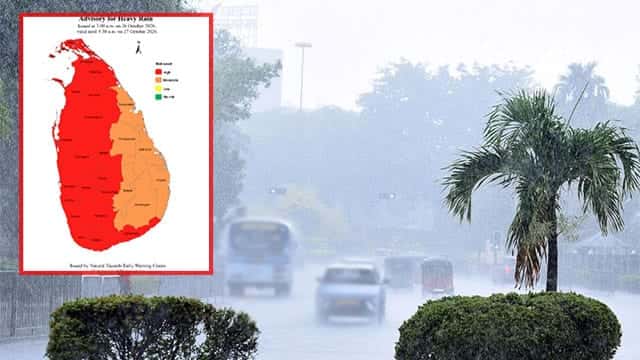










Prices of several upcountry and low-country vegetables have increased amid the prevailing rainy weather.
Accordingly, the wholesale price of a kilogram of tomatoes, which was between Rs. 350 and Rs. 400 last week, has increased to between Rs. 600 and Rs. 650.
In addition, the price of a kilogram of capsicum, which was previously Rs. 250, has risen to between Rs. 400 and Rs. 450, while the wholesale price of a kilogram of cabbage has increased from Rs. 150 to Rs. 350.
Former Chief Organiser of Manning Market Traders Union Anil Indrajith said vegetable prices could rise further as the festive season approaches.
Speaking on the matter, Anil Indrajith said:
“Vegetable prices have increased these days. The main reason for this is the prevailing weather conditions in the country. Tomatoes are currently the most expensive, with wholesale prices reaching around Rs. 600 per kilogram.
“Beans are priced between Rs. 400 and Rs. 500 per kilogram, while carrots are priced between Rs. 200 and Rs. 250. Leeks are priced at Rs. 200, while green chillies are priced between Rs. 350 and Rs. 400 per kilogram.
“Prices of low-country vegetables have also increased. A kilogram of snake gourd is currently selling for around Rs. 400, while ridge gourd is priced between Rs. 200 and Rs. 250. Pumpkin prices have also increased, with a kilogram costing more than Rs. 200.
“Only vegetables such as ash gourd and cucumber are available at prices below Rs. 100 per kilogram.
“Overall, vegetable prices have increased compared to last month. Generally, vegetable prices tend to rise every year as December approaches. Therefore, a price reduction cannot be expected in the coming period, and prices could increase further.”
Meanwhile, Chairman of the All-Island Poultry Association Ajith Gunasekara said purchases of eggs and chicken had declined by around 20%.
He pointed out that although the production cost of an egg ranges between Rs. 30 and Rs. 32, eggs are currently being released by farms at the same prices, making it difficult for producers to earn a profit.
Gunasekara said chicken consumption had also declined amid the prevailing economic conditions.
However, he stated that steps would be taken to ensure a continuous supply of eggs and chicken to the market during the festive season without any shortages.
The association also expressed its expectation that the situation would return to normal with the commencement of the festive season after November 15.
Commenting on the matter, Ajith Gunasekara said:
“Consumers’ purchasing power has declined at present. When we conduct market surveys, we can see that purchases of eggs and chicken have decreased. We observe that consumption in the market has declined by around 20%.
“The production cost of an egg is generally between Rs. 30 and Rs. 32. However, farms are currently releasing eggs at prices ranging between Rs. 30 and Rs. 32 as well. Therefore, producers are not in a profitable position.
“The price of chicken has also decreased. We believe that chicken consumption has declined due to the prevailing economic conditions.
“However, production is continuing without interruption. We are taking steps to provide the market with the required supplies during the festive season without any shortages.
“Therefore, we hope that the situation will return to normal with the commencement of the festive season after November 15.”