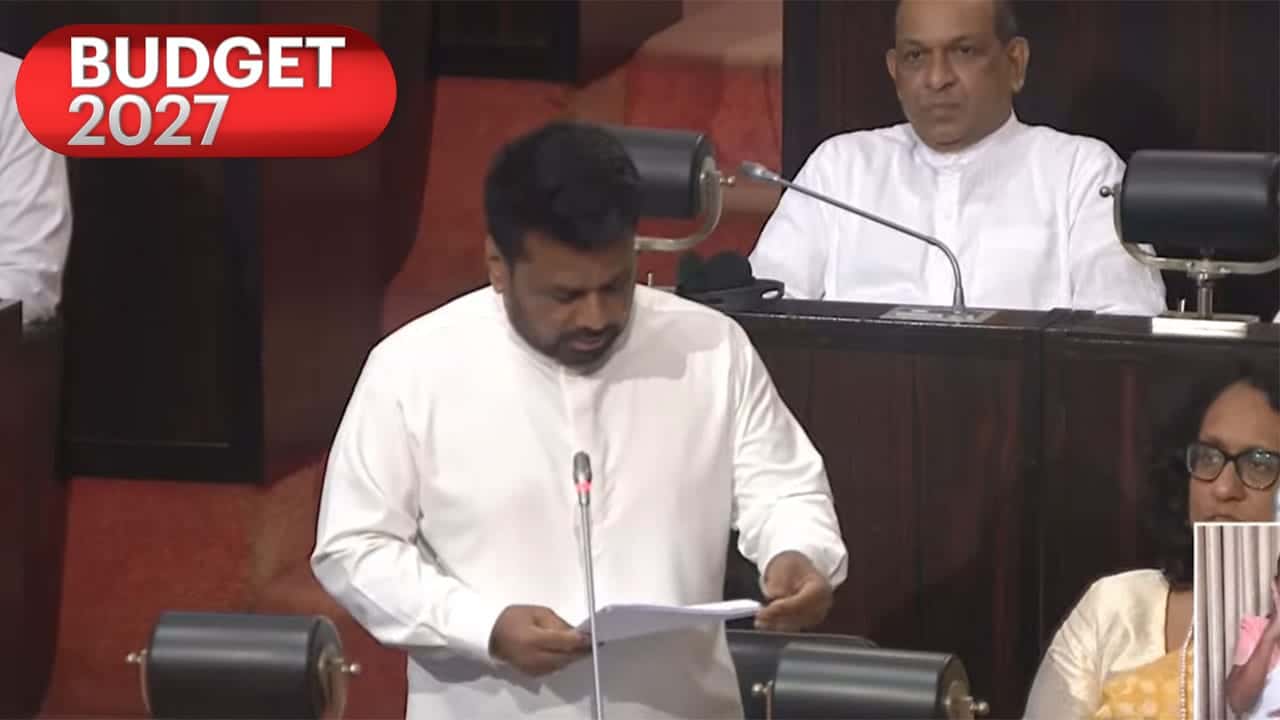









President Anura Kumara Dissanayake has announced a capital expenditure allocation of Rs. 131 billion for the maintenance and development of Sri Lanka’s public health service under the 2027 Budget.
Presenting the Budget in Parliament today (12), the President said the allocation was aimed at ensuring that every citizen has access to quality healthcare services through medical institutions administered by both the Central Government and Provincial Councils.
As part of efforts to strengthen healthcare delivery, the Government has recruited 1,797 doctors, 303 indigenous medical practitioners, 64 dental surgeons, 3,441 nurses, 952 public health midwives and 3,415 support staff to address longstanding vacancies in the health sector.
Meanwhile, the Government plans to establish 1,000 Arogya Wellness Centres across the country between 2027 and 2029, with a total investment of Rs. 17.44 billion in collaboration with Provincial Councils.
The pilot programme, comprising 39 centres designed to provide patient-centred healthcare services to communities of between 5,000 and 10,000 people, is already being implemented. An allocation of Rs. 3.6 billion has been made for 2027 to expand the programme.
The President also announced plans to bring six District General Hospitals currently administered by Provincial Councils under the Central Government. The hospitals are located in Mannar, Mullaitivu, Vavuniya, Kilinochchi, Gampaha and Avissawella.
In another healthcare development initiative, Rs. 300 million has been allocated to construct a modern Accident and Emergency Treatment Unit at the Thambuttegama Base Hospital.
Rs. 20.5 Billion for Advanced Medical Equipment
The Government has identified a requirement of Rs. 65.587 billion to meet the country's high-end biomedical equipment needs within three years, including MRI scanners, CT scanners and Cath Lab facilities.
Accordingly, Rs. 15.5 billion has already been allocated for 2027, with a further Rs. 5 billion proposed for this purpose to accelerate the provision of modern diagnostic and treatment equipment to hospitals.
New Ambulances to Strengthen Emergency Services
The Government has also announced a major programme to replace ageing ambulances and expand emergency medical services.
President Dissanayake said around 400 ambulances currently in the health service are more than 20 years old, with approximately half exceeding 25 years.
An allocation of Rs. 3 billion has been proposed for 2027 to replace ageing ambulances.
In addition, 25 ambulances will be received through an Asian Development Bank loan facility, while another 20 ambulances will be provided as a grant from Japan, coordinated through the ADB.
A further 100 ambulances will be added to the 1990 Suwa Seriya emergency ambulance service under Indian assistance amounting to Rs. 1.725 billion. The service currently operates 319 ambulances.
Rs. 3.15 Billion Organ Transplant Centre at National Hospital
A new organ transplant centre, including facilities for liver transplantation, will be established at the National Hospital of Colombo at an estimated cost of Rs. 3.155 billion.
The project will receive financial contributions from local and international institutions and organisations, with Rs. 50 million allocated in 2027 for its initial activities.
Meanwhile, Rs. 400 million has been allocated to expand the biological Wolbachia dengue vector control programme across the country, with technical assistance from the World Mosquito Program (WMP), as part of efforts to combat dengue.
The Government has also proposed an allocation of Rs. 100 million to provide free spectacles to schoolchildren to minimise disruptions to their education caused by vision-related problems.
Hospital Development Projects Across the Country
A further Rs. 1.245 billion has been allocated to commence new hospital development projects, including staff quarters, at the Badulla and Batticaloa Teaching Hospitals, Matale and Nawalapitiya District General Hospitals, and Puttalam Base Hospital.
In addition, Rs. 510 million has been allocated for feasibility studies and preliminary planning in 2027 for several proposed hospital development projects.
These include the proposed relocation of Matara District General Hospital to Kotawila in Kamburugamuwa, as well as development projects at the Kurunegala, Kalubowila and Kuliyapitiya Teaching Hospitals, Trincomalee Siddha Teaching Hospital, Moneragala and Polonnaruwa District General Hospitals, National Institute of Infectious Diseases and Gampola Base Hospital.
The allocation will also cover planning for staff accommodation facilities and regional medical supplies stores.
Rs. 250 Million for Robotic Surgery Training
The Government has proposed establishing a robotic surgery training centre at the Faculty of Medicine, Ragama, with an allocation of Rs. 250 million.
Training will be conducted in collaboration with foreign universities to develop local expertise in robotic-assisted surgical procedures.
Rabies-Free Sri Lanka by 2030
The President also outlined plans to strengthen the national programme aimed at eradicating canine rabies by 2030.
The initiative will focus primarily on vaccinating dogs and improving canine sterilisation programmes through coordinated action involving the Ministry of Health and Mass Media, the Department of Animal Production and Health and local government institutions.
The Government intends to coordinate existing resources and allocations among the relevant institutions to ensure the effective implementation of the programme, the President said in his 2027 Budget speech.