





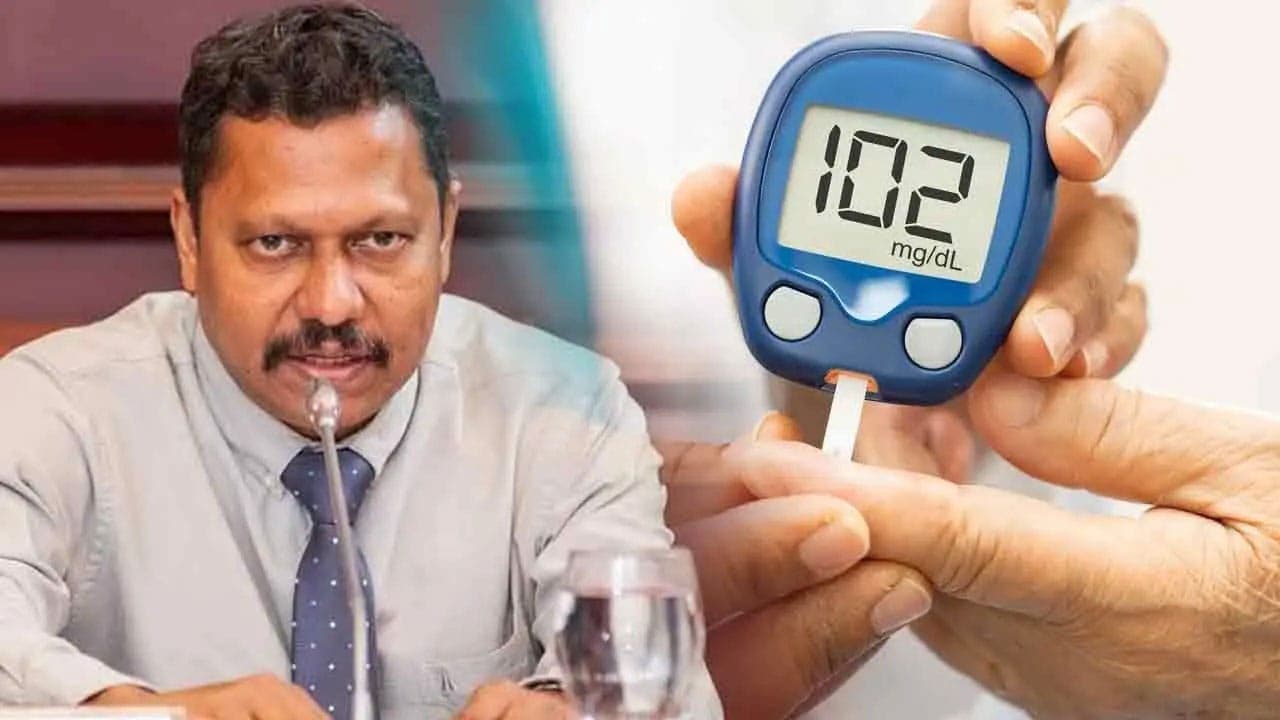


Nearly 19% of Sri Lanka’s population is suffering from diabetes, Deputy Minister of Health Dr. Hansaka Wijemuni stated.
Accordingly, approximately one in every five people in the country has been identified as having diabetes, while the actual figure could be even higher, he noted.
The Deputy Minister made these remarks while attending an event held in Colombo to mark World Diabetes Day.
Pointing out that non-communicable diseases (NCDs), particularly diabetes and hypertension, have emerged as major challenges facing the country’s healthcare sector, he stressed the importance of detecting such conditions at an early stage.
He further urged the public to undergo regular medical check-ups, even in the absence of any symptoms.
Dr. Wijemuni also noted that early detection of diabetes, followed by appropriate treatment and management, could help prevent numerous complications in the future.
He warned that if the condition is left undetected and progresses to a more complicated stage, patients may require expensive medical treatments, placing a significant burden on both their quality of life and the country's healthcare system.
Addressing the event, Deputy Minister of Health Dr. Hansaka Wijemuni said:
"Diabetes is one of the biggest challenges facing Sri Lanka's healthcare sector. This is because we have identified approximately one in every five people in our population as suffering from diabetes. In numerical terms, this accounts for around 19% of the population. However, the actual figure could be even higher.
Although Sri Lanka performs well in many health indicators, we are still lagging behind in preventing non-communicable diseases, particularly diabetes and hypertension. This is largely because many people tend to believe that they are not suffering from any illness.
It is particularly important to detect conditions such as diabetes and hypertension at an early stage.
Therefore, we urge the public to undergo medical examinations and assess their health conditions, even if they do not experience any symptoms.
Falling ill does not affect only the individual but also the country as a whole. Ultimately, it places a considerable burden on the healthcare system.
Diabetes, which can be managed through relatively low-cost medication, may progress to serious complications if left uncontrolled, potentially requiring major surgical procedures such as bypass surgery.
Therefore, controlling these diseases is essential, both from an economic perspective and in terms of maintaining quality of life.
A considerable allocation has also been made in this year's Budget to raise public awareness of non-communicable diseases.
Our foremost priority should be the early detection of diseases. Having to identify them only after complications have developed would be difficult for a country like ours to bear."
Meanwhile, more than 15% of the adult population in Sri Lanka is reported to be suffering from diabetes, according to President of the Sri Lanka Diabetes Association, Consultant Physician Dr. Manilka Sumanatilleke.
He further pointed out that, among the adult population in the Colombo District, one in every four people is affected by diabetes.