







NASA’s Voyager 1 spacecraft is nearing a historic milestone, becoming the first human-made object to travel a distance equivalent to one light-day through space.
According to NASA, Voyager 1 is expected to reach the milestone on November 18, after travelling approximately 16.09 billion miles (25.9 billion kilometres), the distance light travels in one day.
The spacecraft was launched from Cape Canaveral, Florida, on September 5, 1977, with its initial mission focused on conducting close-up studies of Jupiter, the largest planet in the Solar System, Saturn and their moons.
Although its primary mission was originally designed to last five years, Voyager 1 successfully completed its initial objectives and continued its journey beyond the boundary of the Sun's influence to explore interstellar space.
Among its significant discoveries, Voyager 1 confirmed that Titan, Saturn's largest moon, has a dense atmosphere rich in nitrogen.
The spacecraft also captured the iconic 'Pale Blue Dot' photograph of Earth on February 14, 1990, after turning its camera towards our planet from a distance of approximately six billion kilometres.
Another major milestone came on August 25, 2012, when Voyager 1 became the first spacecraft to enter interstellar space after crossing the boundary of the Sun's magnetic influence.
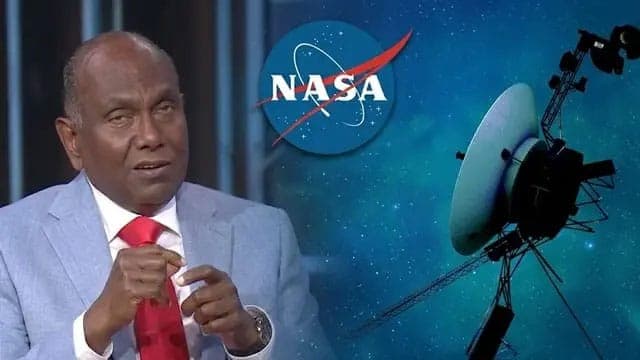
Meanwhile, NASA's Sri Lankan-born senior scientist Dr. Sarath Gunapala has spoken about the information and messages carried aboard the spacecraft since its launch.
He explained that Voyager 1 carries a 12-inch golden record containing information about Earth, the Sun and the Milky Way, along with various sounds from our planet.
The record also contains greetings in approximately 55 languages, including the Sinhala greeting 'Ayubowan'.
Dr. Gunapala said the messages were intended for the possibility that an intelligent and technologically advanced civilisation might one day discover the spacecraft.
"If a highly intelligent and advanced civilisation capable of travelling through space discovers it someday, they may be able to establish that life existed in this part of the universe or galaxy millions of years ago," he explained.
To mark this historic achievement in space exploration, NASA has invited people around the world to take part in a special celebration.
The agency has encouraged people to shine their mobile phone lights or other sources of light towards the sky after sunset on November 17 to commemorate Voyager 1's extraordinary journey and its approaching one-light-day milestone.