








By Dr .Nalinda Somasiri Associate Professor in Generative AI and Machine Learning, York St John's University
Walk along any beach on Sri Lanka's north-eastern coast Pulmoddai, Nilaveli, Kokkilai and you will notice patches of dark, heavy sand glinting in the tropical sun. That darkness is not mud. It is ilmenite, an iron-titanium oxide mineral with the chemical formula FeTiO₃, and it is one of the most commercially important minerals on the planet.
Ilmenite is the principal feedstock for titanium dioxide (TiO₂) the brilliant white pigment found in paints, plastics, paper, cosmetics and sunscreens. It is also a starting material for titanium metal, used in aerospace, medical implants and advanced engineering. Associated heavy minerals in Sri Lanka's beach sands include rutile, a higher-purity TiO₂ mineral used directly in speciality welding rods and pigment production, and zircon (ZrSiO₄), a refractory mineral valued by ceramics, foundry and nuclear industries. Together, these three minerals represent an extraordinary concentration of industrial value sitting in Sri Lanka's coastal dunes.
The paradox is stark. Raw ilmenite concentrate leaves Sri Lankan ports at an estimated export price of approximately US$65 to 90 per tonne. Pigment-grade titanium dioxidemade from that same ilmenite after several processing stages commands roughly US$1,800–2,000 per tonne on global markets. The gap between these figures represents the difference between exporting a raw commodity and capturing genuine industrial value at home.
“Raw ilmenite leaves at $65 to 90 per tonne. Pigment-grade TiO₂ commands $1,800–2,000 per tonne. The difference is captured through processing not more mining.”
Transforming that gap into national revenue requires significant investment in processing technology, energy infrastructure, trained personnel, environmental stewardship and regulatory governance. It also requires intelligent data use at every stage of the value chain. AI, applied responsibly and transparently, offers Sri Lanka a credible pathway not a shortcut, but a set of practical tools to do the work better, safer and more sustainably.
Where Sri Lanka finds ilmenite
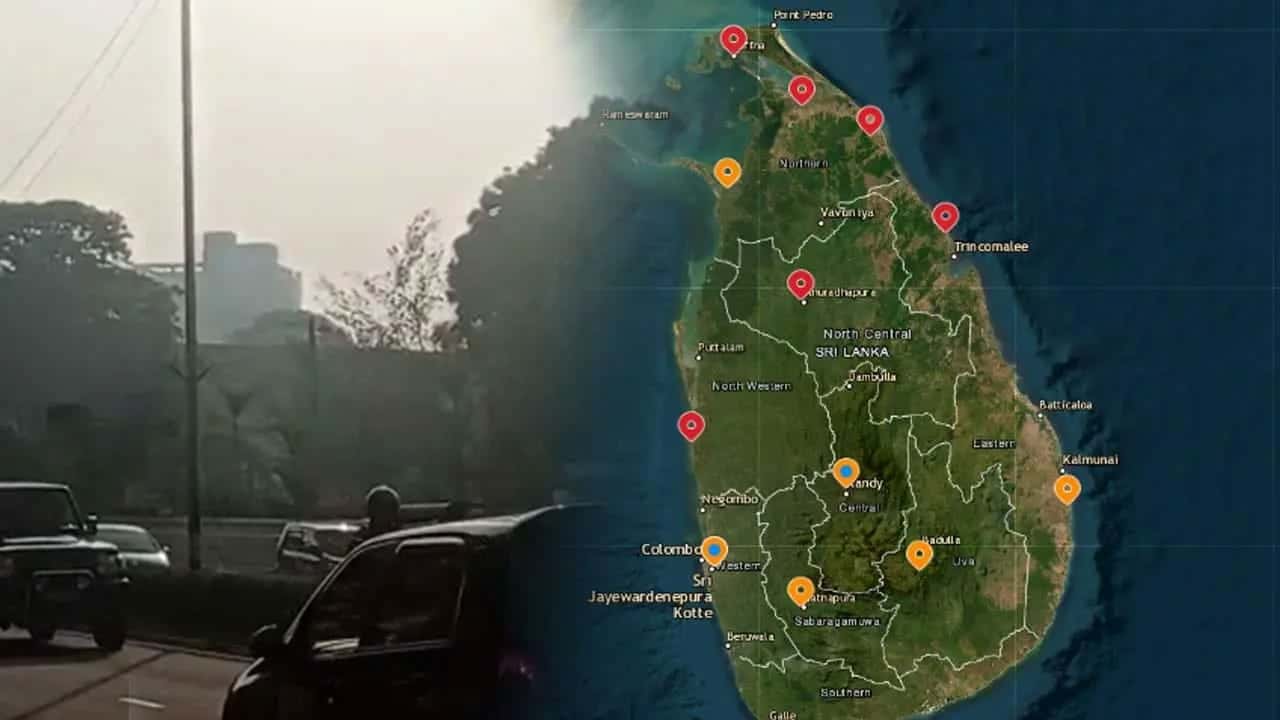
Pulmoddai is the starting point for commercial supply. The Ministry of Industry’s 2025 progress report records Lanka Mineral Sands Limited’s ilmenite stocks there, and the company lists ilmenite among its products. An industrial buyer can contact the company for specifications and sale terms. The other points on the map illustrate where studies have reported mineral sands.
Researchers have identified ilmenite in samples around Kokkilai lagoon, and studies report ilmenite-bearing sands at Nayaru and Verugal. A University of Moratuwa study also identified ilmenite in samples from the Batticaloa beach stretch. On the south coast, Kirinda has reported garnet and ilmenite. A sample tells us what is present at a location. A reserve estimate needs evidence of the deposit’s extent, grade and recoverability.
How Sand Becomes Pigment
The first job is to separate grains. Washing and screening remove fine clay and larger debris. Spiral concentrators use differences in density to separate heavier mineral grains from much of the lighter quartz. After drying, separators exploit differences in magnetic response and electrical conductivity to recover marketable mineral streams. Zircon and rutile can have their own buyers.
Before any chemistry is possible, the heavy minerals must be physically separated from the bulk of common silica sand. The process at Pulmoddai and similar plants involves a disciplined sequence of unit operations, each exploiting a different physical property of the mineral grains:
Washing and screening removes fine clay, mud and organic material that would impede downstream separation. Vibrating screens remove oversized particles. Gravity and spiral separation uses the density difference between heavy minerals and silica. Spiral concentrators rotate slurries around a helical trough; denser grains migrate inward while silica discharges to the outer edge. Magnetic separation: exploits the ferromagnetic properties of ilmenite. High-intensity electromagnets draw ilmenite (and some associated minerals) out of the non-magnetic stream, leaving rutile and zircon behind.
Electrostatic separation discriminates between conducting minerals (rutile) and non-conducting minerals (zircon) by applying a high-voltage electric field across a rotating drum, producing the final three-product separation.
Where AI Can Help
The best place to start is where a wrong decision already costs money. A plant that discovers poor concentrate quality only after a batch has been processed has already spent electricity and labour on it. A plant that spots a drift in the feed earlier can take a sample and investigate while it still has options.
On the coast, satellite images and repeat drone surveys could help geologists track shoreline movement and identify dark-sand bands worth sampling. Wet sand can look dark too, and tides can change what the camera sees. A model trained against field samples from different seasons could help prioritise surveys. Laboratory mineralogy would establish whether the grains actually contain ilmenite.
At the separation plant, machine learning could combine feed rate, moisture and equipment readings with laboratory results to estimate concentrate grade between samples. Operators could use those estimates to decide when to check a separator or collect an extra sample. Vibration and motor-current data could also help maintenance teams investigate a pump or drive before it fails.
Start with one line and run the model alongside normal operations. Record dry tonnes processed, concentrate grade, titanium recovery, water use and kilowatt-hours per tonne. Compare shifts with similar feed and moisture and test the model on later batches that it has never seen. An apparent energy saving can disappear if titanium recovery falls or more product has to be reworked.
Generative AI could help staff search approved operating manuals or draft shift summaries that link back to the underlying readings. Engineers would review those summaries and remain responsible for operating decisions. Furnace protection and chemical safety interlocks would remain under the plant’s established control systems.
“AI supports, but does not replace engineers, geologists, community representatives and regulatory authorities. It is a decision-support tool, not a decision-maker.”
What the energy bill could look like
A European Commission industry reference published in 2007 gives full-capacity benchmarks of 17-25 gigajoules per tonne of finished pigment for the chloride route and 23–41 for the sulphate route. These historical benchmarks cover energy at the pigment plant, including electricity and heat. A Sri Lankan project would need a separate budget for mining, wet separation, drying and any upstream upgrading carried out outside that plant boundary.
Take a hypothetical chloride plant making 50,000 tonnes of pigment a year. Multiplying output by the benchmark gives 0.85-1.25 petajoules a year, the energy equivalent of about 236-347 gigawatt-hours. That total includes heat. For a sense of the electrical component, the reference’s historical chloride plant averages add up to 6.6 gigajoules of electricity per tonne across conversion, finishing and effluent treatment. At the same output, that works out to about 92 gigawatt-hours a year, or roughly 10.5 megawatts averaged over the full year. Peak load and any separate smelter would require their own estimates.
A feasibility study should meter electricity and fuel separately at each stage and estimate hourly demand, peak load and the cost of outages. An electric smelter would require firm supply. Drying and pigment finishing also need heat, so heat recovery deserves a costed comparison alongside grid power and renewables backed by reliable supply. The Ceylon Electricity Board’s generation plan gives national context. The local connection, tariff and supply profile would determine the project’s actual power bill.
Sri Lanka can make a stronger case for moving beyond concentrate exports by publishing the results of a pilot. It should tell readers how much titanium was recovered, how much electricity and heat were used, what qualified buyers would pay, and how the coast was monitored. Those figures would show whether producing pigment here is worth the investment.
Dr Nalinda Somasiri is an Associate Professor in Generative AI and Machine Learning and leader of the AI for Climate and Disaster Resilience Research Group (AICDRG) at York St John University, UK. He is at the forefront of South Asia's regional transformation in AI research and application. The views expressed are personal.