





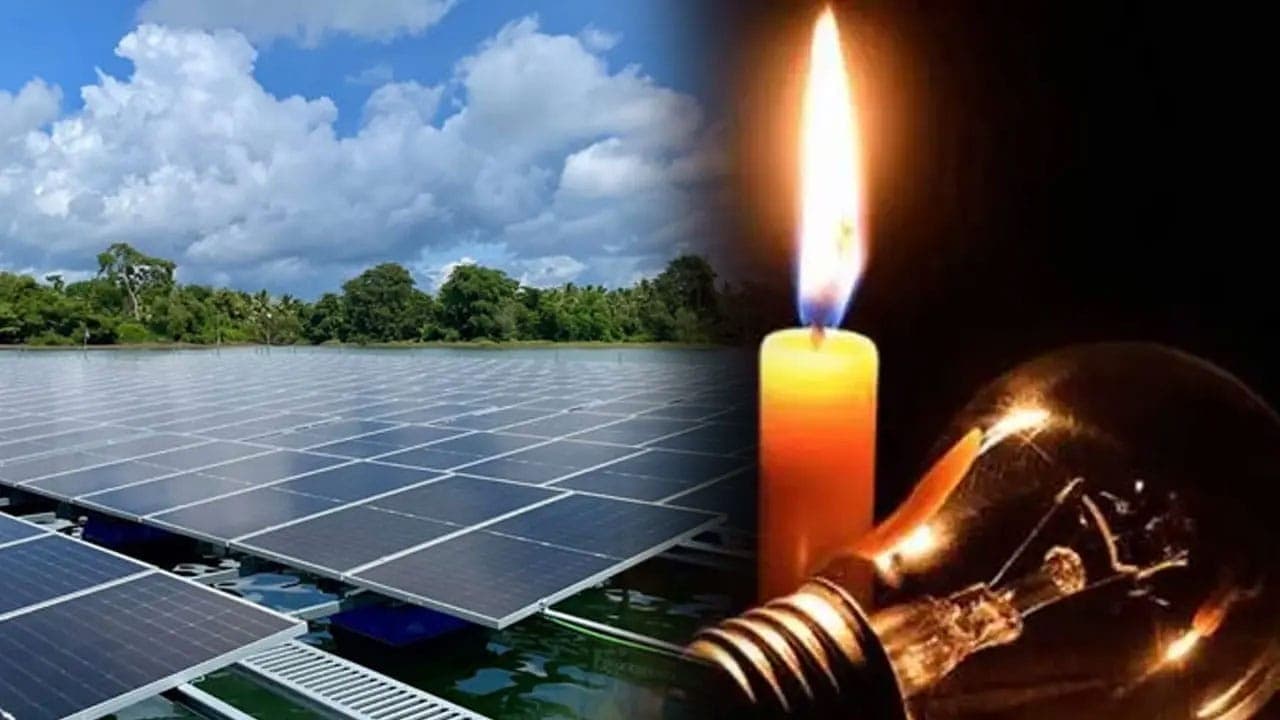


Sri Lanka could face electricity shortages and power cuts from next year due to government measures that are hampering the expansion of rooftop solar power projects, renewable energy specialist Asoka Abeygunawardana has warned.
He also claimed that a Cabinet proposal concerning solar power development had now gone missing, with no clarity on what had happened to it.
Explaining the shortcomings of the new system introduced by the government, Asoka Abeygunawardana said a Cabinet paper had been submitted highlighting concerns over the rapid expansion of rooftop solar power installations, which had exceeded the Ceylon Electricity Board's expectations.
He explained that the Board was not adequately prepared to store the excess electricity generated by rooftop solar systems during the daytime for use at night.
According to him, the Cabinet proposal had cited concerns that the electricity system could become unstable due to the inability to accommodate the expected volume of solar power generation by 2030.
However, he argued that discouraging rooftop solar development could create further electricity supply challenges, particularly during the dry season in February and March from next year onwards.
He warned that the country could be forced to resort to power cuts or increase electricity generation through expensive fuel-powered plants, which would place an additional financial burden on consumers and the electricity sector.
Renewable energy specialist Asoka Abeygunawardana said the government should instead have continued purchasing electricity from rooftop solar producers while addressing the country's energy storage limitations.
He noted that two proposals had been included in the Cabinet paper to address the issue: the 'Zero Export' scheme and the 'Net Plus 1' system.
Under the Zero Export system, excess electricity generated by rooftop solar installations would not be supplied to the national grid.
Unlike the previous Net Metering arrangement, electricity purchased from and supplied to the grid would not be offset against each other.
He explained that this would require households to invest in battery storage systems in addition to installing rooftop solar panels.
Under the Net Plus 1 system, electricity supplied during the daytime and at night would be accounted for separately according to the applicable rates. However, households would also need to install batteries to store electricity for use at night.
While encouraging households to install battery systems could help address the National System Operator’s (NSO) current storage limitations, Abeygunawardana cautioned that requiring every household to install batteries would be economically inefficient for the country.
He estimated that installing battery storage systems across individual households could cost around three times more than establishing battery storage facilities centrally through the NSO.