





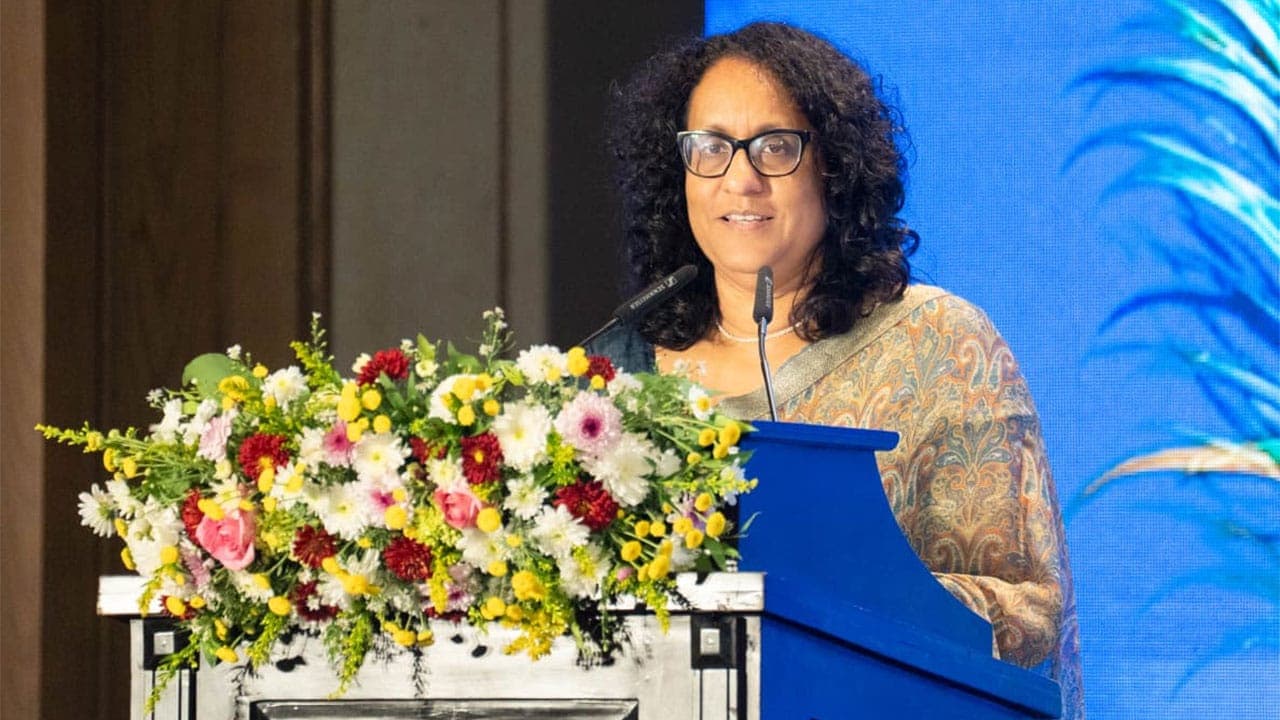


Prime Minister Dr. Harini Amarasuriya stated that access to essential medical services should not be determined by an individual's income or social status, and that building a healthier, fairer society is the government's vision.
The Prime Minister made these remarks while attending the Annual Academic Sessions jointly organized by the Sri Lanka College of Oncologists (SLCO) and the South Asian Federation of Oncologists (SAFO) last afternoon (27) at the Shangri-La Hotel in Colombo, according to the Prime Minister's Media Division.
Coinciding with this session, the induction of the new President and the Dr. Kumar Weerasekera Memorial Oration were also held.
Expressing further views at the event, Prime Minister Dr. Harini Amarasuriya said:
"Strengthening such platforms is vital to guaranteeing equal access to quality healthcare at every stage of life. Cancer care is a critical part of that duty. Moving beyond mere treatment, a comprehensive approach is needed that covers prevention, early detection, diagnosis, rehabilitation, survivorship care, and palliative care.
My family also has personal experience with cancer. My mother's youngest sister passed away from the disease a few years ago, while another of my mother's sisters is a survivor. Therefore, I deeply understand the stress that arises when a loved one is diagnosed, the sorrow of watching them endure pain, and the helplessness of not knowing what to do next.
Keeping the patient at the center of decision-making and securing community participation throughout this entire process are particularly crucial.
Cancer is a growing public health challenge that affects not only individuals, but also their families, communities, and the broader economy. It creates immense demand on the healthcare system while placing a heavy financial burden on households. Above all, it inflicts profound human suffering.
To confront these challenges, a coordinated, evidence-based, and people-centered national program focused on prevention and early detection is required.
Primary healthcare providers must be equipped within the primary care system itself to identify risks, facilitate appropriate screening, and establish effective referral pathways so patients can access further testing and treatment without unnecessary delays.
Providing equal access to quality diagnosis and treatment must remain a core government obligation. Continuous investment in modern diagnostic facilities, medical technology, essential medicines, specialized treatment services, and the human resources required to deliver them is equally imperative. Access to quality oncology care cannot depend on where a person lives or their financial capability.
Furthermore, care does not end with treatment. Rehabilitation, survivorship programs, and palliative services—alongside recognizing and supporting the family members and caregivers who shoulder immense responsibility throughout this journey—are essential.
Consequently, investing in the healthcare workforce is of utmost importance. To keep pace with advancements in medical science and oncology, healthcare professionals—including doctors, nurses, and medical technicians—require continuous education, specialized training, and professional development opportunities. In this regard, the pivotal role played by the Sri Lanka College of Oncologists, as well as building strong links between research and policymaking, is indispensable."
The Prime Minister further noted that since countries across the South Asian region face common challenges regarding timely diagnosis, essential medicines, specialized treatment facilities, health infrastructure, and a sufficiently trained oncology workforce, regional cooperation is vital, and the South Asian Federation of Oncologists provides a valuable platform for this purpose.
A group of local and foreign doctors and researchers attended the event, including the President of the Sri Lanka College of Oncologists, Dr. Sanjeeva Gunasekera, Immediate Past President, Dr. Sanath Wanigasooriya, Secretary, Dr. Buddhika Somawardhana, and Professor and Head of the Department of Medical Oncology at Tata Memorial Centre, India, Prof. Manju Sengar.