




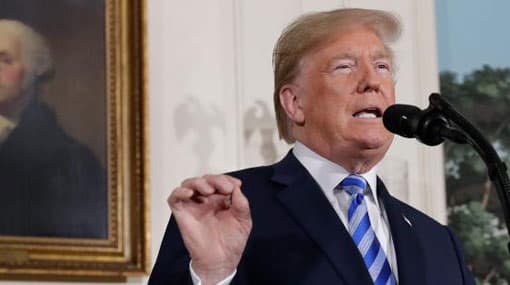



President Donald Trump announced Tuesday he is quitting the Iran nuclear deal, pitting him against the United States’ closest allies and leaving the future of Tehran’s nuclear ambitions in question.
“It is clear to me that we cannot prevent an Iranian nuclear bomb under the decaying and rotten structure of the current agreement,” Trump said from the White House Diplomatic Room. “The Iran deal is defective at its core. If we do nothing we know exactly what will happen.”
In announcing his long-telegraphed decision, Trump said he would initiate new sanctions on the regime, crippling the touchstone agreement negotiated by his predecessor. Trump said any country that helps Iran obtain nuclear weapons would also be “strongly sanctioned.”
“This was a horrible one-sided deal that should have never, ever been made,” the President said in remarks that, at times, misrepresented the international agreement’s provisions. “It didn’t bring calm, it didn’t bring peace, and it never will.”
Trump’s decision could have explosive consequences, straining longstanding US alliances, disrupting oil markets and boosting tensions in the Middle East, even if the US reversal doesn’t lead Iran to restart its atomic program.
While Trump supporters praised the move, analysts and critics said it undermines Washington’s credibility in future negotiations -- particularly with North Korea -- and potentially empowers the very hardliners in Iran that Trump vilified in his remarks.
It also further isolates Trump on the global stage, where he has angered even the staunchest US allies by reneging on US commitments to the Paris climate accord and pulling out of the Trans-Pacific Partnership trade agreement.
Former President Barack Obama, who rarely comments on his successor, issued a statement describing Trump’s move as a “serious mistake” that could leave the US with a “losing choice between a nuclear-armed Iran or another war in the Middle East.”
Some of the US’ closest allies, the UK. France and Germany, issued a statement expressing “regret and concern” about the decision, emphasizing Iran’s compliance with the deal and their “continuing commitment” to the Joint Commission Plan of Action, as the deal is formally known.
Iran’s President, Hassan Rouhani, said he had ordered the country’s atomic industry to be ready to restart industrial uranium enrichment , while the country’s foreign minister said he would work with the pact’s remaining partners -- France, the UK, Germany, China and Russia -- to see whether they could ensure “full benefits for Iran. Outcome will determine our response,” Javad Zarif tweeted.
Tensions in the region are high, with US officials citing “concerns” that Iran might attack Israel, without citing their evidence for the claim, while Israel called up reserves and the State Department issued a security alert for US citizens in the Golan Heights.
-CNN