









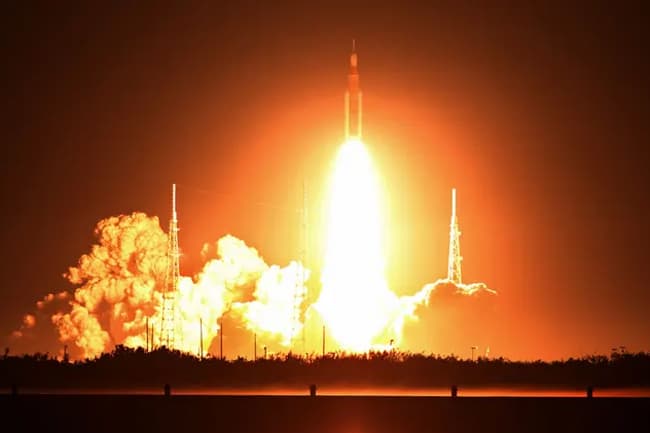



NASA’s towering next-generation moon rocket blasted off from Florida early on Wednesday on its debut flight, a crewless voyage inaugurating the U.S. space agency’s Artemis exploration program 50 years after the final Apollo moon mission.
The 32-story Space Launch System (SLS) rocket surged off the launch pad from the Kennedy Space Center in Cape Canaveral to send its Orion capsule on a three-week test journey around the moon and back without astronauts aboard.
Liftoff came on the third attempt at launching the long-delayed, multibillion-dollar rocket, after 10 weeks beset by numerous technical mishaps, back-to-back hurricanes and two excursions trundling the spacecraft out of its hangar to the launch pad.
Dubbed Artemis I, the mission marks the first flight of the SLS rocket and the Orion capsule together, built by Boeing Co and Lockheed Martin Corp, respectively, under contract with NASA.
It also signals a major change in direction for NASA’s post-Apollo human spaceflight program after decades focused on low-Earth orbit with space shuttles and the International Space Station.
Named for the ancient Greek goddess of the hunt - and Apollo’s twin sister - Artemis aims to return astronauts to the moon’s surface as early as 2025.
Twelve astronauts walked on the moon during six Apollo missions from 1969 to 1972, the only spaceflights yet to place humans on the lunar surface. But Apollo, born of the Cold War-era U.S.-Soviet space race, was less science-driven than Artemis.
The new moon program has enlisted commercial partners such as Elon Musk’s SpaceX and the space agencies of Europe, Canada and Japan to eventually establish a long-term lunar base as a stepping stone to even more ambitious human voyages to Mars.
The Artemis I countdown climaxed with the rocket’s four main R-25 engines and its twin solid-rocket boosters roaring to life, sending the spacecraft streaking skyward and lighting up the night sky over Florida’s central Atlantic coast.
About 90 minutes after launch, the rocket’s upper stage is designed to loft Orion out of Earth orbit on course for a 25-day flight that will bring it to within 60 miles (97 km) of the lunar surface before sailing 40,000 miles (64,374 km) beyond the moon and back to Earth.
The capsule is expected to splash down on Dec. 11.
Spaceflight stress test
Getting the SLS-Orion spacecraft off the ground was a key hurdle for the ambitious Artemis program. Its first voyage is intended to put the vehicle through its paces in a rigorous test flight, pushing its design limits to prove the spacecraft is suitable to fly astronauts.
If the mission succeeds, a crewed Artemis II flight around the moon and back could come as early as 2024, followed within a few more years by the program’s first lunar landing of astronauts, one of them a woman, with Artemis III.
Billed as the most powerful, complex rocket in the world, the SLS represents the biggest new vertical launch system NASA has built since the Saturn V of the Apollo era.
Although no people were aboard, Orion carried a simulated crew of three - one male and two female mannequins - fitted with sensors to measure radiation levels and other stresses that astronauts would experience.
A top objective is to test the durability of Orion’s heat shield during re-entry as it hits Earth’s atmosphere at 24,500 miles (39,429 km) per hour, or 32 times the speed of sound, on its return from lunar orbit - much faster than re-entries from the space station.
The heat shield is designed to withstand re-entry friction expected to raise temperatures outside the capsule to nearly 5,000 degrees Fahrenheit (2,760 degrees Celsius).
The spacecraft also is set to release a payload of 10 miniaturized science satellites, called CubeSats, including one designed to map the abundance of ice deposits on the moon’s south pole, where Artemis seeks to eventually land astronauts.
Sending astronauts to Mars, an order of magnitude more challenging than lunar landings, is expected to take at least another decade and a half to achieve.
More than a decade in development with years of delays and budget overruns, the SLS-Orion spacecraft has so far cost NASA at least $37 billion, including design, construction, testing and ground facilities. NASA’s Office of Inspector General has projected total Artemis costs at $93 billion by 2025.
NASA calls the program a boon to space exploration that has generated tens of thousands of jobs and billions of dollars in commerce.
Source: Reuters