





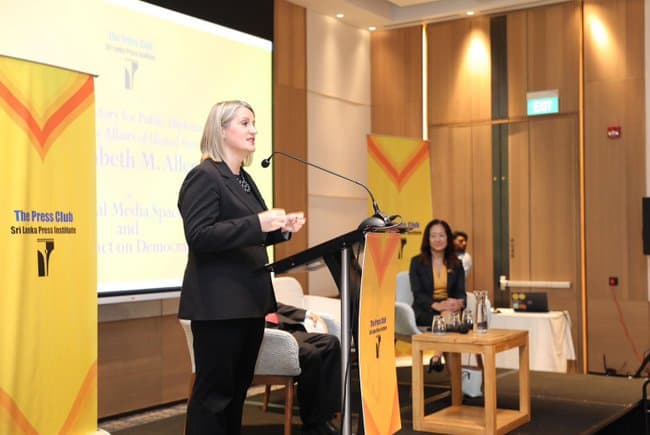


US Under Secretary of State for Public Diplomacy Elizabeth Allen has raised concerns that several aspects of the freedom of expression are currently under threat globally, including certain concerns in Sri Lanka.
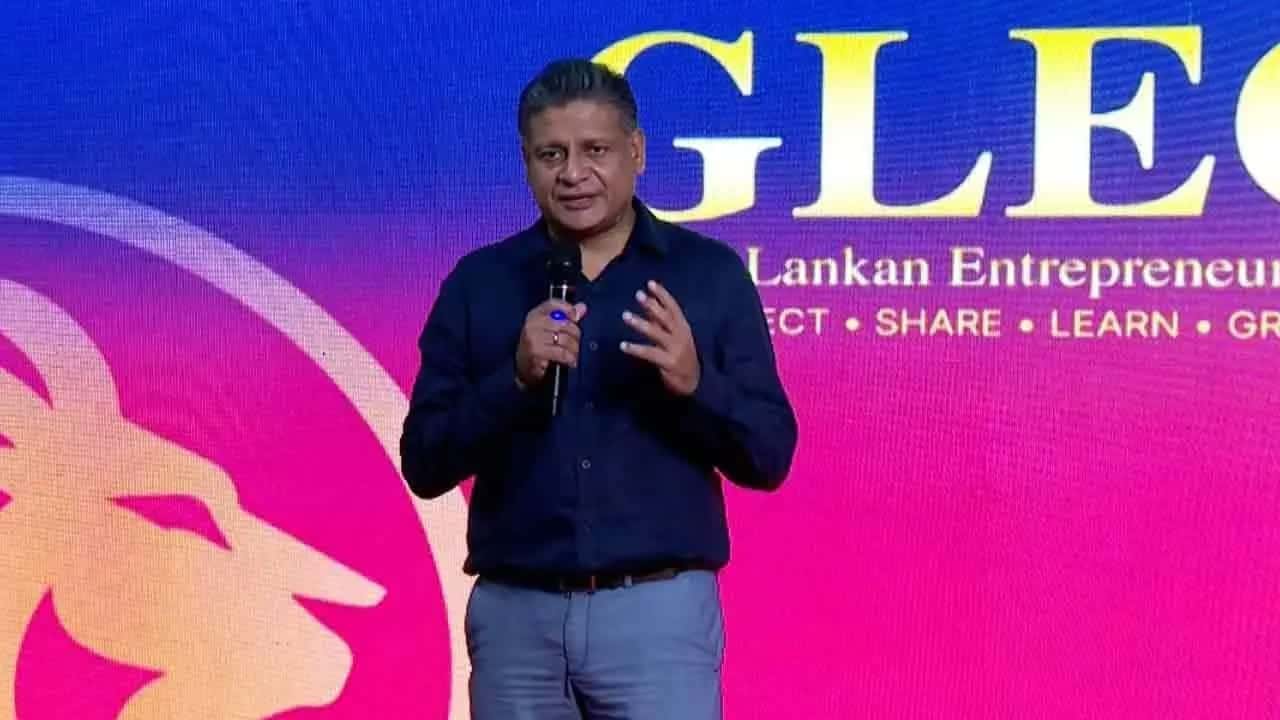
Speaking at an event hosted by the Sri Lanka Press Institute (SLPI) Press Club themed ‘The Global Media Space and its Impact on Democracy’, Under Secretary Allen stated that several essential freedoms are under threat globally, including in Sri Lanka.
“Globally, we’re witnessing serious and escalating challenges to media freedom. The United States stands firmly for the freedom of expression, advocating for press freedom both online and offline, and ensuring the safety of journalists and media workers worldwide. Unfortunately, these essential freedoms are under threat globally, including concerns raised here in Sri Lanka”, she said.
Speaking on the recent passage of the Online Safety Bill in Sri Lanka, the US Under Secretary recalled that the US government “voiced concerns over its potential effects on freedom of expression, innovation, and privacy”.
“When governments intensify efforts to withhold information from the public by restricting internet access and censoring content, we must speak up”, she noted.
While highlighting that although there are several concerns against unfettered freedom of expression, Under Secretary Allen emphasised that “It’s essential to remember that a free press isn’t an adversary to Sri Lanka; it’s one of its greatest allies, paving the way for a resilient and flourishing society”.
“It’s common to hear arguments against unfettered freedom of expression. Critics claim the media is biased, aiming to embarrass governments and undermine public trust. Others worry that without checks, freedom of expression may fuel the spread of misinformation. Some argue that an unchecked press can incite tension and compromise security. And there’s concern that continuous reports on corruption, violence, and political strife can tarnish a nation’s image, deterring investment and hampering development”, she said in this regard.
Attached below is the US Under Secretary’s full speech:
Thank you, Kumar, for that warm introduction. It’s fantastic to be here with everyone today, truly. And Ambassador Chung, thank you for your leadership in representing the American people in Sri Lanka.
I’m thrilled to be here today, thanks to the Sri Lanka Press Institute. Your dedication to journalism’s craft is nothing short of inspiring.
Know this: the U.S. Embassy is all in on supporting your incredible work. Sure, we might bump heads over a story now and then, but above all, we’re your biggest fans. We’re all in on programs that hone your skills because we believe in your right to pursue journalism freely and fearlessly.
As I find myself in front of a room of journalists, I want to thank you for protecting the rights and freedoms of journalists here in Sri Lanka and around the world, ensuring all citizens enjoy the right to express their ideas and opinions openly and freely. Even in difficult times, you continue to press forward and ask difficult questions. Your commitment to seeking out the truth and shouting it from the rooftops remains a democratic staple, and I truly appreciate what you do.
It’s only fitting that I begin my remarks this afternoon by telling a story that I think is relevant in light of today’s topic about the media’s role in a democracy.
Over a century ago, American media coined the term “muckraker” for journalists who delved into societal issues, exposing corruption.
Although the term carried a somewhat negative connotation, labeling these journalists as mere “gossip mongers,” today, we honor them as the pioneers of investigative journalism.
These muckrakers played a pivotal role in ushering in the Progressive Era, a time of significant social and political reform in American history.
Even President Theodore Roosevelt referred to them as “muckrakers,” criticizing their focus on society’s flaws through figures like Lincoln Steffens, whose work shed light on corruption and spurred a nationwide call for accountability and reform.
Steffens’ book ‘The Shame of the Cities,’ published in 1904, made him renowned for uncovering corruption within American cities, highlighting the nefarious links between political leaders, businesses, and organized crime.
His fearless journalism raised critical awareness about the urgent need for governmental and corporate accountability. Steffens wasn’t acting as a public relations officer for the government; his role was to uncover the truth; however unpleasant it might be.
Faced with the stark realities Steffens presented, American officials and the public were compelled to confront a pivotal question: ‘Is this the kind of country we aspire to be?’ The resounding answer was no.
Steffens’ work didn’t just expose wrongdoing; it sparked a nationwide demand for reform and played a crucial role in fostering a dialogue about the essential role of investigative journalism in ensuring power remains accountable.
This story showcases how freedom of the press and freedom of expression are not just fundamental human rights, they are also vital contributors to a country’s development and growth.
This brings me to my main point: how the global media space supports democracy and fosters peaceful, just, and inclusive societies.
In my mind, the correlation is obvious: When a government constricts the rights and freedoms of its citizens, the future and the development of the country will naturally suffer.
Globally, we’re witnessing serious and escalating challenges to media freedom. The United States stands firmly for the freedom of expression, advocating for press freedom both online and offline, and ensuring the safety of journalists and media workers worldwide. Unfortunately, these essential freedoms are under threat globally, including concerns raised here in Sri Lanka.
When governments intensify efforts to withhold information from the public by restricting internet access and censoring content, we must speak up. Notably, when Sri Lanka’s Parliament passed the Online Safety Bill in January, the United States voiced concerns over its potential effects on freedom of expression, innovation, and privacy.
It’s common to hear arguments against unfettered freedom of expression. Critics claim the media is biased, aiming to embarrass governments and undermine public trust. Others worry that without checks, freedom of expression may fuel the spread of misinformation.
Some argue that an unchecked press can incite tension and compromise security. And there’s concern that continuous reports on corruption, violence, and political strife can tarnish a nation’s image, deterring investment and hampering development.
However, the media’s bias should lean towards the public’s interest, acting as a guardian to ensure that leaders fulfill their duties. This principle holds in Sri Lanka, the United States, and globally.
The challenge of negative press, often labeled as “fake news” or “biased journalism,” is not new. For generations, governments and the media have navigated a complex, sometimes adversarial relationship. This dynamic isn’t unique to any one nation; in the United States, for instance, presidents from both major political parties have experienced their share of friction with the press.
This tension, a hallmark of democratic societies, plays a crucial role in fostering transparency and encouraging effective governance. It’s a familiar scene: politicians and journalists engage in heated exchanges, especially when leaders feel their actions are misrepresented, leading to accusations of inaccuracies and biased reporting.
The press’s duty is to deliver facts as they stand, shedding light on the government’s achievements as well as spotlighting areas where policies or programs fall short. This transparency not only informs the public but also strengthens the nation as it encourages constructive action and improvement.
And suppressing voices only complicates matters further. Attempting to conceal issues rather than addressing them is akin to hiding a broken tool rather than fixing it. True progress comes from collaborative dialogue, even if it means embracing the messiness of public discourse.
This was evident during my recent visit to IdeaHell here in Colombo, a hub for creative minds dubbed “where good ideas go to die.” My interaction with the young, innovative minds there underscored the critical need to protect the freedom for creators, journalists, and entrepreneurs to explore and innovate without fear. Yes, some good ideas die, but creators should be free to think and attempt and even fail. That is how we achieve progress.
Overly broad and ambiguous limitations on expression can choke creativity, robbing society of potential advancements that fuel innovation and economic growth. A climate of censorship not only stifles innovation but also dampens the community’s spirit to solve pressing issues with novel solutions.
I urge you to reflect on the initial spark that drew you to journalism. It’s doubtful it was the allure of wealth or fame; more likely, it was a drive to enact change and contribute to Sri Lanka’s betterment. Should these be the forces that drive you, I implore you to persevere. Your dedication, your rights, and your freedom are pivotal to the nation’s ongoing growth and prosperity.
Consider this: among you, who will emerge as the modern-day Lincoln Steffens? Who will pen the narratives that propel Sri Lanka’s economic and social advancement? That individual could very well be among us now, ready to champion free speech, press freedom, and the unbridled exchange of ideas. It’s essential to remember that a free press isn’t an adversary to Sri Lanka; it’s one of its greatest allies, paving the way for a resilient and flourishing society.
Thank you.