








A special meeting to review the progress of Sri Lanka’s national programme to digitalise the school education system and identify future strategic steps was held at the Parliament Complex.
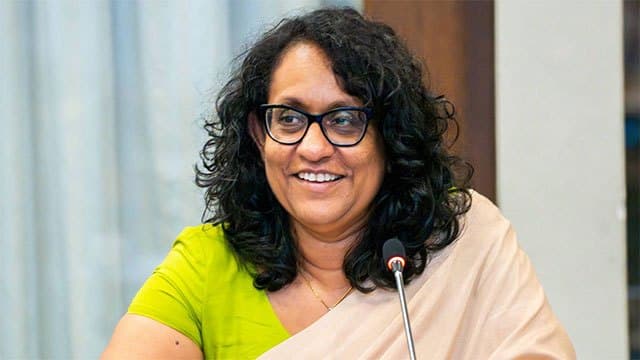
The meeting was chaired by Prime Minister Dr. Harini Amarasuriya and attended by Deputy Minister of Digital Economy Eng. Eranga Weeraratne, President’s Chief Advisor on Digital Economy Dr. Hans Wijayasuriya, Secretary to the Prime Minister Pradeep Saputhanthri, Secretary to the Ministry of Digital Economy Waruna Sri Dhanapala and senior government officials.
Representatives from the Digital Task Force, Prime Minister’s Office, Ministry of Education, Ministry of Digital Economy, GovTech, Sri Lanka Air Force, Sri Lanka Telecom (SLT), and Dialog Axiata also participated in the discussion.
The meeting reviewed the progress of the initiative to provide high-speed internet connectivity to island-wide schools through fibre-optic technology. Officials discussed challenges faced by schools where fibre connectivity cannot be established due to geographical and technical limitations, and explored alternative solutions to provide digital access to those institutions.
Discussions also focused on accelerating the School Internet Project, which aims to connect more than 6,000 secondary schools across the country to national digital systems and online learning platforms.
The meeting further addressed the expansion of digital education facilities, including Distance Learning Management Systems (DLMS), Smart Classrooms, the National Education Management Information System (NEMIS), and the modernisation of the e-Thaksalawa online learning platform.
It was also decided that the Ministry of Education and GovTech would establish a formal partnership through a Memorandum of Understanding (MoU) to ensure the effective implementation of these digital transformation initiatives.
Officials also highlighted the importance of online child safety while expanding digital access to education, with discussions focusing on measures to address online gambling addiction among schoolchildren and strengthen awareness programmes to protect students and the wider community.