









The Supreme Court today (01) adjourned until tomorrow the hearing of petitions challenging the constitutionality of the government’s proposed 22nd Amendment to the Constitution Bill.
Submissions by the petitioners’ side concluded at around 10:30 p.m. today, following which the Court directed that further submissions be heard tomorrow.
The petitioners’ remaining submissions, followed by arguments from the intervening petitioners and the Attorney General, are scheduled to be heard tomorrow.
The petitions are being considered by a five-member bench headed by Chief Justice Preethi Padman Surasena, comprising Justices Achala Wengappuli, Arjuna Obeyesekere, Sampath Abeykoon and Gihan Kulatunga.
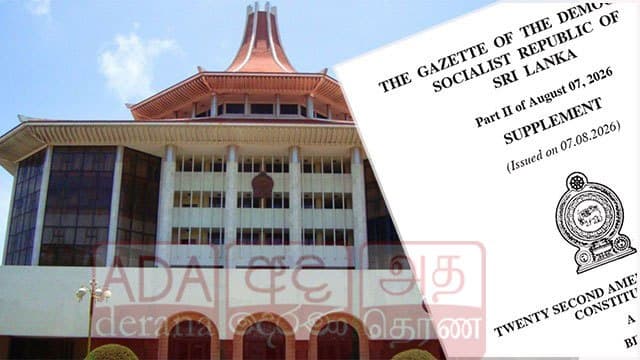
The proposed 22nd Amendment was presented to Parliament on August 18, 2026, by Minister of Justice Harshana Nanayakkara. The Bill was first published in the Government Gazette on August 7.
The key proposal concerns the retirement age of judges of the superior courts. If enacted, the retirement age of Supreme Court judges would be increased from 65 to 67, while the retirement age of Court of Appeal judges would rise from 63 to 65.
The proposed amendment has prompted a significant number of legal challenges. A total of 67 petitions have been filed before the Supreme Court in connection with the Bill, including petitions challenging and supporting the proposed amendment.
Petitioners challenging the Bill have raised concerns over its potential impact on judicial independence, public sovereignty and the rule of law. Some petitioners have argued that the amendment would require not only a two-thirds majority in Parliament but also approval at a referendum.
The Bar Association of Sri Lanka and several professional organisations and trade unions have also expressed opposition to the proposed amendment, arguing that extending the retirement age of judges could affect the independence of the Judiciary.
Meanwhile, petitions have also been filed in support of the Bill. Supporters argue that the proposed provisions do not violate the sovereignty of the people or the independence of the Judiciary and can therefore be enacted through the parliamentary process without a referendum.
The Supreme Court’s determination on the petitions will establish the constitutional requirements that must be followed if the government proceeds with the proposed 22nd Amendment.