




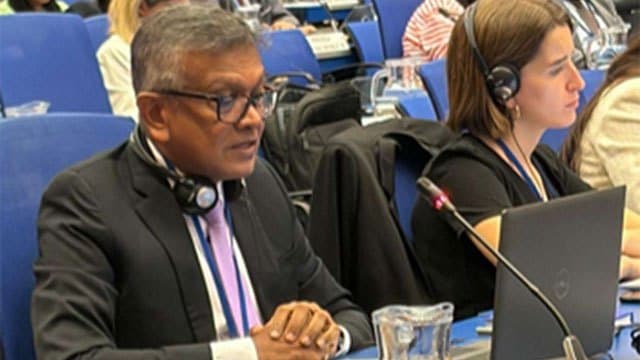


The Chairman of the Commission to Investigate Allegations of Bribery or Corruption (CIABOC), Justice Neil Iddawala, has delivered a significant address highlighting Sri Lanka’s transformative progress in anti-corruption measures, legislative reforms, and digital transparency on the opening day of the First Resumed Session of the 17th Session of the Implementation Review Group (IRG), held at the United Nations Office on Drugs and Crime (UNODC) in Vienna.
The CIABOC Chairman’s address received widespread appreciation from international delegates, representatives of States Parties, and legal experts participating in the session, according to a statement issued by the Commission to Investigate Allegations of Bribery or Corruption (CIABOC).
Justice Iddawala emphasized that Sri Lanka views the United Nations Review Mechanism not merely as a process for assessing legal compliance, but as a catalyst for genuine national reform and institutional transformation.
Highlighting the significant changes to Sri Lanka’s legal framework, Justice Iddawala explained how the Anti-Corruption Act No. 9 of 2023 has fundamentally restructured the country’s anti corruption legal framework, the statement said.
He also outlined Sri Lanka’s progress in introducing the Centralized Electronic Assets and Liabilities Declaration System and in leveraging technology to minimize corruption risks, strengthen transparency, and enhance institutional efficiency.
He further highlighted the implementation of the National Anti-Corruption Action Plan 2025–2029, “Towards Integrity,” as well as extensive capacity-building programmes conducted for local government institutions, the police service, and the financial sector. He also referred to direct interventions in public-sector systems identified as vulnerable to corruption.
Concluding his address, Justice Iddawala called upon the international community to transform the United Nations Review Mechanism into an instrument that actively drives practical reforms in all countries, the CIABOC said.
"For Sri Lanka, the true measure of success is not the number of laws enacted, institutions created or systems launched. It is whether these reforms produce a measurable improvement in integrity, accountability, public confidence and the recovery of public resources. Let us make the Review Mechanism not simply a mechanism for reviewing implementation, but a mechanism that drives implementation, encourages reform and strengthens collective action against corruption."
Sri Lanka’s comprehensive approach received commendation from international participants, with the country’s progress from legislative reform to digital implementation being highlighted as a practical example for developing countries, it added.