






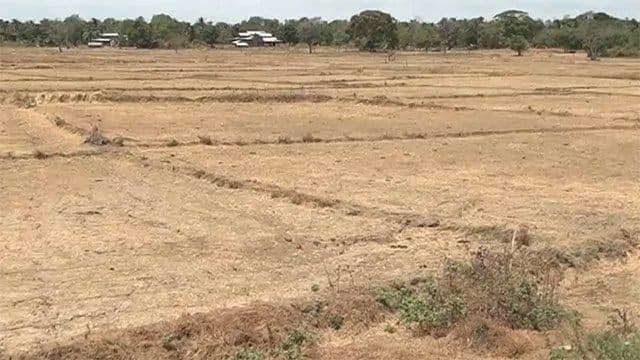


Crop damage has been reported across approximately 8,000 to 8,500 acres of cultivated land in Sri Lanka due to the prevailing El Niño conditions affecting the country.
The Agricultural and Agrarian Insurance Board says compensation payments for farmers whose crops have been damaged will begin today (04) in several affected districts.
Accordingly, arrangements have been made to credit insurance compensation payments to the bank accounts of affected farmers in the Polonnaruwa District today. Compensation payments to farmers in all other affected districts are expected to be completed before the 15th of this month.
Crops including paddy and maize have been damaged by the prevailing dry weather conditions in Hambantota, Ampara, Puttalam, Anuradhapura, Polonnaruwa and Monaragala districts.
Following reports of crop damage by farmers, officials inspected the affected farmlands and assessed the extent of the damage. Compensation payments were subsequently approved based on the assessed extent of crop damage.
The Agricultural and Agrarian Insurance Board said the government has already allocated approximately Rs. 3 billion to provide compensation for the crop damage.
Compensation will be provided for six crops including paddy, maize, big onions, potatoes, soybeans and chilli, at a maximum rate of Rs. 100,000 per hectare, covering up to five acres per farmer.
Meanwhile, the severe dry weather caused by the El Niño conditions has also had a significant impact on the Polonnaruwa District.
Amid the high temperatures, the water capacity of the Parakrama Samudraya in Polonnaruwa has fallen to around 66,000 acre-feet.
As the water level has dropped, the remains of the historic Sitha Maligawa, believed to have been built by King Parakramabahu within the Parakrama Samudraya as a summer retreat, have become visible. Several small islands located nearby have also emerged.
A large number of fish have also been found dead in the area surrounding the Ekka Ela sluice gate of the Parakrama Samudraya, with reports of a foul odour spreading across the area.
Officials suspect that the decline in the water level may have reduced the oxygen content in the water, possibly resulting in the deaths of the fish.
Residents of Kandurugaswewa village in Grama Niladhari Division No. 120 of the Medirigiriya Divisional Secretariat Division are also facing severe difficulties due to a lack of drinking water.
Residents of Mailagas Junction and Rambewa in Medirigiriya are similarly affected by the water shortage, while crops cultivated by farmers in these areas have also been destroyed.
Livestock, including dairy cattle, are also being affected as grazing lands and water sources continue to dry up.
Meanwhile, farmers in Thirappane, Mawathawewa, Pandikettuwewa, Puliyankulama and Kuttikulama complain that wild elephants entering their farmlands at night are causing extensive damage to upland crops they have managed to protect despite the water shortage.
The dry weather conditions in the Monaragala District are also continuing to intensify, with the Yudaganawa Tank in Buttala having almost completely dried up. The land at the centre of the tank has also begun to crack.
In Ampara District, the water level of the Kora Wewa in Thirukkovil is also declining. Migratory birds arriving in search of the remaining water can now be seen in the area.
Meanwhile, drinking water is being distributed by water bowsers to residents of Sirimal village and Kalan Watta in Badulla, who are facing a drinking water crisis due to the prevailing dry weather conditions.