





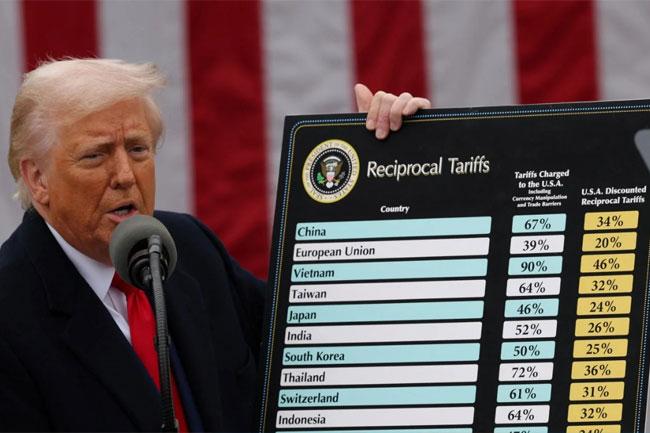



United States President Donald Trump on Wednesday announced a sweeping set of reciprocal tariffs, imposing a baseline 10 per cent tax on all imports and significantly higher rates on dozens of countries with which the US runs trade deficits.
The sweeping duties, which drew bewildered condemnation from many long-standing U.S. allies who found themselves tagged with unexpectedly high tariff rates, promise to erect new barriers around the world’s largest consumer economy, reversing decades of trade liberalization that have shaped the global order.
In a statement delivered from the White House Rose Garden, Trump described the measure as a “declaration of economic independence” and vowed to boost domestic production by levelling the playing field with foreign competitors.
Trading partners are expected to respond with countermeasures of their own that could lead to dramatically higher prices for everything from bicycles to wine.
U.S. stock futures dropped sharply after the announcement, following weeks of volatile trading as investors speculated about how the incoming tariffs might affect the global economy, inflation and corporate earnings. U.S. stocks have erased nearly $5 trillion of value since mid-February.
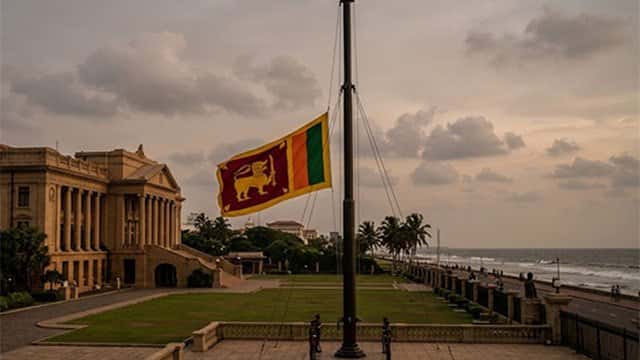
The new tariff structure introduces a 10 per cent flat rate on all imports and applies higher rates to several major trading partners. At 49 per cent, Cambodia faces the steepest tariff, followed closely by Vietnam at 46 per cent, Sri Lanka at 44 per cent, and China at 34 per cent. Trump also announced a 26 per cent “discounted reciprocal tariff” on imports from India.
Sri Lanka faces the 6th highest tariff rates in the world, while currently 25% of the island nation’s total exports go to the US.
The “reciprocal” tariffs, Trump said, were a response to duties and other non-tariff barriers put on U.S. goods. He argued that the new levies will boost manufacturing jobs at home.
Outside economists have warned that tariffs could slow the global economy, raise the risk of recession, and increase living costs for the average U.S. family by thousands of dollars.
Canada and Mexico, the two largest U.S. trading partners, already face 25% tariffs on many goods and will not face additional levies from Wednesday’s announcement.
Even some fellow Republicans have expressed concern about Trump’s aggressive trade policy. Within hours of Wednesday’s announcement, the Senate voted 51-48 to approve legislation that would terminate Trump’s Canadian tariffs, with a handful of Republicans breaking with the president. Passage in the Republican-controlled U.S. House of Representatives, however, was seen as unlikely.
Trump’s top economist, Stephen Miran, told Fox Business on Wednesday the tariffs would work out well for the U.S. in the long run, even if they cause some initial disruption.
Tariff concerns have already slowed manufacturing activity across the globe, while also spurring sales of autos and other imported products as consumers rush to make purchases before prices rise.
European leaders reacted with dismay, saying a trade war would hurt consumers and benefit neither side.
Countries facing the highest tariffs (40 per cent and above):
Lesotho: 50 per cent (charges US 99 per cent)
Saint Pierre and Miquelon: 50 per cent (charges US 99 per cent)
Cambodia: 49 per cent (charges US 97 per cent)
Laos: 48 per cent (charges US 95 per cent)
Madagascar: 47 per cent (charges US 93 per cent)
Vietnam: 46 per cent (charges US 90 per cent)
Myanmar: 44 percent (charges US 88 per cent)
Sri Lanka: 44 per cent (charges US 88 per cent)
Falkland Islands: 41 per cent (charges US 82 per cent)
Syria: 41 per cent (charges US 81 per cent)
Moderate-to-high tariffs (20 to 39 per cent):
Iraq: 39 per cent (charges US 78 per cent)
Guyana: 38 per cent (charges US 76 per cent)
Bangladesh: 37 per cent (charges US 74 per cent)
Botswana: 37 per cent (charges US 74 per cent)
Reunion: 37 per cent (charges US 73 per cent)
Serbia: 37 per cent (charges US 74 per cent)
Thailand: 36 per cent (charges US 72 per cent)
Bosnia and Herzegovina: 35 per cent (charges US 70 per cent)
Tunisia: 28 per cent (charges US 55 per cent)
Kazakhstan: 27 per cent (charges US 54 per cent)
India: 26 per cent (charges US 52 per cent)
South Korea: 25 per cent (charges US 50 per cent)
Japan: 24 per cent (charges US 46 per cent)
Malaysia: 24 per cent (charges US 47 per cent)
Cote d’Ivoire: 21 per cent (charges US 41 per cent)
Namibia: 21 per cent (charges US 42 per cent)
European Union: 20 per cent (charges US 39 per cent)
Jordan: 20 per cent (charges US 40 per cent)
Low or standardised tariffs (10 to 19 per cent):
Nicaragua: 18 per cent (charges US 36 per cent)
Malawi: 17 per cent (charges US 34 per cent)
Philippines: 17 per cent (charges US 34 per cent)
Israel: 17 per cent (charges US 33 per cent)
Zambia: 17 per cent (charges US 33 per cent)
Mozambique: 16 per cent (charges US 31 per cent)
Venezuela: 15 per cent (charges US 29 per cent)
Nigeria: 14 per cent (charges US 27 per cent)
Equatorial Guinea: 13 per cent (charges US 25 per cent)
Cameroon: 11 per cent (charges US 22 per cent)
Argentina: 10 per cent (charges US 10 per cent)
Australia: 10 per cent (charges US 10 per cent)
Azerbaijan: 10 per cent (charges US 10 per cent)
Bahamas: 10 per cent (charges US 10 per cent)
Bahrain: 10 per cent (charges US 10 per cent)
Bolivia: 10 per cent (charges US 20 per cent)
Brazil: 10 per cent (charges US 10 per cent)
Chile: 10 per cent (charges US 10 per cent)
Colombia: 10 per cent (charges US 10 per cent)
Costa Rica: 10 per cent (charges US 17 per cent)
Dominican Republic: 10 per cent (charges US 10 per cent)
Ecuador: 10 per cent (charges US 12 per cent)
Egypt: 10 per cent (charges US 10 per cent)
El Salvador: 10 per cent (charges US 10 per cent)
Ethiopia: 10 per cent (charges US 10 per cent)
Georgia: 10 per cent (charges US 10 per cent)
Ghana: 10 per cent (charges US 17 per cent)
Guatemala: 10 per cent (charges US 10 per cent)
Haiti: 10 per cent (charges US 10 per cent)
Honduras: 10 per cent (charges US 10 per cent)
Iceland: 10 per cent (charges US 10 per cent)
Jamaica: 10 per cent (charges US 10 per cent)
Kenya: 10 per cent (charges US 10 per cent)
Lebanon: 10 per cent (charges US 10 per cent)
Morocco: 10 per cent (charges US 10 per cent)
New Zealand: 10 per cent (charges US 20 per cent)
Oman: 10 per cent (charges US 10 per cent)
Panama: 10 per cent (charges US 10 per cent)
Paraguay: 10 per cent (charges US 10 per cent)
Peru: 10 per cent (charges US 10 per cent)
Qatar: 10 per cent (charges US 10 per cent)
Saudi Arabia: 10 per cent (charges US 10 per cent)
Senegal: 10 per cent (charges US 10 per cent)
Singapore: 10 per cent (charges US 10 per cent)
Tanzania: 10 per cent (charges US 10 per cent)
Trinidad and Tobago: 10 per cent (charges US 12 per cent)
Turkey: 10 per cent (charges US 10 per cent)
UAE: 10 per cent (charges US 10 per cent)
Uganda: 10 per cent (charges US 20 per cent)
Ukraine: 10 per cent (charges US 10 per cent)
United Kingdom: 10 per cent (charges US 10 per cent)
Uruguay: 10 per cent (charges US 10 per cent)
The move, part of Trump’s broader “Liberation Day” economic agenda, is considered by his administration as a key strategy to rectify what it sees as unfair trade practices by imposing duties that match those levied by other countries on US products. However, economists warn the move may prompt retaliatory measures and raise prices for American consumers already struggling with inflation.
--Agencies