








Nasa has said it hopes to send astronauts on a ten-day trip around the Moon as soon as February.
The US space agency had previously committed to launching no later than the end of April but said it aims to bring the mission forward.
It’s been 50 years since any country has flown a crewed lunar mission. Nasa will send four astronauts there and back to test systems.
The Artemis II mission is the second launch of the Artemis programme, whose aim is to land astronauts and eventually establish a long-term presence on the lunar surface.
Lakiesha Hawkins, Nasa’s acting deputy associate administrator said it would be an important moment in the human exploration of space.
“We together have a front row seat to history,” she told a news conference this afternoon.
“The launch window could open as early as the fifth of February, but we want to emphasize that safety is our top priority.”
Artemis Launch Director, Charlie Blackwell-Thompson explained that the powerful rocket system built to take the astronauts to the Moon, the Space Launch System (SLS) was “pretty much stacked and ready to go”.
All that remained was to complete the crew capsule, called Orion, connected to SLS and to complete ground tests.
The first Artemis mission lasted 25 days and saw the launch of an uncrewed spacecraft in November 2022. It saw a spacecraft travel around the Moon and re-enter the Earth’s atmosphere.
The mission was overwhelmingly successful, though there were issues with the heatshield as the spacecraft re-entered the Earth’s atmosphere. These have since been addressed.
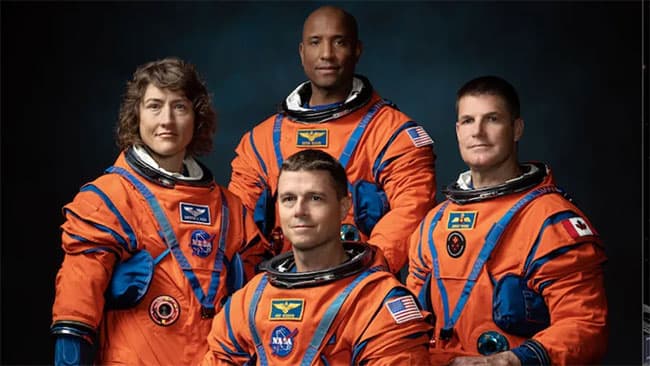
The Artemis II launch will see four astronauts go on a ten-day round trip to the Moon and back to the Earth. The astronauts, Reid Wiseman, Victor Glover, and Christina Koch, of Nasa and Jeremy Hansen of the Canadian Space Agency, will not land on the Moon, though they will be the first crew to travel beyond low Earth orbit since Apollo 17 in 1972.
The lead Artemis II flight director, Jeff Radigan explained that the crew would be flying further into space than anyone had been before.
“They’re going at least 5,000 nautical miles (9,200Km) past the Moon, which is much higher than previous missions have gone,” he told reporters.
The aim of the mission is to test the rocket and spacecraft’s systems to lay the ground for a lunar landing.
The astronauts will enter the Orion capsule, which will be their home for the duration of their journey which sits on top of SLS.
This will be carried initially into Earth orbit with the help of two solid rocket boosters, which will fall back to Earth two minutes after launch once they have done the heavy lifting.
Eight minutes after launch the massive Core stage will separate from the second stage, called the Interim Cryogenic Propulsion System (ICPS), and the Orion crew capsule. Orion’s solar arrays will unfurl and begin charging the spacecraft’s batteries to provide power when it is not in direct sunlight.
Ninety minutes later ICPS fires its engines to raise the vehicle to a higher Earth orbit, and for the next 25 hours there will be a full systems check.
If everything is in order, Orion will separate from ICPS and there will be a form of “space ballet” between the two vehicles, more prosaically called the Proximity Operations Demonstration.
Astronauts will manually control Orion’s manoeuvring thruster to dance toward and away from ICPS. This will be to rehearse docking procedures in order to link up with a landing vehicle for the eventual Moon landing.
Twenty-three hours later Orion’s service module carries out a Translunar Injection (TLI) burn - a blast of thrust aiming it at the Moon - before Orion makes its four-day journey, taking the astronauts more than 230,000 miles from Earth.
During the journey the astronauts will be continue to carry out systems checks.
The crew will in some ways be human guinea pigs.
Experiments will monitor how their bodies are affected by space. Scientists will grow tissue samples from the astronauts’ blood called organoids both before and after their journey.
The two sets of organoids will be compared to see how the astronauts’ bodies have been affected by space, according to Dr Nicky Fox, Nasa’s head of science.
“You may be wondering why we are doing all that when we have the actual astronauts, she told BBC News.
“We want to be able to study in depth the effect of the microgravity and the radiation on these samples. I’m certainly not going to dissect an astronaut! But I can dissect these little organoid samples and really look at the difference.”
After the spacecraft slingshots past the Moon, the astronauts begin their four-day journey home, drawn back with the help of the Earth’s gravity.
On arrival, the service module, which has the spacecraft’s primary propulsion system, separates from the crew module. The astronauts will then begin a dangerous part of the mission as they re-enter the Earth’s atmosphere, and parachute back to the surface off the coast of California.
The success of the mission will determine how soon Nasa can launch Artemis III, to actually land on the Moon. But even if the mission goes to perfection, the space agency’s stated aim of “no earlier than mid-2027” is unrealistic, according to Dr Simeon Barber of the Open University.
“‘No earlier than’ is familiar language for NASA, and it means just that. That’s the earliest possibility,” he said, adding that he deemed that optimistic due to the expense of keeping Artemis III on track.
“The Moon landing will require [Elon Musk’s] SpaceX Starship to take the astronauts to and from the surface, and we’ve seen in recent months that Starship itself still has a long way to go before it can even achieve an orbital flight around the Earth, let alone put astronauts on board.”
Source: BBC
--Agencies