







China’s Belt and Road Initiative (BRI) is far more ambitious than the ports, railways and highways that it is often reduced to in Western commentary, said Hussein Askary, a prominent Iraqi-Swedish scholar of international relations and geo-economics.
At its core, he argued, lies the concept of “a community with a shared future for mankind” — an idea that encompasses not only economic cooperation but also cultural exchange and mutual learning among civilisations.
“The Belt and Road is not just about infrastructure,” Askary told the 21st Century Business Herald in an interview on the sidelines of a conference in Beijing. “It is about the true essence of the ancient Silk Road: deep exchanges and the transmission of knowledge between different civilisations.”
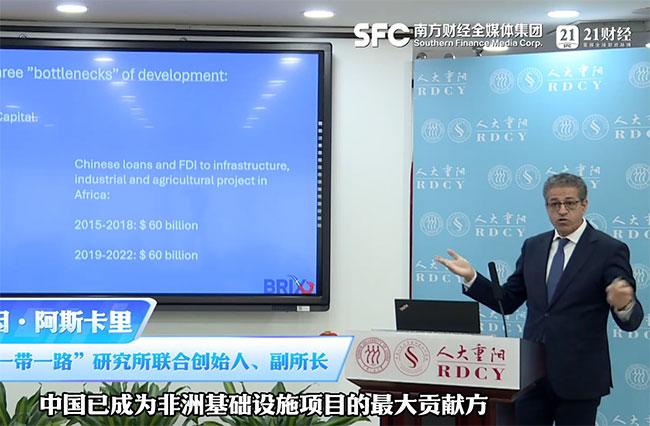
Askary is co-founder and deputy director of the Belt and Road Institute in Sweden (BRIX) and has spent years researching and advocating for the initiative.
He is co-author of Extending the New Silk Road to West Asia and Africa, a special research fellow at the Guangdong Institute for International Strategies, and an economic strategy analyst at the Schiller Institute.
On April 14 he addressed the 21st session of the “U.S. Series” of the Regional and Country Studies Forum, organised by the Chongyang Institute for Financial Studies at Renmin University of China. His lecture, titled “‘America First’ Meets ‘China’s Approach’: How China is Deeply Engaging West Asia and Africa”, examined the BRI’s growing influence in those regions.
“Debt Trap” Narrative Is Baseless, Says Askary
In a wide-ranging discussion during a break in the proceedings, Askary forcefully rejected the long-running Western accusation that China is creating a “debt trap” in Africa and other developing regions. He argued that the real source of African debt problems lies not with China, but with Western financial institutions.
“If you look at the debt structure of countries like Zambia, Kenya, or Pakistan, you will see that China’s share is very small compared to Western private lenders such as BlackRock, Ashmore, or even multilateral institutions like the IMF and the World Bank,” Askary explained. “The so-called ‘debt trap’ narrative is not based on facts — it is a geopolitical story pushed by the U.S. State Department and some Harvard academics.”
He added that Chinese loans are typically long-term (20–25 years), carry low interest rates of around 2–3%, and are invested in productive infrastructure that helps countries generate future income.
In contrast, Western loans are often short-term, with interest rates of 6–10%, and are frequently used to cover budget deficits or roll over existing debt — creating a genuine “snowball effect.” “The real debt trap,” Askary concluded, “comes from the Western financial system, not from China.”
“America First” Policy Accelerating American Decline
Turning to U.S. foreign policy, Askary argued that the frequent American military actions this year do not reflect a coherent strategy but rather what he called “extractive intervention” — from Venezuela to the Middle East. Such an approach, he suggested, is unlikely to deliver stability and may instead hasten America’s relative decline.
True long-term national strength, he added, is measured by economic productivity and living standards rather than short-term military or political leverage. “If these policies continue, they will leave behind an unstable international environment while eroding the foundations of America’s own development,” Askary said.
History, he noted, shows that empires often weaken themselves precisely through prolonged efforts to dominate others.
Should conflicts in the Middle East be resolved peacefully, he believes, the world could see the emergence of a more cooperative paradigm — one that countries in the Global South are actively promoting and eager to embrace.
BRI as a Vehicle for Civilisational Dialogue
In the lecture, Askary’s central thesis is that the BRI has always transcended narrow infrastructure goals, whose deeper purpose is to foster mutual learning among civilisations under the framework of a shared future for humanity.
The ancient Silk Road, he pointed out, was never primarily about silk; it was about the sustained exchange of ideas, technologies and cultures across continents.
While the rise and fall of many civilisations have historically been marked by violent conflict and immense human cost, China’s own continuous civilisation offers a different model.
For the first time, Askary argued, the world has the chance to achieve a genuine “dialogue among civilisations” — one in which nations and cultures engage on equal terms within the same historical period.
Economic development, in this view, is not an end in itself but a means to a higher form of civilisation. The real value of the BRI, he concluded, lies in its capacity to promote not only material progress but also deeper cultural understanding and civilisational integration — helping humanity find common ground while preserving diversity.
Source: m21.jingji
--Agencies