




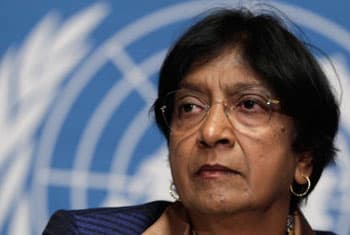



The Sri Lankan Government today categorically rejected the recent statement of the UN human rights chief regarding the impeachment of the Chief Justice, terming it as biased and claimed that it is “marred by erroneous facts”.
A statement, delivered at the OHCHR Press Briefing on January 18, criticized the impeachment and removal of the Chief Justice, saying it is a “calamitous setback” for rule of law in Sri Lanka, as well as for accountability and reconciliation.
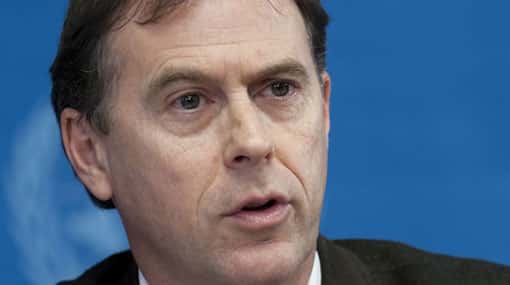
“The removal of the Chief Justice through a flawed process – which has been deemed unconstitutional by the highest courts of the land – is, in the High Commissioner’s view, gross interference in the independence of the judiciary and a calamitous setback for the rule of law in Sri Lanka,” Rupert Colville, spokesperson for High Commissioner Navi Pillay, had told reporters in Geneva.
In a scathing response to this the government charged that the statement “lacks any semblance of objectivity, steeped as it is in bias, marred by erroneous facts and further compounded by the inappropriate tenor of its language, all of which are indicative of unequal and invidious treatment of Sri Lanka.”
The government charged that Navi Pillay was “resorting to unwarranted comments with a series of innuendos on an issue which is entirely a domestic matter for Sri Lanka.”
With regard to the impeachment of the former Chief Justice, the government stated that it has followed the due procedure that is set out in the Constitution of Sri Lanka.
This procedure is indeed in conformity with principles which govern disciplinary proceedings against judges contained in the Basic Principles on the Independence of the Judiciary endorsed by the UNGA in 1985, it said.
“The content of your statement sadly demonstrates that neither you nor your office has the understanding of the provisions of Sri Lanka’s Constitution, and the related procedures for the removal of judges of the superior courts,” reads the letter addressed to the United Nations High Commissioner for Human Rights.
It further said that Pillay’s assertion that “Sri Lanka has a long history of abuse of executive power” is offensive to this nation, and is clearly beyond her mandate. “In this regard, you have transgressed the basic norms which should be observed by a discerning international civil servant, by bringing into question the constitutional governance of a sovereign State.”
In response to the concerns raised regarding the “independence and impartiality” of the new Chief Justice Mohan Peiris, the government stated that this is reflective of the complete bias and negative mindset manifested and nurtured by “parties inimical to Sri Lanka and with vested interests.”
“By such an allegation, you have sought inexcusably to undermine the Office of Chief Justice,” the strongly worded letter added.
It further said that the position articulated by Navi Pillay is a “prejudgement” on her part, which it claims has been a “sustained practice” adopted by her, in relation to Sri Lanka.
“Regrettably, this cavalier statement brings into question the standards of impartiality and equality expected of the UN System,” the government accused.
It said that Sri Lanka has engaged with the UN System consistently and transparently, and therefore expects reciprocity from the Office of the High Commissioner for Human Rights.
“A statement of this palpably biased nature could hurt the engagement between Sri Lanka and the UN System.”