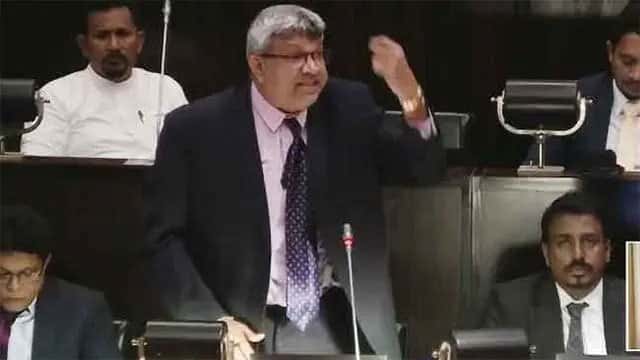




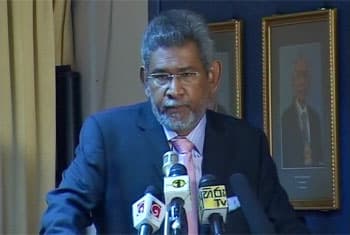



The “Cold War” being waged on Sri Lanka by its “external enemies,” using the gap between Colombo and other states, can only be resolved by fulfilling the bargain struck between Sri Lanka and India in 1987, says Dr. Dayan Jayatilleka.
Colombo’s former Ambassador and Permanent Representative to the UN Office in Geneva stated that Sri Lanka has no enemies in the inter-state system or in the domestic sphere, but it does have enemies.
“As far as states, governments go Sri Lanka does not have enemies. We do have differences of opinion, in the form of a resolution we obviously have a clash of perceptions, national interests,” he said.
But that does not mean that those who are bringing the resolution should be seen as the enemies of Sri Lanka, the senior diplomat said, addressing a forum on issues pertaining to Sri Lanka and International Relations.
Dr. Jayatilleka also said he does not believe Sri Lanka has -after the defeat of the Tigers- any enemies within its borders.
But the enemies Sri Lanka does have are the pro secessionist politically fundamentalist or militant elements within Tamil Nadu and within the Tamil Diaspora.
He clarified that he was not referring to the whole of Tamil Nadu or whole of Tamil Diaspora but the “very visible networks that stand for the breakup of Sri Lanka”.
He stated that the fundamental difference between those who have moved a resolution against Sri Lanka and the enemies of Sri Lanka is that the former – for good or bad reasons- do not question the basic legitimacy of the military victory achieved by Sri Lanka and the reunification of the Sri Lankan state.
“None of those states are uncritical of the LTTE. None of them are sympathetic or supportive of the LTTE,” he said.
Dr. Dayan Jayatilleka further said he does not believe the government propaganda that all criticisms of Sri Lanka are the work of, “what it inelegantly calls- the LTTE rump”.
He stated that if the rump faction of the LTT is capable of getting Congressman Eliot Engel to write to US Secretary of State John Kerry and also get politicians in Malaysia to protest against Sri Lanka, “that is one pretty large rump”.
The LTTE network internationally is one of the components of the coalition of enemies of Sri Lanka, but it is not necessarily the driving force at the present moment, he pointed out.
“What this means is there is a Cold War being waged against Sri Lanka by the external enemies of Sri Lanka and the strategy of Sri Lanka’s enemies is to use the gap between Sri Lank as a state and the other states in the global interstate system,” said Dr. Jayatilleka, addressing the gathering .
He stated that the enemies of Sri Lanka are now using and operating in the gap between Colombo and Delhi and that the gap “seems to be widening”.
He conceded that a crisis exists in Sri Lanka’s external relations and the “barometer” of that crisis is the vote in Geneva.
The extremists in Tamil Nadu can only be dealt with by the use of the well-known doctrine of the balance of power, which means helping the moderates in Tamil Nadu balance off the extremists and helping Delhi balance off Chennai, he said.
“The only way to do this is to stick to the grand bargain that was struck between Sri Lanka and India in 1987 when these factors were in play. That grand bargain turned Delhi against Tamil militancy and at the heart of it was provincial level devolution as codified in the 13th Amendment to the Constitution.”
“It is an inescapable part of any successful attempt to balance off the moderates in Tamil Nadu with the extremists,” Dr. Jayatilleka stressed.
He stated that Sri Lanka has no realistic option but to manage the relationship with India “and that means managing our relationship with Sri Lanka’s Tamil community”.
On claims by certain sections that the Tamil isssue is entirely an internal problem, he said, “it stopped being a purely internal problem in the 1980s.”