


Latest
Sri Lanka asks Pillay to not give credence to unsubstantiated allegations
Sep 09, 201310:47 PM

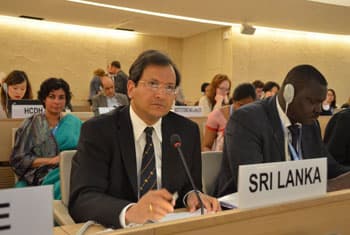



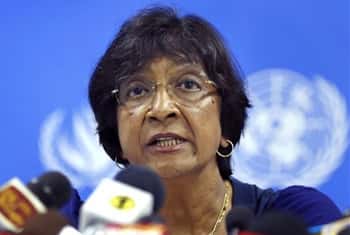
Sri Lanka on Monday asked the UN Human Rights Chief Navanethem Pillay to not give credence to unsubstantiated allegations of those with vested interests and agendas, following her recent visit to the island nation.
“Since the High Commissioner was able to ascertain first-hand the multi-faceted progress in the reconciliation process in Sri Lanka, we believe she is now better placed not to give credence to unsubstantiated allegations of those with vested interests and agendas, largely driven by certain extreme elements in the Sri Lankan Diaspora,” Sri Lanka’s Ambassador to the UN in Geneva and Leader of the Sri Lanka Delegation, Ravinatha Aryasinha said.
“In this context, we look forward to an objective and unbiased approach to Sri Lanka by the High Commissioner in fulfilment of her mandate,” he said, delivering the national statement at the 24th session of the UN Human Rights Council (HRC) in Geneva which opened on Monday (Sep 9)
Responding to the High Commissioner’s ‘immediate concern’ for the protection of human rights defenders, journalists and communities she met in Sri Lanka, Ambassador Aryasinha said Sri Lanka has a vibrant civil society, a fact that was amply demonstrated through the wide range of meetings and events that were arranged independently by the UN team in Colombo with civil society groups and persons of all ethnic and religious denominations for her during her recent visit.
He stated that the Government of Sri Lanka is fully committed to protecting human rights defenders, and in this regard had requested the High Commissioner and her office to provide specific information of such incidents, if any.
However, he said, the Government does not wish to add credence to unsubstantiated allegations that are made for political purposes by certain groups with vested interests, who have also done so previously to embarrass the Government, which is in contravention of GA resolution 60/251.
Apraising the Human Rights Council of progress with regard to the reconciliation process in Sri Lanka since its last session in June 2013, Ambassador Aryasinha highlighted that in July the Government accepted an additional 53 recommendations of the LLRC to be implemented, while in August the inquiry into the case of the killing of 5 students in Trincomalee commenced, a three-member Commission was appointed to Investigate Missing Persons related to the conflict, and the Police was placed within a newly created Ministry of Law and Order.
After a lapse of 23 years, train services to Killinochchi will resume shortly further consolidating connection between Colombo and the northern Vanni heartland, and for the first time since the introduction of the Provincial Council system in 1987 elections to the Northern Provincial Council will be held on 21 September.
Further a visit by the Special Rapporteur on IDPs has been scheduled for December, the Special Rapporteur on Education has been invited to visit in January 2014, and Sri Lanka will continue to process requests for visits by other special procedures mandate holders. The Ambassador said, these steps, once again prove those who doubted the will of the Government wrong.
Following is the Full Statement:
Statement by Sri Lanka at Human Rights Council 24th Regular Session, by deranapics