







The Prime Minister of Singapore, Lee Hsien Loong on Sunday agreed that more time is required to “heal wounds” after a prolonged war and has assured that they would not “take sides” over the Sri Lanka’s human rights issue.
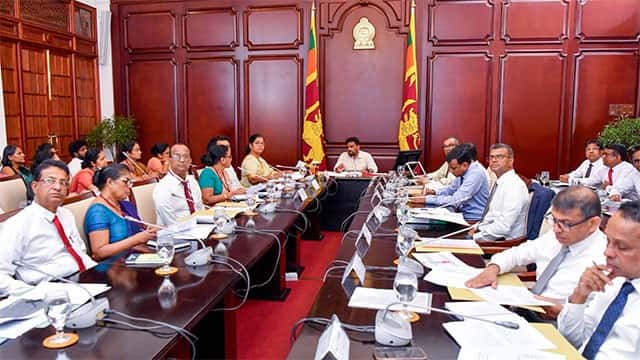
The Prime Minister of Singapore, who is in Colombo to attend the current Commonwealth Heads of Government Meeting (CHOGM) 2013, called on President Mahinda Rajapaksa at Water’s Edge this afternoon.
President Rajapaksa briefing the visiting Prime Minister on the country’s present situation said, “We suffered for nearly 30 years from terrorism. There were killings and destruction almost every day in some part of the country during that dark period. Now peace has returned and Sri Lanka is on the path to development.”
The President said that since the end of the conflict a great deal of progress has been made in areas of resettlement, rehabilitation, reconstruction and reconciliation, the President’s Media Unit said.
Although the people are happy with what has been done, politicians with their own agendas do not, the President observed. A Parliamentary Special Committee has been established to reach consensus on political issues, he added.
Singapore Prime Minister Loong agreed that complex issues remain for long after a prolonged war ended and more time is needed to heal wounds.
“We are observers and don’t take sides, “ said Prime Minister Loong.
Commending the Sri Lankan President for the “spectacular” inauguration ceremony of the CHOGM 2013 said, he said “Your speech at the inauguration was rich with new ideas”.
The Singapore Prime Minister had said yesterday that countries cannot force reconciliation on Sri Lanka, nor is it their business to intervene in another country’s affairs.
Mr Lee noted that Singapore’s view is to encourage reconciliation -- and to do so by engaging Sri Lanka.
Speaking to Singapore media in Colombo Mr Lee said: “But really, you cannot impose reconciliation from the outside, nor is it our business to intervene in other countries affairs. Just as if we had a problem in Singapore of some sort, either religious problem or racial problem, and somebody else outside says ‘let me come and help you, one group or the other’, I think we will have a problem.
“Because we will consider this our domestic, internal, national affair, and not something that outsiders should get involved with, however good the intention.”
He acknowledged that there are familial ties between the Tamil population in Singapore and in Sri Lanka, but as a country, Singapore has to take a position.
Mr Lee said: “It’s a complicated world, there are family ties. We have family ties in the region, some even further. There are some family ties even between Singapore and Jaffna. There is a Jaffna Tamil community in Singapore. Some more recent -- some living here for several generations. The connections are there.
“On an individual and personal level, we may have emotional connections and concerns. As a nation, as a country, to take a position, we have to take the correct position. That we are Singapore, they are Sri Lanka. We mean them well, we help. But it is not possible, nor proper for us to go and interfere in other people’s national affairs.
“Whatever the views on Sri Lanka, it’s clear that the end of the civil war four years ago has changed the country. There are new highways, new buildings -- a lot of the new infrastructure here is donated by countries like India and China, two of the largest development aid giver to Sri Lanka.”
- With excerpts from CNA