



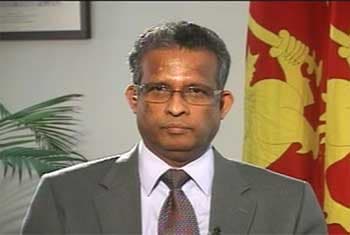



We understood the political compulsions behind the Indian Prime Minister, Manmohan Singh, not attending the Commonwealth Heads of Government Meeting (CHOGM), Sri Lankan High Commissioner to India, Prasad Kariyawasam told Indian Media.
In an interview with the Economic Times, Kariyawasam stated that many Sri Lankans were disappointed that the Indian PM could not make it to the summit and claimed that in his opinion the region would have benefited from the PM’s presence.
Answering a question on whether ties between Sri Lanka and Pakistan/China would deepen as a result of the PM’s absence, the High Commissioner said that the government has no intention of harming the interests of any friend of Sri Lanka when dealing with other friends.
He also said that there was no need for an international inquiry into war crimes in Sri Lanka as there is a fully capable justice system in place while adding that retributive justice was being paraded under the guise of accountability.
FULL INTERVIEW WITH THE ECONOMIC TIMES OF INDIA.
Are you happy with level of India’s participation at CHOGM?
Commonwealth Summit was held in Asia after 24 years, therefore, highest-level participation from India was expected. Many in Sri Lanka were disappointed that the prime minister could not make to the CHOGM. But, our political leadership understood the political compulsions before the PM. To my mind our region would have benefited from Indian PM’s presence in Colombo as top leaders from leading Commonwealth nations were present.
Will Colombo’s ties with China and Pakistan deepen in the backdrop of PM’s decision to skip CHOGM?
Our relationship with India and our relations with China and Pakistan cannot be viewed as ‘zero-sum game’. Indo-Lankan ties go back to the days of Emperor Ashoka. With regard to our friends-China and Pakistan-they are assisting us economically, particularly China.
But we have no intentions to harm interests of any of our friends including India, when we deal with other friends. We are very keen for regional stability in the Indian Ocean Region but pained to note resolution in the Tamil Nadu Assembly. Now that democracy has returned to the Northern Provinces in Sri Lanka following the elections, we want support from all our friends in India.
What is Lanka doing to empower Tamils?
The 13th Amendment to the Sri Lankan Constitution was a result of the Indo-Lankan Accord in 1987. There is an effort by the Lankan government to improve on it. The government has assigned the task to the Parliament. For the first time in three decades we have a Chief Minister for the Northern Province who represents the Tamil National Alliance.
One must understand that we don’t have same model of Indian federalism in Sri Lanka. We have a power sharing model at the periphery and the Centre. This is the best model for Sri Lanka and the 13th Amendment is the basis for that.
What is Colombo’s view on demands of international enquiry for the war crimes in Sri Lanka?
We do not feel that there is a need for international enquiry into the situation in Sri Lanka. We had established a reconciliation commission and its recommendations are being implemented step by step. In the post conflict situation we have to find sustainable method. We think our justice system is fully capable of addressing the issues. We feel that the demand for retributive justice in the garb of accountability can only delay the process of reconciliation.
What are the next initiatives in the India-Lanka relations?
We want India to be deeply involved in rehabilitation and reconstruction efforts in Sri Lanka. While India’s efforts have largely focused on reconstruction efforts in Northern and Eastern parts of Sri Lanka, we wish that India would expand its presence in the other parts of the country.