




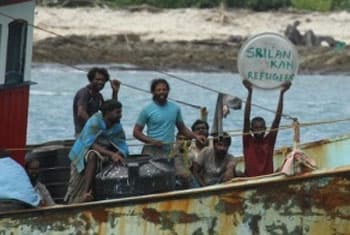



The flow of boatpeople from Sri Lanka and Iran to Australia has reversed for the first time in three years, with more being sent back than arrive.
The net decline in asylum-seekers from two of the biggest source countries in the past three years coincides with the lowest November total for asylum-seeker arrivals since Kevin Rudd repealed the Howard government border-protection laws.
Last month, there were 207 arrivals and 66 people were sent back, including more than 40 Iranians. All Sri Lankans who arrived illegally since mid-September have been sent back or volunteered to return to Sri Lanka.
This month is expected to see more people who have arrived illegally from the two countries sent back than those still arriving on boats.
This will mark the tipping point in attempts to stem the flow of illegal boat arrivals and deal with the backlog of 33,000 asylum-seekers in Australia.
It appears the decline in illegal boat arrivals, particularly among Iranians, is a result of combined actions by the Indonesian government, the second Rudd Labor government and the Abbott government.
Tony Abbott and Immigration Minister Scott Morrison have both this week cited a reduction in the number of boat arrivals under the Coalition’s Operation Sovereign Borders since September 18 of between 80 and 90 per cent, compared with the last months of the Labor government. The 86 per cent reduction is based on the 5463 illegal arrivals in the last 72 days of the Labor government and the 751 illegal arrivals in the first 72 days of the Abbott government.
The decline in illegal arrivals from a peak under Labor began after July when the Rudd government reopened the Howard government’s arrangement with PNG on Manus Island for offshore processing and regional resettlement.
In July there was an average of 10 illegal boat arrivals a week, carrying an average of almost 1000 people.
In mid-July, just before calling the election, Kevin Rudd announced the regional resettlement program and Indonesia did away with visa-free arrivals for Iranians, who had previously been able to come to Indonesia without a visa and board boats bound for Australia.
In August the average dropped to six boats a week and the average number of people arriving illegally dropped to about 400 a week.
During the uncertainty of the election campaign in August and September, there was a spike in boat arrivals, but since the election the average has dropped to two boats a week carrying an average 78 people.
In the last week of November, despite tensions between Australia and Indonesia over spying allegations, there was only one illegal boat arrival with nine passengers. During the peak week in July, 12 boats arrived with a total of 1036 people on board.
While campaigning for the restoration of temporary protection visas, Mr Morrison conceded in parliament that some of Labor’s policies before the election were starting “to head in the right direction”.
“Before the last election the previous government had to be dragged kicking and screaming to put offshore processing back in place,” Mr Morrison said.
“They previously said it had no role in stopping the boats under the Howard government. But they were forced, as the political winds blew hard against them, not out of conviction but out of political fear, to reintroduce offshore processing.
“At the last election, the people of Australia made a judgment. They said that they did not trust the Labor Party with border-protection policies, even if some of those border-protection policies were starting to head in the right direction,” The Australian reports.