






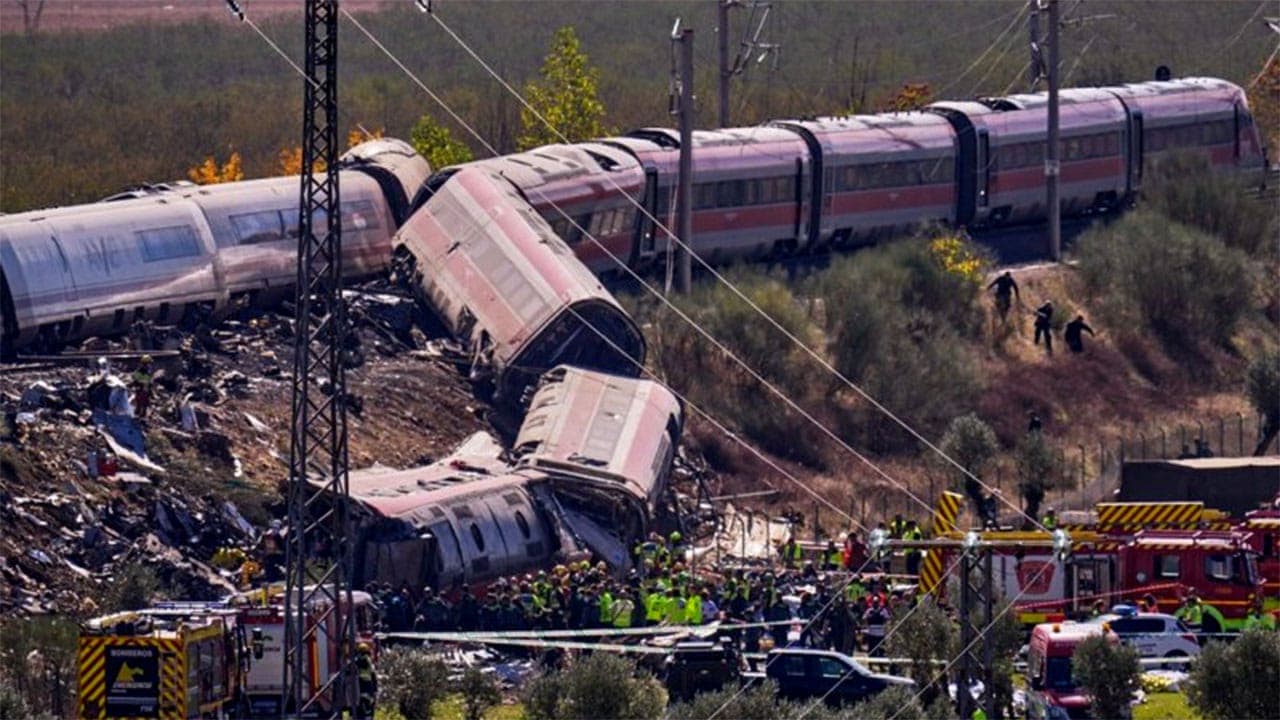


The death toll from Spain’s high-speed rail disaster rose to 69 on Thursday as questions mounted over why safety systems failed to prevent a train from slamming into another that was stopped ahead.
Emiliano Garcia-Page, president of Castile-La Mancha, announced the latest death following Wednesday’s collision near Urda in Toledo province.
Of 110 people hospitalized, 60 had been discharged and 50 remained under treatment, he said. The four most seriously injured among 15 critical patients were improving, offering grounds for cautious optimism, he added.
Crews were removing wreckage and identifying victims after recovering additional human remains overnight. Garcia-Page said authorities did not expect to find more bodies beneath the carriages.
Prime Minister Pedro Sanchez pledged to establish what happened and prevent another disaster.
“The entire central government is working day and night to respond to victims’ families, clarify every last detail of this tragedy and strengthen safety so this does not happen again,” he said at a joint news conference with Garcia-Page.
Safety failures under scrutiny
Transport Minister Oscar Puente said Wednesday that a technical failure of the LZB automatic train protection system stopped at least six trains before controllers authorized a Renfe train to resume normal speed, meaning up to 200 kilometers (124 miles) per hour.
Puente called that decision “inexplicable,” given that an Iryo train remained stationary ahead. The controller has reportedly been questioned by Spanish police.
Recordings broadcast by Spanish media captured the authorization to resume normal running. The Iryo driver also reported being unable to move about five minutes before the impact, according to the recordings.
The disaster has renewed scrutiny of safeguards when automatic protection fails.
Spain’s rail accident investigation commission warned after a 2024 incident in Cuenca that the only effective barrier against a potential collision had been a controller’s visual check that the track section was clear – something which appears to have been the case again in Wednesday’s tragedy.
That safeguard depended entirely on human judgment and could fail, the commission said, recommending technical protections, according to a report cited by Cadena SER.
Experts also questioned both infrastructure upkeep and operational decisions. Spain spent €95,860 ($106,812) per kilometer on rail maintenance in 2022, roughly half the EU average, according to European Commission figures cited by El Pais.
Meanwhile, high-speed passenger numbers reached 44.5 million last year, double the 2019 total, the newspaper reported.
Engineer Jordi Vinolas Prat told El Pais that the system itself “worked perfectly” by stopping the trains, but the crucial question was related to internal protocol and how this type of mistake was allowed to happen.
The crash comes amid campaigning for Spain’s national elections and follows January’s high-speed collision in Adamuz, which killed 46 people.
Sanchez said Wednesday that two high-speed rail disasters in one year were “unacceptable.”
Opposition leader Alberto Nunez Feijoo demanded a “complete and independent review” of the rail network and answers about warnings received over the past year. The left-wing Frente Amplio also called for an independent audit and for the transport minister to testify in the Spanish parliament.
The far-right Vox party was the only party to have continued campaigning Wednesday, with its leader Santiago Abascal blaming the disaster on Sanchez’s “corruption and ideological fanaticism.”
Source: Anadolu Ajansı
-Agencies