





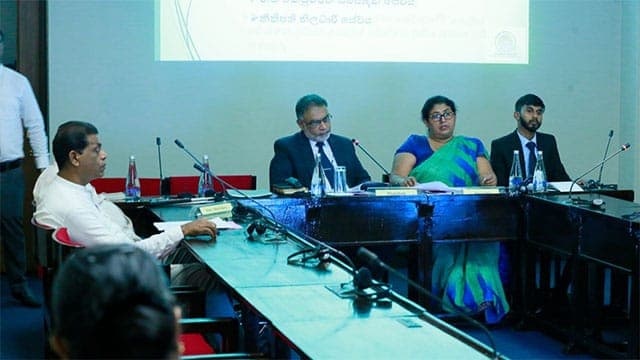


Salary anomalies arising when teachers are appointed to the Sri Lanka Principals’ Service have been discussed at length at a subcommittee appointed by the Sectoral Oversight Committee on Education, Manpower and Human Capital.
The matters were discussed when the subcommittee met under the chairmanship of Member of Parliament Sunil Rajapaksa.
Representatives of trade unions of the Sri Lanka Principals’ Service and officials representing the Ministry of Education, Higher Education and Vocational Education and the Ministry of Finance, Planning and Economic Development participated in the meeting.
Trade union representatives pointed out that one of the main reasons for these salary anomalies was the fact that the transition from the Teachers’ Service to the Principals’ Service was treated as a “new appointment” rather than a promotion.
They further noted that the situation was exacerbated by the significant difference in salary increments when teachers in Grade I of the Teachers’ Service are appointed to Grade III of the Principals’ Service.
They also pointed out that although an adjustment allowance had been granted to compensate for the salary difference arising from the appointment to the Principals’ Service, a further salary disparity emerges over time. This is because officers do not receive the higher salary increments, they would have been entitled to had they remained in the Teachers’ Service.
It was further emphasized that this situation has discouraged senior and experienced teachers serving in Grades I and II-I of the Teachers’ Service from sitting for the Principals’ Service examination and joining the Principals’ Service.
The Chairman of the Subcommittee stated that, having considered the matters presented to the Committee, steps would be taken to submit the relevant recommendations to the Salaries and Pensions Commission for Public Officers.
In addition, the Subcommittee decided to hold discussions with the Ministry of Education, Higher Education and Vocational Education, the Ministry of Finance, Planning and Economic Development, and the Director General of Establishments to address other issues faced by officers serving in the Principals’ Service.