







In mid-January, when a thick morning fog descended on some parts of Sri Lanka’s arid North Central province, the older generation was quick to take note. Local lore has it that unusually heavy fog is a harbinger of severe drought.
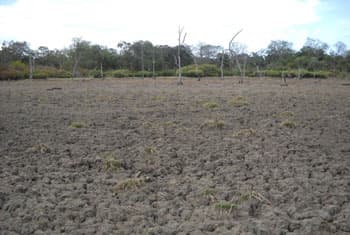
In fact, the impact of dry weather is already clear to see. The island nation has had no significant rains since mid-November and its longest river, the Mahaweli, has been reduced to a trickle in some stretches.
Experts in Sri Lanka fear that despite the increased frequency of extreme dry seasons, the country still lacks measures to ease the impact on vital sectors like agriculture, energy and water resources.
Ranjith Punyawardena, chief climatologist at the Department of Agriculture, said that this year’s main paddy rice harvest was likely to shrink by 7-10 percent due to the shortage of rainfall.
“The lack of rains from November meant that the planted extent was reduced,” Punyawardena said.
The loss could be around 280,000 tonnes, he estimates, pushing the year’s yield below 4 million tonnes.
But the shocks are unlikely to be limited to the main harvest. The secondary harvest, due mid-year, depends on residual irrigation from the main harvesting season, but Punyawardena said that the lack of rains means there is less water left over this season.
“The water situation is very critical right now,” he said.
Ranbanda Punchihewa, a farmer from Anuradhapura district in North Central Province, has limited his planting to about half his usual one-acre (0.4-hectare) extent as a result of the drought.
“I did not want to take the risk of losing my full crop. I decided to plant half and make sure that I was able to save it,” he said.
With warnings that the warming El Nino weather system may make a comeback later this year, the impact of the dry weather is likely to be felt across Sri Lanka’s farms.
Ranga Pallawala, head of the Energy and Urban Programme at Practical Action, a non-governmental organisation that works on climate-related issues, said that last year, for the first time in a decade, there were reports that coconut trees had died due to severe dry weather.
“There is increased intensity of the dry and wet weather experienced right now,” he said. “There are periods of very dry weather and then heavy rains.”
The country’s vital tea sector, which according to Pallawala provides income for almost 10 percent of the country’s population of a little over 20 million, is also facing a heat-related threat.
Tea exports are estimated to have reaped $1.5 billion in export revenues in 2013, but rising temperatures are likely to have a negative impact on the quality of the crop, Pallawala said, as heat affects the leaves.
LESS HYDROPOWER
The island’s power generators will also see costs rise if the rains fail. In normal years around 40 percent of Sri Lanka’s power demand is met through hydropower generation. If the rains are good, this share can even rise to more than 50 percent.
But in years of poor rainfall the country is forced to rely heavily on expensive thermal power generation, as it was in 2012. That year, half of Sri Lanka’s $4.2 billion oil import bill was for furnace oil for the generators.
Last year finance secretary Punchi Banda Jayasundera admitted that the country’sx balance of payments was adversely impacted by the high cost of importing oil.
Asoka Abeygunawardana, executive director of the Sri Lanka Energy Forum and an advisor to the country’s technology ministry, said that Sri Lanka’s long-term energy plans rely on hydropower generation for at least 30 percent of the country’s power needs. He believes Sri Lanka must look at renewable energy and alternative energy sources to shake its dependency on oil and on rainfall.
Agriculture department official Punyawardena said that if Sri Lanka was to meet the challenges posed by extended warm weather conditions, it also must change its attitude to water usage.
“Water today is an expensive luxury good. It should be treated like one,” he said, adding that farmers needed to consider adopting climate-resistant crop varieties instead of depending on the current varieties.
BUILDING AWARENESS
While research is being conducted on the impact of climate change, he added, the same kind of intensity is lacking in building public awareness.
“We train farmers on fertilizer use, likewise we need to train them on using water effectively,” he said.
Pallawala, of Practical Action, said that newer and innovative technologies need to be used, such as drip irrigation in coconut plantations and beginning irritation in tea plantations. “There is some irrigation now being used in a small scale in the coconut sector,” he said.
But the climate expert observed that building mass awareness on the impacts of changing climate patterns must involve those at the top as well as farmers.
“When government officials are given basic administrative training, a component on changing climate and impact is now imperative. But this a process and will take time to bear results,” he said.
“I think the policy initiatives are taking place, (but) what we lack is people’s knowledge on how the changing climate patterns are having an effect on their lives.”
Courtesy: Thomson Reuters Foundation