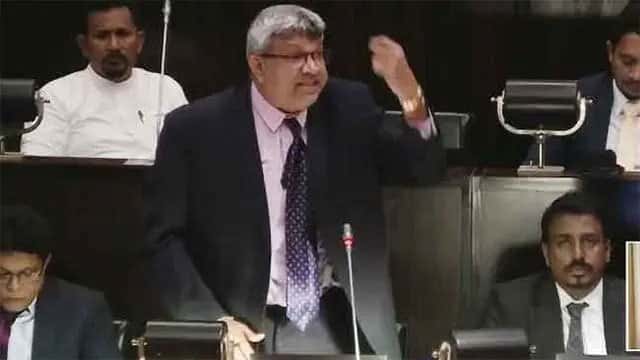








The chief minister of the Northern Province of Sri Lanka C.V. Wigneswaran says that although there is a more democratic ambience perceivable in the country, the expectations of the people of the North are hardly being fulfilled in earnest.
“Not only in the North, but elsewhere too there is a more democratic ambience perceivable. But the expectations of the people of the Northern Province are hardly being fulfilled in earnest though His Excellency, Mr. Sirisena, and his government profess to do so,” he said in an interview with The Wire.
He stated that the return of lands occupied by the army has been happening “very slowly.”
Proper resettlement has not been undertaken even with regard to the lands that have been returned, he charged. “With the army in the vicinity people cannot get the benefits of even the lands so far returned.” -Agencies
A transcript of the interview published on The Wire has been reproduced below:
Since Maithripala Sirisena became president in January 2015, what has changed for people residing in the Northern Province?
Not only in the North, but elsewhere too there is a more democratic ambience perceivable. But the expectations of the people of the Northern Province are hardly being fulfilled in earnest though His Excellency, Mr. Sirisena, and his government profess to do so. The return of lands occupied by the army has been happening very slowly. Proper resettlement has not been undertaken even with regard to the lands that have been returned. With the army in the vicinity people cannot get the benefits of even the lands so far returned.
The hegemonic attitude of the central government still continues. No discussions take place with the provincial administration when projects are formulated for the North. Often projects have a political agenda favourable to the centre. Deciding for them in other provinces may be overlooked by the respective provincial administrations there. Not so with the Northern and Eastern Provinces. We are different. We have a different party. We speak a different language. We have a different culture. Hence the centre should not ride roughshod over us. It is we who asked for devolution and asymmetrical power-sharing at the time of the Indo-Sri Lanka Agreement in 1987, but the Sri Lankan government enacted the provincial council system throughout the island. As a result, our rights and aspirations and concerns were lost sight of.
What are the effects of militarisation in the North?
The daily lives of our people have been affected negatively and adversely since the end of the war, with the continued presence of the military. The military cultivates acres and acres of private lands of our people and sells the produce in the market. No compensation is paid to the owners. Owners are in makeshift Internally Displaced Person (IDP) camps. These camps are not provided for adequately [by the government]. The Northern Provincial Council (NPC) for some time paid for them using public donations.
Businesses are run by the army. Inter alia, they are running hotels and tourist resorts. Fishing is allowed for illegal immigrants from the south by the military, but the local fishermen are not allowed to fish in their own traditional fishing areas. Resources from the province are whisked away outside the province with the active help of the military. The NPC has very little control. Still lands are being acquired by the military for their use. The safety of our women, especially the war widows and female heads of families, is in danger. Buddhist statues and temples are being constructed without permission being obtained from the local authorities; this is happening with the help of the military in areas where no Buddhists live. The army interferes in civil matters. Schools, public buildings, playgrounds, et cetera are still kept in military custody and not handed over to the people to run their own affairs.
What could the coalition government do in the next three to six months to convince you that it’s serious about transitional justice and a lasting political solution to the ethnic conflict?
How could they do anything when they are not serious about either of these matters? They are desperate now because the Geneva dates – pertaining to the 34th session of the UN Human Rights Council (UNHRC) – are drawing nigh. Nothing has been done to conform to the requests of the UN High Commissioner for Human Rights. The will to solve the problems of the Tamils is lacking. The bogey of Rajapaksa coming back is being put forward as the reason for the government not being serious. If they are serious let them grant what we have asked as the NPC’s solution to the National Question – a federal constitution recognising the identity and individuality of both the Tamils and the Muslims of the North and East. Let them conform to what the UN High Commissioner for Human Rights has asked of them and implement the consensus UNHRC resolution with foreign inputs. Let them ensure accountability.
In terms of crafting a political solution, what do you think will happen? Is a federal system of devolution on the table?
A federal system is the only way out. The details can be worked out. But the fact that the Tamils, with over 2,000 years of continued history, [are] occupying definite areas of residence in the North and East needs to be accepted. If the government has any reservations with regard to this fact they should get proper advice from historians of international repute. Lots of wrong perceptions among the Sinhalese will vanish if such advice is obtained. On our part we are quite certain about our antiquity, identity and individuality. And we wish to preserve them.
You are a co-chair of the recently created Tamil People’s Council (TPC). Would you tell us a little bit about the TPC?
It is a civil society organisation consisting of members from the intelligentsia in the North and East. They are also persons who have their ears to the ground. They project the aspirations of the people. I am like a non-working director of a company. Though a co-chairman, I am brought in only for selected meetings. After four months, I was called yesterday to address them. I take no part in their day-to-day deliberations.
What is the relationship between the TPC and the TNA?
The TNA thought the TPC was mooted as an alternative political organisation, and as a result there was so much agitation and angry words were bandied about. But now it has been realised that it is an auxiliary organisation uninterested in electoral politics. The relationship between the leader of the Ilankai Tamil Arasu Kadchi, Mavai Senathirajah, and the TPC is very cordial.
There were reports earlier this year that you were contemplating leaving the TNA to form a new political party. Is that true? If yes, what would be your principal reasons for leaving the alliance?
Why on earth would I want to leave the TNA? These diabolical falsehoods may have been the creation of persons who had certain hidden agendas. I am quite comfortable being in the TNA.
What can the international community do to help the Tamil community?
Plenty. Firstly, the international community can cajole the government to conform to the accountability process initiated by the UNHRC. Secondly, it can educate the government and explain that federalism has only kept a country intact and without compromising its territorial integrity, and never divided. It can explain how Quebec preferred to stay as part of Canada rather than secede. So too is the case with Scotland and the UK. Thirdly, the international community can ensure adequate funds are collected to help the war-affected Tamil people through our provincial council with strict budgetary controls. I am aware that sometimes out of every 100 [Sri Lankan] rupees collected only 20-25 rupees goes to the benefit of the people. The balance is utilised for ‘administrative’ costs.
In terms of negotiating a political solution, what role – if any – would you like to see India play?
Quite a robust role. Do not forget that India represented us [the Tamil cause] at the Indo-Sri Lanka Accord of 1987, which brought in the 13th amendment to Sri Lanka’s constitution. India must find out our needs, priorities and aspirations and educate the Sinhala polity to solve the national problem once and for all. It is useless standing on the side and watching developments.
Source: The Wire