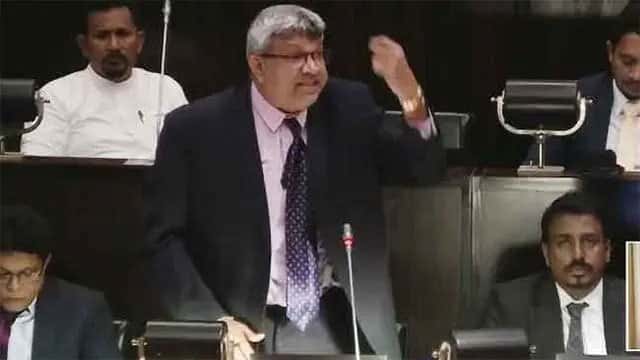




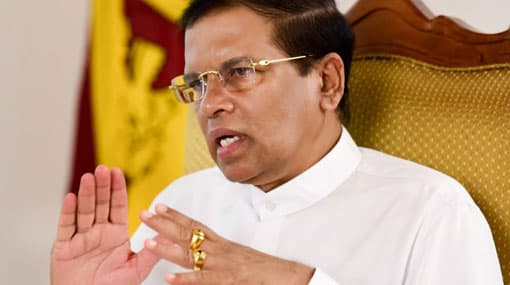



Emphasising his commitment to resolving Sri Lanka’s Tamil question, President Maithripala Sirisena has said he has an obligation to address the concerns of the island’s Tamils, most of whom had voted for him.
About 90 per cent of the people in Sri Lanka’s Tamil-dominated north voted for him in the January 2015 elections, he said. “They have confidence in me that I will solve their problems. So it is not only my responsibility, but also my obligation to solve their problems,” he told The Hindu in an exclusive interview on Wednesday at the Presidential Secretariat in Colombo.
Amid growing concern over the apparently slow-paced reconciliation efforts, President Sirisena said: “Reconciliation is not something that can be done in a few days.”
The government’s endeavour must be acceptable to the Sinhalese, Tamils, Muslims and other communities. “That is not an easy task,” he observed.
Asked about accountability for alleged war crimes, which many Tamils believe is integral to reconciliation, President Sirisena ruled out participation of international judges in any probe, as suggested in the UNHRC resolution co-sponsored by Sri Lanka. However, he added: “We can obtain advice from foreign judicial experts.”
He dismissed the view that as leader of the Sri Lanka Freedom Party, running a consensus government with the United National Party, he was facing pressure from the faction led by Mahinda Rajapaksa. “There is no pressure or influence within the party that I cannot withstand.”
Speaking to The Hindu in Colombo, President Sirisena discusses the progress made so far, the problems that linger, and his political vision for Sri Lanka.
Excerpts from the interview:
Q. In November 2014, you left the ruling party to join the common opposition. At that time, you spoke of grave personal risks associated with the defection that proved historic, leading to a regime change in Sri Lanka. When you look back now, how does it feel? What do you consider your biggest success as President?
A. Now 22 months have passed since I became the President. I am satisfied with my performance during this time. There are reasons for that. Firstly, I succeeded in getting the 19th Amendment to the Constitution (that clips powers of the executive President and strengthens the independence of oversight bodies) passed in parliament. We actually proposed that the executive powers of the President be reduced immediately. The Supreme Court said major clauses cannot be deleted without a referendum. Furthermore, the Supreme Court told us what could be done with two-thirds majority in parliament. So we have changed clauses to the maximum extent possible with two-thirds majority in parliament.
Establishment of independent commissions is another reason. It was essential for the country to ensure [protection of] human rights, democratic rights, fundamental rights and the freedom of the people. I have ensured that people get these rights, I have succeeded in doing that as President. I have given the maximum possible media freedom.
The international community is so satisfied with my performance that they have completely changed their impression of the country. I have told the international community that I cannot accept any proposal that allows foreign judges to probe our domestic matters. This is another great victory I was able to achieve in this time.
The former President Mahinda Rajapaksa called snap polls even though he had two more years in power left. There are two reasons for that.
There were two problems he could not solve as President. One was the UNHRC (United Nations Human Rights Council) proposals against our country. The second was that the country was heavily indebted at that time. We had a national debt of 9,000 billion [Sri Lankan] rupees. That was a major economic crisis for our country.
I am now dealing with the UNHRC proposals while protecting the respect and dignity of my country. In order to solve this major economic crisis, we have been formulating a new economic plan. I believe in a mixed economy. One is the increase of foreign and local investments. My second step is to strengthen the export production market and increase our exports.
The new programme for national reconciliation is being implemented. It is a major initiative for reconciliation among Sinhala, Tamil, Muslim, Malay, Burgher and other communities to ensure coexistence and harmony.
With all these successful efforts I am quite satisfied with my performance.
Those who have been in power and have lost power are trying to sabotage all these activities. I am confident that I can face all these challenges and make our country better. The experience I have from my 50 years in politics gives me enough strength to meet all these challenges successfully.
Q. You spoke about the economy. As someone with a leftist background now in coalition with the United National Party known for its right-wing economic policies, how do you think your government can promote economic growth while safeguarding living standards and social welfare of farmers and workers?
A. We have a consensual government of the two major parties. There are similarities as well as differences in the vision and policies of these two parties. My vision is social democracy. Your question is how compatible is liberal democracy with social democracy. The two major parties have agreed on a consensual formula. We need large-scale investments. We cannot come out of the economic crisis without such investments. At the same time, enhancing social welfare and subsidies are also essential. The poor man is the one badly affected by a market economy. We have to protect the welfare and economy of the ordinary man.
Q. You have been a frequent visitor to the Tamil-majority Northern Province. How do you respond to the Tamil political leadership’s concern over the pace of reconciliation, with unresolved issues like militarisation, political prisoners and the call to repeal the Prevention of Terrorism Act (PTA)?
A. Reconciliation is not something that can be done in a few days. In the last 22 months I have been to Jaffna as President 11 times. Prior to that no leader went to the north [as often]. I feel very happy to interact — not just with the Tamil politicians in the north, but also with the people and obtain their ideas directly. A vast majority — about 90 per cent of the people — in the north voted for me. They have confidence in me that I will solve their problems. So it is not only my responsibility, but also my obligation to solve their problems.
In drafting the new Constitution, we are looking at a Constitution that will strengthen the reconciliation between the communities. These things will have to be done keeping the southern Sinhala-Buddhist masses also satisfied. If the southern people are opposed to certain things, we cannot have a successful reconciliation process. Hence our endeavour towards reconciliation must also be acceptable to the Sinhalese, Tamils, Muslims and other communities. That is not an easy task. But we have to do this challenging job.
Q. Can reconciliation proceed without accountability? How will you convince the Tamils, who have little confidence in domestic judicial mechanisms, that an internal probe will be fair?
A. When we came to power, our judiciary was very weak. One of the reasons we appointed a Chief Justice from the minority community was to enhance confidence in the judicial system among the minorities.
We have improved the quality of the judiciary and its independence and impartial nature. We can obtain advice from foreign judicial experts. As per our constitutional provisions, there is no possibility of foreign judges participating in our judicial process or conducting cases. I don’t have any mandate to act against constitutional provisions. We have to create a judicial mechanism that has the fullest confidence of the people in the north.
Q. In the context of the ongoing constitutional reform, there is a call from the Tamils for federalism. Do you think the new Constitution can meet that aspiration? Some political actors in the south want a unitary Constitution, while constitutional experts seem to suggest that a compromise might be not terming the Constitution either unitary or federal.
A. People of the south are scared of the word ‘federal’. People of the north are scared of the word ‘unitary’. What we should do is not fight over these two words. We should come up with a formula that is acceptable to all. It takes maturity to understand devolution. We cannot satisfy the extremist elements either in the north or in the south. We have to do what is good for, and acceptable to, the majority of the people. We should not waste time over these arguments. We have to do whatever is possible as early as possible.
Q. As the leader of the SLFP, how will you hold the party together given the political pressure from the pro-Rajapaksa faction, even as you work with the UNP in Sri Lanka’s first national unity government?
A. This is the first time in history that the two parties have come together in a consensual government. We were always used to governing separately, within the political party lines. The confidence in the SLFP as a party among the people is something lasting ages. People have recognised and accepted these two major parties — SLFP and the UNP. Therefore, in these circumstances, there is no possibility of new political forces coming up. As a political party we have the ability to solve any problem.
Q. What about pressure within the SLFP?
A. There is no such pressure or influence within the party that I cannot withstand.
Q. Given the enhanced ties between India and Sri Lanka, do you think there is reason to expedite signing of the ETCA (Economic and Technological Cooperation Agreement), which has drawn considerable local resistance?
A. Since ancient times we have very close relations with India. This relationship has been built on Hindu and Buddhist philosophies. We expect to sign trade agreements with quite a number of countries. These agreements are aimed at benefitting both the signatory countries, and we don’t intend signing any agreement that could be detrimental to any one country. The proposal for India and Sri Lanka to sign a fresh [trade] agreement has been there for the last 10-15 years. Deliberations and discussions continued under different names. We will enter into an agreement which is not harmful to either party. There should not be any unnecessary apprehension or fear over this. We cannot do anything in secrecy, we are transparent and accountable to the people. We’ll discuss it in the Cabinet, and after that it will also be produced in parliament. If there are any unsuitable clauses, we will have further discussions and finalise the agreement.
Q. Work on China’s port city project has resumed under your government amid local opposition. How is your government’s policy towards China different from former President Rajapaksa’s?
A. The port city agreement, when it was signed during President Rajapaksa’s time, was contradictory to the constitutional provisions. No government in the past had signed such an agreement. We amended certain clauses of that agreement as the new government. In such an agreement, the importance of national security as well as regional security should be taken into consideration. Both China and India are our good friends.
Courtesy : The Hindu