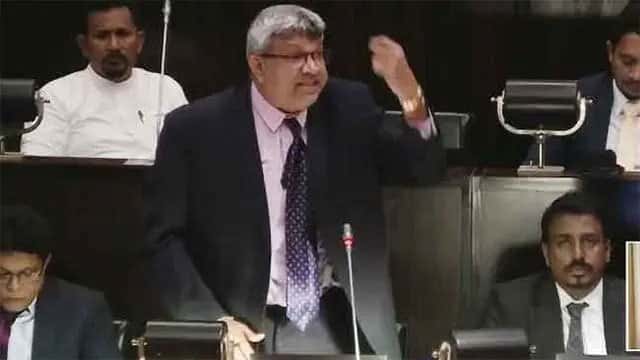








“India’s influence in Sri Lankan elections cannot be ignored. India is important in regional politics and several sectors see mutual involvement of both India and Sri Lanka. We cannot ignore India’s influence. We cannot ignore India,” says Namal Rajapaksa in an exclusive interview to TNM.
Months after his defeat to Maithripala Sirisena, former President Mahinda Rajapaksa reportedly told the Hong Kong-based South China Morning Post, “It was very open, Americans, the Norwegians, Europeans were openly working against me. And RAW (India’s Research Analysis Wing). Both the US and India openly used their embassies to bring me down.” Reuters, however, reported that the former President had claimed he was not aware of all the facts.
Namal denies that his father made this statement but paints the same allegation with a broader brush, “It is the popular belief in Sri Lanka that India and US worked against President Rajapaksa in the last elections. Majority still believe that. He (Mahinda) never mentioned that India is partly responsible. People know that India had a major role. It was the situation between the two countries at that time. I am talking about the statements and behaviour of certain diplomats in Sri Lanka.”
It was widely reported after the fall of the Rajapaksa government that a RAW official was instrumental in uniting rival political parties — the Sri Lanka Freedom Party (SLFP) and the United National Party (UNP) — against him during the polls. The official allegedly helped gather support for Sirisena. He was reportedly transferred but the Indian Government had called it ‘routine’.
When pressed further for names, the 31-year-old parliamentarian says “We saw through the media that the Indian High Commissioner and ambassador were with Sirisena and certain media said they favour them. I am not saying they are responsible. But certain behaviours and statements might have affected (the elections), is what people believe.”
Why did India interfere?
India has involved itself in the internal politics of the island nation before. The Congress Government had sent its troops to Sri Lanka in 1987 to broker peace between the government and the LTTE. This time around, however, it is reported that the ‘influence’ asserted was to counter another regional rival that has increasingly threatened the country’s stronghold in South Asia - China.
Multiple factors are said to have been responsible for India’s growing discontent with the Rajapaksa government. The first was when India was stunned in 2014 when Chinese submarines docked in Sri Lanka on two separate occasions. India saw it as part of Beijing’s ‘string of pearls’ strategy to secure a foothold in South Asia and fulfil its desire to gain increasing maritime access through the Indian Ocean.
Namal, however, refutes that the Rajapaksa government was compromising on India’s security interests.
“During our government’s tenure, my father was very clear that Sri Lankan soil will not be used against India or any other neighbour,” he claims.
But it was not just this blatant aggression that China was displaying, investments became another route for them to gain more control over Sri Lankan assets.
During his rule, Rajapaksa got $8 billion in loans from China to build a road network and infrastructure in Hambantota district and the Colombo Port City which is an offshore city built on a manmade island.
“We first offered the port and the southern highway to the Indian Government. But for three years, they did not deliver. So, what do you expect us to do as a government in power?” asks Namal. “Wait for another three years for a country to come develop it? We instead gave it to people who were ready to take on the projects. If China’s economic interests in Sri Lanka trouble India, then they should take up more projects too,” he adds defensively.
But while this challenge is logical at first glance, reports reveal that it was the presence of Rajapaksa himself that deterred other countries from agreeing to invest in Sri Lanka. He was seen as an international pariah due to the manner in which his government eradicated the threat of the Liberation Tigers of Tamil Eelam (LTTE) a terrorist organisation against whom they had fought a 25-year-long civil war for a separate homeland for the Tamil people. The civilian casualties that it caused and the government’s refusal to acknowledge the human right violations they had committed became a matter of international debate.
China and Pakistan are said to have supplied arms to Sri Lanka and provided support to fight the ethnic conflict.
And now, since the Rajapaksa’s move to accept China’s loan, the country’s presence has grown larger. “Of course, we brought them (China). We are not denying it. We are happy about it,” admits Namal. “But it is the Sirisena government that sold the port to them for 99 years. Why did they do that?” he asks.
As it turns out when the Sri Lanka Freedom Party-United National Party alliance came to power, they initially did put the deals on hold. The transaction with the Chinese were allegedly perceived as symbols of corruption and misplaced development. However, ballooning debt as a result of its predecessor’s decisions reportedly compelled it to renegotiate the Hambantota port deal by turning debt into equity and giving it on a 99-year-long lease.
Namal however doesn’t seem to take into account the debt his government caused as he alleges, “The Government is compromising on Sri Lankan interests by giving away control of the country’s resources to a Chinese company. If the Rajapaksa government comes to power we will renegotiate the port deal.”
Has Sri Lanka betrayed India?
“The government has not betrayed India or China through this port deal. They have betrayed Sri Lankans. They need to make sure Sri Lankans benefit from whatever they do be it in terms of local labour or the like. They failed to do that.”
So, will Sri Lanka go the Maldives way and end up in a debt trap with China?
In February, the exiled former Maldivian President Mohammed Nasheed had warned the world that what China offers in the guise of development is in fact debt traps. Will Sri Lanka be trapped in a position where they can’t say no to China?
“It is not a debt trap in Sri Lanka,” argues Namal. “All investors will come negotiate for their benefit. But receiving end should negotiate for our benefit. Which our government is not willing to do. Terms and conditions should benefit Sri Lankans. The Sri Lankan government will not come to a position to not say no. It is about how we handle and negotiate them,” he explains.
He further claims that China’s economic interests will not gain military colours. But China is already casting its nets to gain more control over the Indian Ocean.
Multiple reports suggest that China will be attempting to monitor Indian maritime activity in the name of academic interests.
They claim they are stepping up the academic work on the southern coast of Sri Lanka, but India sees it as a threat. As per the statement by China, it is reportedly going to set up a radar station at Ruhuna University for oceanographic studies. India believes that ship tracking is going be part of this ‘studies’.
Even Namal, who has been supporting the Chinese investment says, “Our government will not allow monitoring of Indian ships or compromise of their interests. Not sure how the current government will handle this geo politically.”
But ask about Sri Lanka’s continuing relations with Pakistan which has been constantly accused of sponsoring terror in India and Namal says, “We believe in non-alignment policy. We are being close to Pakistan in fighting terrorism. Pakistan has always been very close to Sri Lanka. We have close alliances with them.”
What happened to the Tamils?
Only a week ago, Sri Lanka lifted a state of national emergency it had imposed due to an outbreak of violence against Muslim communities. Hundreds of troops were deployed in the Kandy area and tear gas was used on groups which continued to defy government curfews.
Namal, however, is not surprised by this. “It was a problem between two groups. Politicians got involved in it. Any country can have such isolated incidents. The current government is responsible because they didn’t handle the situation properly,” he alleges.
“When you use communal tensions during elections, it will boomerang on you,” Namal adds.
It was the first time in seven years that Sri Lanka had imposed a state of emergency. They were under the measure for nearly three decades when the government fought Tamil rebels in the civil war. And Namal Rajapaksa is no stranger to the violence and blamegame that ethnic conflicts can bring with it.
“Our government has been accused of human right violation and the death of civilians. But every media report and international organisation quotes a different death toll,” argues Namal.
Leaving numbers aside, can he deny that his government was responsible for the death of thousands of civilians and innocents? Even LTTE’s deceased chief Prabhakaran’s minor son was allegedly shot at close range by the army.
“But we defeated terrorism and millions of Tamil and Sinhalese people are living peacefully,” says Namal. “Instead of Tamil youth having cyanide around their necks, they are going to school and to work. Tamils are taking care of their families and growing,” he adds.
Source: The News Minute
-Agencies