





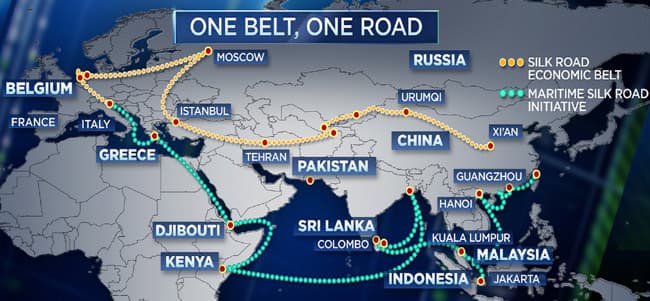



The official narrative in China and the highlighting of the country’s “core interests” in terms of fostering and promoting economic development in Europe and the Indo-Pacific region through the ambitiously conceived “Belt Road Initiative” (BRI) may not be entirely true.
According to a report prepared by the Center for Advanced Defense Studies (C4ADS), a Washington D.C.-based non-profit organisation dedicated to data-driven analysis and evidence-based reporting of global conflict and security issues, Beijing so-called dynamic infrastructure and investment-dominant BRI initiative most definitely has a strategic component to it that a wary international community is aware and concerned about.
The report says, “investments may not be principally driven by the concept of win-win development. Maritime infrastructure investment is inherently dual-use and is capable of furthering both legitimate business activities and military operations. The strategic characteristics of six analytical dimensions that are exhibited across China’s Indo-Pacific investments-having strategic location, a dual-use development model, notable Communist Party presence, significant financial control, limited transparency and unequal benefits.”
These “several marked examples of unprofitability suggest that Beijing is actively seeking to leverage the geopolitical capacity of its port projects, as discussed by Chinese analysts.
The C4ADS report is also of the view that port-linked investments by China will eventually deliver to it strategic advantages and are indicative of that country’s long acknowledged and accepted policy of centralized control of schemes that it conceives from time to time, whether at home or abroad.
The report does not hesitate to flag China’s ulterior motives through its analysis, maintaining that its BRI-related investments “are both serving China’s national security interests and altering the strategic operating environment of the United States and its allies.”
According to the report, port projects in the Indo-Pacific region fall along just a few of the BRI’s nine economic pathways, and if looked at from the economic perspective, the Chinese government and through it Chinese firms are creating new markets for the exploitation of cheap labour as costs rise at home.
It is felt that Beijing’s manufacturing facilities place significant emphasis on agricultural output, “which addresses China’s food insecurity.”
The report quotes Geoff Wade of the Australian National University as alleging that militarily, Cambodia’s three ports on Koh Kong, which receives ships from Singapore, Malaysia and Thailand, “will be large enough to potentially host China’s frigates and destroyers, though there is no concrete indication that China plans to establish a base there or use the proposed port as a place of forward deployment.”
It must be kept in mind that planned hospitals and recreational areas in this port area “could theoretically host People’s Liberation Army Navy crews on patrol in the Gulf of Thailand or on the eastern side of the Malacca Strait. Its proposed future industrial capacity could also theoretically provide logistical support to Chinese warships in line with strategies proposed by China’s analysts.”
Creating port related pilot zone, for instance in Cambodia, could potentially allow China to use a proposed “Thai Canal” to “circumvent China’s Malacca Dilemma and cut approximately three days from the time required to ship through the Malacca Strait. In addition to facilitating exports and imports between the Indian Ocean and South East Asia, the Koh Kong Port could provide PLAN ships swifter access to the Indian Ocean and allow Beijing’s navy to monitor these new sea lanes. Notably, the Chinese ambassador to Thailand (has) reportedly asserted that the Thai Canal is part of China’s vision for the BRI.”
Officially though what has been projected is that the Pilot Zone’s master plan imagines building a nearly complete economy, with medical treatment centers, condominiums, resorts and hotels, manufacturing facilities, a deep-water port, and an international airport.
China’s gradual control over Sri Lanka’s Hambantota Port is another example of a country not being able to pay of its debts and opting to cede lease-based control to another country to arrive at some sort of one-sided concessional arrangement.
According to the C4ADS report, “Sri Lanka agreed to the aforementioned deal with China Merchants Holding and China Communication Construction Company for berth operating rights at Hambantota. Local media alleged that since negotiations for the deal had continued until the day before the agreement was signed, it was impossible that the Sri Lankan Cabinet had properly vetted the agreement prior to signing. Instead, local media contend that the contract was a backroom deal between (then President Mahinda) Rajapaksa and Beijing, in which Sri Lanka conceded the berths in exchange for more favorable repayment terms on other loans owed to China.”
The report further reveals that, “All told, between 2005 and 2012, China is reported to have provided 4.761 billion USD in loans to Sri Lanka. Between 2012 and 2014, it pledged an additional 2.18 billion USD. Many of these ventures, particularly those named in honor of the president, have been described as vanity projects rather than legitimate sources of economic development for Sri Lanka.”
“China appears to have established financial leverage over Sri Lanka through investment in alleged vanity projects” worth billions of dollars signed as Beijing courted the country’s previous president, Mahinda Rajapaksa, the report said.
Debt levels for those projects prevented his successor from extricating the country from the deals and pivoting Sri Lanka away from China’s influence, it said.
China’s influence in Sri Lanka, according to the C4ADS report, has, “seemingly resulted in a number of geostrategic wins for Beijing through 2014. Achieving operational control of four of seven berths at Hambantota coincided with port visits by the Chinese Navy’s nuclear-powered submarine and the “Warship Changxing Dao”, which alarmed India, as it had not been informed by Colombo ahead of time.
On the surface, the only objective of China’s BRI is to increase infrastructure connectivity within Asia and beyond so as to facilitate “win-win” economic development and prosperity. Officially, these maritime infrastructure investments do not indicate any strategic agenda, but Western analysts think otherwise.
The report conclusively warns that, “If states do not heed the lessons of the Indo-Pacific, China will continue to pursue a security strategy that utilizes infrastructure investments to generate political influence, stealthily expand Beijing’s military presence, and create an advantageous strategic environment.”
Source: ANI
-Agencies