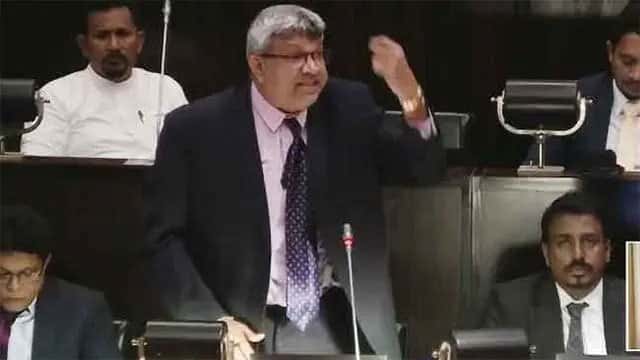









The Leader of the Opposition Mahinda Rajapaksa says that the government is attempting to promote the Counter-Terrorism Bill claiming that it can prohibit Sri Lankans from having links with foreign terrorist organizations.
The Opposition leader stated this issuing a statement today (05).
He says that the proposed counter-terrorism law is designed to treat terrorists with the utmost leniency to the extent where its actual effect will be that of protecting and giving encouragement to terrorists – not countering terrorism.
According to the statement issued by Rajapaksa, if the trial under this Act is not concluded within one year, the High Court is required to release the accused on bail.
He says that if the proposed Counter-Terrorism Bill is passed into law, it will hamper ongoing efforts to suppress terrorism following the Easter Sunday bomb attacks.
The complete statement issued by Mahinda Rajapaksa:
“One of the pledges given by the present government to their foreign masters through UN Human Rights Council Resolution No: 30/1 of October 2015 was to repeal and replace the Prevention of Terrorism Act of 1979. The draft counter terrorism law that has been presented to Parliament for this purpose has encountered opposition from political and media activist son the grounds that the way it defines the term ‘terrorism’ leaves room for legitimate political and trade union action as well as the dissemination of information and protection of sources by the media to be labeled as terrorist activity. In the aftermath of the Easter Sunday bombings, the government has been trying to sell their Counter Terrorism Bill to the public with the claim that it has provisions to prohibit Sri Lankan nationals from having links with foreign terrorist organizations.
While the government’s proposed law is tough on ordinary citizens by having provisions that can be used to stifle political dissent and the freedom of expression, it is designed to treat terrorists with the utmost leniency to the extent where its actual effect will be that of protecting and giving encouragement to terrorists – not countering terrorism. Our Penal Code prescribes the death penalty for killing just one person, but under the proposed counter terrorism law, a terrorist convicted of killing hundreds of or even thousands of people can only be given a maximum sentence of life imprisonment. Furthermore while the Penal Code prescribes the death penalty for aiding and abetting in murder, the penalty for aiding and abetting in mass murder in the proposed law is just fifteen years imprisonment and a fine of up to Rs. one million. How is terrorism to be deterred by giving convicted terrorists lesser punishments than what the ordinary law of the land prescribes for the same offences?
The proposed counter terrorism law also requires the police and the armed forces to treat terrorist suspects with the utmost solicitude. If a terrorist suspect is arrested by the armed forces, he has to be handed over to the OIC of the nearest police station within 24 hours. The latter has to examine him for injuries and present him before a JMO for treatment or a report. The Human Rights Commission has to be informed within 24 hours of the arrest so that they can determine whether the arrest has infringed the fundamental rights of the suspect. When a terrorist suspect is arrested, the arresting officer has to reveal his identity to the suspect and the suspect’s next of kin or associates despite a history in this country of terrorists having massacred entire families of armed forces personnel. The next of kin of terrorist suspects have to be provided ‘reasonable’ access to the suspect in a situation where today, the next of kin may well be the next suicide bomber coming to receive instructions. From the time of the arrest, the welfare of the terrorist suspect takes precedence over everything else.
All arrested suspects have to be produced before a Magistrate within 48 hours and the Magistrate is required by law to personally look into the well-being and welfare of the suspect. A suspect can be kept in detention only for two weeks and if this period can be extended only with the approval of a Magistrate. The total period of detention of a suspect cannot exceed eight weeks. Under the PTA in contrast, a suspect can be kept in detention for three months and this can be extended up to a total of eighteen months. A suspect arrested under the proposed counter terrorism law can be held in remand without instituting criminal proceedings for six months and this period may be extended for another six months on an order of the High Court. If criminal proceedings are not instituted within this extended period, the suspect will have to be granted bail. Under the PTA however, a suspect can be kept in remand until the conclusion of the trial. The proposed counter terrorism law requires the Human Rights Commission and the Magistrates to make unannounced visits to all places of detention and remand to look into the welfare of terrorist suspects and they have to ensure that the suspects are provided all the basic facilities. If the trial against a person remanded under this Act has not been concluded within one year, the High Court is mandatorily required to release the accused on bail.
Even at the trial stage, terrorist suspects are afforded special relief. The proposed law states that ‘if death or grievous bodily injury has not been caused’ or ‘if the security of the State has not been seriously affected’ by the suspect’s actions, and he displays contrition by among other things, publicly expressing remorse, providing reparations to victims and participating in a rehabilitation program, the Attorney General may either suspend criminal proceedings or withdraw the indictment altogether. How can a person who has harmed no one and not endangered the security of the State end up being arrested and prosecuted under a counter terrorism law? In practice, it is very difficult to collect sufficient evidence against a terrorism suspect largely because of the unsettled conditions that would be prevailing in the country. If a terrorist suspect is arrested and charged in court but is still incongruously deemed to have ‘not caused any harm to anyone’ or ‘endangered the security of the country’ that would only be due to the lack of evidence and not because he has not committed the crime he is accused of.
The proposed counter terrorism law acknowledges this reality by requiring an accused person to express remorse for something he is not supposed to have done and even pay reparations to victims he is not supposed to have harmed, before the Attorney General suspends or withdraws the indictment against him. Such bizarre provisions in the draft counter terrorism law are an acknowledgement of the practical difficulties in prosecuting terrorism suspects under the ordinary law which requires a high evidentiary bar. Most often what can be achieved through anti-terrorist legislation is the suppression of terrorism rather than prosecution and punishment of terrorists, which is why such laws have to be tough enough to enable its primary purpose to be achieved. There is no argument about the fact that the Prevention of Terrorism Act introduced by the UNP government in 1979 is a tough law. But we have had to deal with the most ruthless terrorists the world has ever seen and that would not have been possible if not for such laws.
Even in sentencing a terrorist after conviction under the proposed counter terrorism law, a reduced sentence can be handed down after considering mitigating factors such as a public denunciation of terrorism, provision of reparations to the victims and a public denouncement of violence etc. The government’s proposed counter terrorism law is in fact a comprehensive relief package for terrorists. If the proposed Counter Terrorism Bill is passed into law, it will seriously hamper ongoing efforts to suppress terrorism following the Easter Sunday bomb attacks. Since this country is once again confronted with terrorism, the government should be prevented from making any changes to the Public Security Ordinance of 1947 or the Prevention of Terrorism Act of 1979.Priority should be given to the people’s right to life over the rights of terrorists.”