




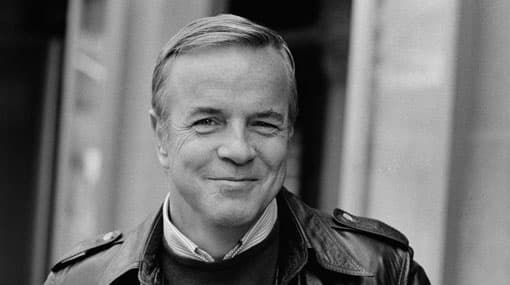



Italian director Franco Zeffirelli, who delighted audiences around the world with his romantic vision and extravagant productions, most famously captured in his cinematic “Romeo and Juliet” and the miniseries “Jesus of Nazareth,” died Saturday at 96.
While Zeffirelli was most popularly known for his films, his name was also inextricably linked to the theater and opera. He produced classics for the world’s most famous opera houses, from Milan’s venerable La Scala to the Metropolitan Opera in New York, and plays for London and Italian stages.
Zeffirelli’s son Luciano said his father died at home in Rome.
“He had suffered for a while, but he left in a peaceful way,” he said.
Zeffirelli made it his mission to make culture accessible to the masses, often seeking inspiration in Shakespeare and other literary greats for his films, and producing operas aimed at TV audiences. Claiming no favorites, Zeffirelli once likened himself to a sultan with a harem of three: film, theater and opera.
“I am not a film director. I am a director who uses different instruments to express his dreams and his stories — to make people dream,” Zeffirelli told The Associated Press in a 2006 interview.
From his out-of-wedlock birth on the outskirts of Florence on Feb. 12, 1923, Zeffirelli rose to be one of Italy’s most prolific directors, working with such opera greats as Luciano Pavarotti, Placido Domingo and Maria Callas, as well as Hollywood stars including Elizabeth Taylor, Richard Burton, Mel Gibson, Cher and Judi Dench.
Italian Prime Minister Giuseppe Conte said he was “profoundly moved by the death of Zeffirelli, who was an Italian ambassador of cinema, art and beauty.”
Throughout his career, Zeffirelli took risks — and his audacity paid off at the box office. His screen success in America was a rarity among Italian filmmakers.
He was one of the few Italian directors close to the Vatican, and the church turned to Zeffirelli’s theatrical touch for live telecasts of the 1978 papal installation and the 1983 Holy Year opening ceremonies in St. Peter’s Basilica. Former Italian Premier Silvio Berlusconi also tapped him to direct a few high-profile events.
But Zeffirelli was best known outside Italy for his colorful, softly-focused romantic films. His 1968 “Romeo and Juliet” brought Shakespeare’s famous story to a new and appreciative generation, and his 1973 “Brother Sun, Sister Moon,” told the life of St. Francis in parables.
“Romeo and Juliet” set box-office records in the United States, though it was made with two unknown actors, Leonard Whiting and Olivia Hussey. The film, which cost $1.5 million, grossed $52 million and became one of the most successful Shakespearian movies ever.
A year earlier, he directed Taylor and Burton in Shakespeare’s “The Taming of the Shrew,” leaving his distinctive mark on world cinema.
In the 1970s, Zeffirelli’s focus shifted from the romantic to the spiritual. His 1977 made-for-television “Life of Jesus” became an instant classic with its portrayal of a Christ who seemed authentic and relevant. Shown around the world, the film earned more than $300 million.
Where Zeffirelli worked, controversy was never far away. In 1978, he threatened to leave Italy for good because of harsh attacks against him and his art by Italian leftists, who saw Zeffirelli as an exponent of Hollywood.
On the other hand, piqued by American criticism of his 1981 movie “Endless Love,” starring Brooke Shields, Zeffirelli said he might never make another film in the U.S. The movie, as he predicted, was a box office success.
In his 2006 autobiography, Zeffirelli recounted how his mother attended her husband’s funeral pregnant with another man’s child. Unable to give the baby either her name or his father’s, she tried to name him Zeffiretti, after an aria in Mozart’s “Idomeneo.” But a typographical error made it Zeffirelli, making him “the only person in the world with Zeffirelli as a name, thanks to my mother’s folly.”
His mother died of tuberculosis when he was 6, and Zeffirelli went to live with his father’s cousin, whom he affectionately called Zia (Aunt) Lide.
Living in Zia Lide’s house and getting weekly visits from his father, Zeffirelli developed the passions that would shape his life. The first was for opera, after seeing Wagner’s “Walkuere” at age 8 or 9 in Florence. The second was a love of English culture and literature, after his father started him on thrice-weekly English lessons.
His experiences with the British expatriate community under fascism, and their staunch disbelief that they would be victimized by Benito Mussolini’s regime, were at the heart of the semi-autobiographical 1991 film “Tea with Mussolini.”
He remained ever an Anglophile, and was particularly proud when Britain gave him an honorary knighthood in 2004.
As a youth, Zeffirelli served with the partisans during World War II. He later acted as an interpreter for British troops. Then the lifelong bachelor turned to acting at 20 when he joined an experimental troupe in Florence.
Zeffirelli reportedly said in his autobiography that he considered himself a homosexual instead of using the term gay, a word he detested.
After a short-lived acting career, Zeffirelli worked with Luchino Visconti’s theatrical company in Rome, where he showed a flair for dramatic staging techniques in “A Streetcar Named Desire” and “Troilus and Cressida.” He later served as assistant director under Italian film masters Michelangelo Antonioni and Vittorio De Sica.
In 1950, he began a long and fruitful association with lyric theater, working as a director, set designer and costumist, and bringing new life to works by his personal favorites: Mozart, Rossini, Donizetti and Verdi. Over the next decade, he staged dozens of operas, romantic melodramas and contemporary works in Italian and other European theaters, eventually earning a reputation as one of the world’s best directors of musical theater.
Both La Scala and New York’s Metropolitan Opera later hosted Zeffirelli’s classic staging of “La Boheme,” which was shown on American television in 1982.
His first film effort in 1958, a comedy he wrote called “Camping,” had limited success.
Zeffirelli returned to prose theater in 1961 with an innovative interpretation of “Romeo and Juliet” at London’s Old Vic. British critics termed it “revolutionary,” and the director used it as the basis of frequent later productions and the 1968 film.
When Zeffirelli decided to do “La Traviata” on film, he had already worked his stage version of the opera into a classic, performed at La Scala with soprano Maria Callas. He had been planning the film since 1950, he said.
“In the last 30 years, I’ve done everything a lyric theater artist can do,” Zeffirelli wrote as the film was released in 1983. “This work is the one that crowns all my hopes and gratifies all my ambitions.”
The film, with Teresa Stratas and Placido Domingo in the lead roles, found near-unanimous critical acclaim on both sides of the Atlantic and received Oscar nominations for costuming, scenography and artistic direction.
Zeffirelli worked on a new staging of La Traviata as his last project, which will open the 2019 Opera Festival on June 21 at the Verona Arena.
“We’ll pay him a final tribute with one of his most loved operas,” said artistic director Cecilia Gasdia. “He’ll be with us.”
Zeffirelli often turned his talents toward his native city. In 1983, he wrote a historical portrait of Florence during the 15th and 16th centuries. During the disastrous 1966 Florence floods, Zeffirelli produced a well-received documentary on the damage done to the city and its art.
“I feel more like a Florentine than an Italian,” Zeffirelli once said. “A citizen of a Florence that was once the capital of Western civilization.”
Accused by some of heavy-handedness in his staging techniques, Zeffirelli fought frequent verbal battles with others in Italian theater.
“Zeffirelli doesn’t realize that an empty stage can be more dramatic than a stage full of junk,” Carmelo Bene, an avant-garde Italian director and actor, once said.
It was a criticism that some reserved for his lavish production of “Aida” to open La Scala’s 2006-7 season — his first return to the Milan opera house in a dozen years and the fifth “Aida” of his career. The production was a popular success, but may be remembered more for the turbulent exit of the lead tenor, Roberto Alagna, after being booed.
“I’m 83 and I’ve really been working like mad since I was a kid. I’ve done everything, but I never really feel that I have said everything I have to say,” Zeffirelli told The Associated Press shortly before the opening of “Aida.”
Zeffirelli had trouble with his balance after contracting an infection during hip surgery in 1999, but didn’t let that slow him down.
“I always have to cling on this or that to walk ... but the mind is absolutely intact,” he said in the AP interview.
Source: Associated Press
-Agencies