





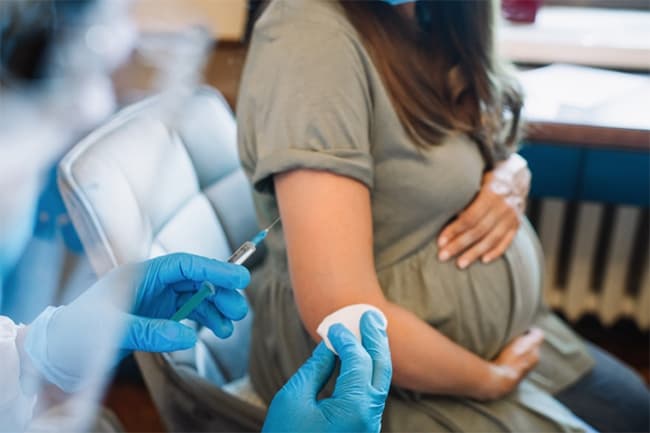



At six months of age, babies born to mothers vaccinated against COVID-19 during pregnancy are more likely to have antibodies against the virus in their blood than babies born to unvaccinated mothers who were infected while pregnant, a small study suggests.
Researchers on Monday reported in JAMA on 28 six-month-old infants born to women who were vaccinated with two doses of an mRNA vaccine at 20 to 32 weeks’ gestation, when transfer of maternal antibodies to the fetus via the placenta is at its highest, and 12 babies of that age whose mothers were infected during that same time frame. They found detectable levels of immunoglobulin G, the most common antibody in blood, in 57% of babies born to vaccinated mothers but in only 8% of the babies of infected, unvaccinated mothers.
It is not clear how high antibody levels need to be to protect against infection, and antibodies are not the body’s only defense mechanism. But “many interested parties from parents to pediatricians want to know how long maternal antibodies persist in infants after vaccination, and now we can provide some answers,” Dr. Andrea Edlow of Massachusetts General Hospital in Boston said in a statement. “We hope these findings will provide further incentive for pregnant people to get vaccinated.”
Moderate/severe COVID-19 tied to higher childbirth risks
Contracting COVID-19 late in pregnancy is linked with a higher risk for obstetric complications, new data suggest.
Among 14,104 women giving birth before vaccines were available, the 586 with moderate or severe COVID-19 during delivery or within 6 weeks beforehand were more likely to need cesarean deliveries, to deliver pre-term, to die around the time of birth, or to experience serious illness from high blood pressure, bleeding, or infections other than SARS-CoV-2. The combined rate of those events was 9.2% in uninfected women versus 26.1% in women with recent or current moderate or severe COVID-19, researchers reported on Monday in JAMA. After accounting for other risk factors, the odds of experiencing at least one of those complications was more than double in the moderate/severe COVID-19 group. Women in that group were also more likely to lose the pregnancy or to have an infant die during the newborn period. Mild or asymptomatic infection was not associated with increased complications, the researchers said.
Their data were collected before the Delta and Omicron variants of the virus appeared, and none of the women had been vaccinated, so the results cannot predict what might happen under current conditions. However, they “underscore the need for women of childbearing age and pregnant individuals to be vaccinated and to take other precautions” against COVID-19, said Dr. Diana Bianchi of the Eunice Kennedy Shriver National Institute of Child Health and Human Development, which funded the study.
Vulnerable U.S. seniors often failed to get antibody drugs
COVID-19 patients in the United States over age 65 face some of the highest risks for severe illness but are often unlikely to have received highly effective treatment with monoclonal antibodies, a nationwide study found.
Researchers reviewed data from more than 1.9 million Medicare beneficiaries diagnosed with COVID-19 between November 2020 and August 2021 who were not hospitalized and who survived at least a week after their diagnosis. Only 7.2% were treated with monoclonal antibodies such as those from Regeneron Pharmaceuticals or Eli Lilly and Co to keep their infections from worsening, the researchers reported on Friday in JAMA. Otherwise healthy seniors were most likely to get the drugs. About 23% of those with no chronic conditions received antibody therapy, compared with 6.3%, 6.0%, and 4.7% of those with 1-3, 4-5, and 6 or more chronic conditions, respectively. Blacks were less likely than whites to receive the infused drugs - 6.2% versus 7.4%. Higher-risk patients may have had difficulty navigating the multiple steps needed to receive the drugs given in hospitals or infusion centers, from receiving a timely diagnosis to referral and scheduling an infusion within 10 days, the researchers said.
These drugs “should first go to patients at the highest risk of death from COVID-19, but the opposite happened - the healthiest patients were the most likely to get treatment,” study leader Michael Barnett of Harvard T.H. Chan School of Public Health said in a statement. “Unfortunately, our federal and state system for distributing these drugs has failed our most vulnerable patients.”
(The above is a summary of some recent studies on COVID-19. They include research that warrants further study to corroborate the findings and that has yet to be certified by peer review.)
Source: Reuters
-Agencies