








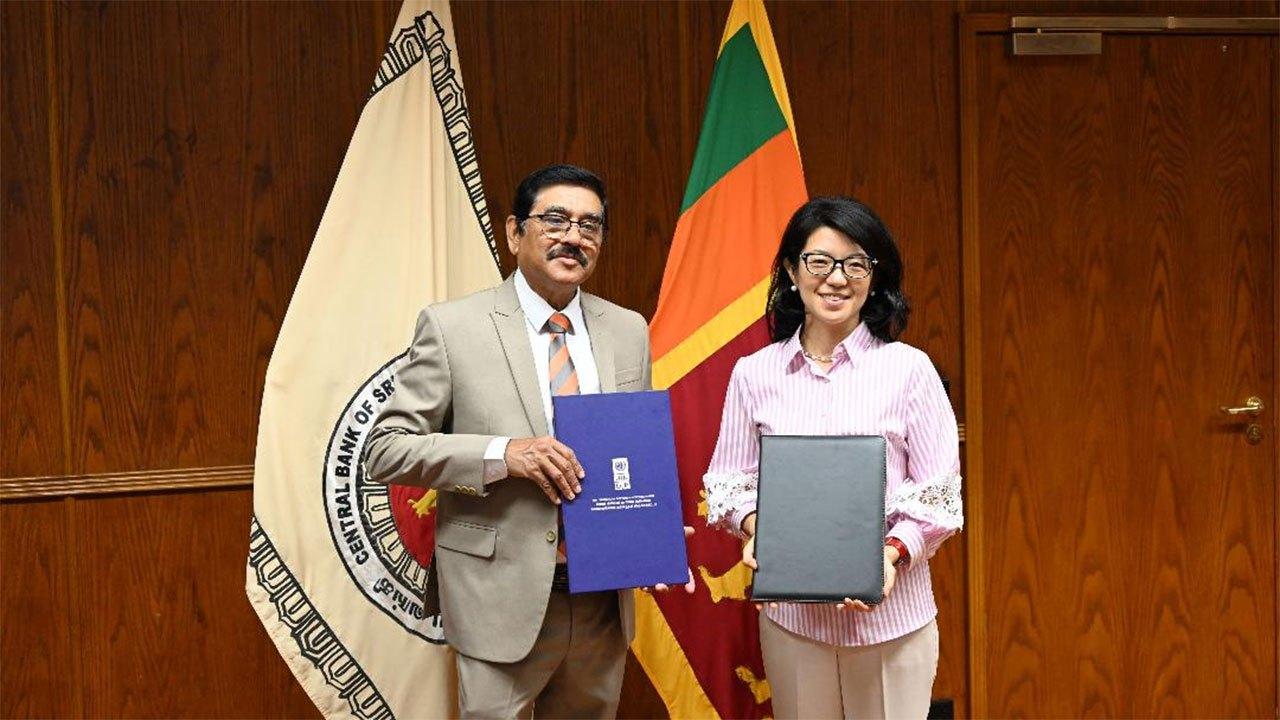



The United Nations Development Programme (UNDP) in Sri Lanka and the Central Bank of Sri Lanka (CBSL) have formalized today (16) the 2nd phase of a continued partnership, reaffirming their joint commitment to advancing financial literacy under Sri Lanka’s National Financial Literacy Roadmap (2024–2028), a key pillar of the National Financial Inclusion Strategy (NFIS).
The partnership was symbolically marked yesterday (15) through a meeting between the Governor of the Central Bank of Sri Lanka, Dr. P Nandalal Weerasinghe and Azusa Kubota, Resident Representative of UNDP in Sri Lanka, along with other representatives from CBSL and UNDP.
The collaboration builds on technical support provided by UNDP in 2024 and 2025 and reflects a shared vision to empower individuals and communities, particularly the most vulnerable to make informed financial decisions that contribute to improved enterprises and strengthened economic resilience at the household and community levels, a statement said.
This renewed partnership will focus on three key areas:
Capacity building at the national level: Strengthening the ability of government outreach officers (Development Officers) across all districts to deliver financial literacy training to rural communities and micro, small and medium enterprises (MSMEs), based on the Financial Literacy Curriculum developed by the CBSL. UNDP will be supporting the improvement of these modules by incorporating elements of climate resilient financial management.
National advocacy and communications: Supporting a comprehensive public awareness campaign to enhance financial literacy messaging and promote responsible financial behaviour.
Financial literacy integration: Embedding financial literacy into UNDP’s inclusive economic growth and MSME support programmes to strengthen financial decision-making, build resilience, and support economic empowerment.
These efforts are closely aligned with the Financial Literacy Roadmap, contributing to expanding access, improving knowledge, and enabling informed financial decision-making nationwide, with support from partners such as the Government of Japan, Chrysalis, VISA, Hirdaramani-Lacoste and others advancing financial literacy initiatives, the statement said.
Commenting on the partnership, Dr. P Nandalal Weerasinghe, Governor of CBSL noted, “We particularly welcome the focus on strengthening financial resilience, climate-related financial preparedness, public awareness campaigns, and capacity building through Training-of-Trainers programmes.
According to UNDP, these initiatives will help broaden the reach of financial literacy efforts and ensure that different segments of society have access to relevant and practical financial knowledge.
This will enable them to improve necessary skills that will lead to a positive attitude, triggering good financial behavior. The continuation of this partnership demonstrates our shared commitment to improving the financial well-being of Sri Lankans and supporting inclusive and sustainable economic development.”
Highlighting UNDP’s technical leadership in this sector, Azusa Kubota, Resident Representative, UNDP in Sri Lanka stated, “Financial literacy is a critical foundation for inclusive and resilient economies.
Through our partnership with the Central Bank of Sri Lanka, we have been working to empower individuals, particularly those most vulnerable, with the knowledge and tools needed to make informed financial decisions and build secure livelihoods.
This collaboration reflects UNDP’s continued commitment to supporting Sri Lanka’s journey towards greater financial inclusion, economic resilience, and sustainable development.”
By leveraging its global expertise in inclusive growth, sustainable finance, MSME development, climate resilience, and strategic communications, UNDP will complement national efforts while scaling impact through its ongoing and upcoming programmes, it added.
The initiative is expected to strengthen financial capability across Sri Lanka, supporting more resilient households, inclusive economic participation, and sustainable development outcomes.