






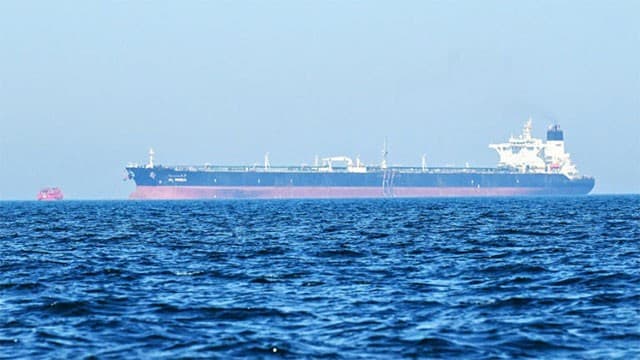


The price of oil jumped more than 5% after President Donald Trump declared on social media Monday morning that the U.S. would be resume its blockade on Iran and be “reimbursed” for helping ships transit the Strait of Hormuz.
U.S. crude oil surged 5%, to more than $75 per barrel, while international Brent crude oil also jumped 5% to $80 per barrel. The recent increase in oil prices have halted declines in U.S. gasoline prices, as well.
Stocks also took a dip lower, with the S&P 500 falling 0.5%. The Nasdaq, which was already sharply lower, hit its lowest level of the day.
Trump said the reimbursement would be “at the rate of 20% on all cargo shipped.” It was not immediately clear how that would work. Energy and shipping companies have loudly rejected a similar idea from Iran, under which ships would pay a toll in order to pass through the critical water way.
The U.S. Treasury Department has warned that anyone who pays Iran for passage through the Strait of Hormuz would expose themselves to sanctions violations, calling it “maritime extortion.”
The president said that the U.S. would be reimposing what he called “THE IRANIAN BLOCKADE,” which appeared to be a reference to a recent U.S. naval blockade preventing ships from entering or exiting Iranian ports. That blockade did not stop non-Iranian commercial vessels from transiting the waterway.
The latest escalation by Trump comes after the U.S. continued to strike targets in Iran as retaliation for the Iranian military hitting multiple commercial vessels, including on Sunday night, with projectiles and drones.
It could also further frustrate traffic in the Strait of Hormuz, a critical waterway where previously 20% of the world’s energy supplies passed to reach global markets.
Asked in May by Bloomberg whether Chevron would pay a fee to the Iranians to get its ships out of the region, CEO Mike Wirth bluntly said, “No we wouldn’t.”
“Freedom of navigation through international waterways is a very well-established principle,” Wirth added. He warned that a toll or fee in the Strait of Hormuz could set a bad precedent that would ripple around the world.
“Anything like this would begin to say that countries adjacent to an international waterway can charge some sort of a transit fee,” he said referring to other places in the world, such as the Straits of Malacca in southern Asia.
– with Agencies inputs --