









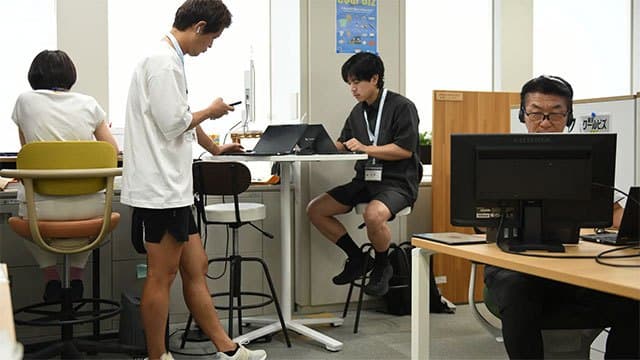



Tokyo is urging office workers to swap suits for shorts as Japan confronts another summer of extreme temperatures, with authorities expanding a long-running campaign aimed at keeping people cool while reducing energy use.
The Tokyo Metropolitan Government has updated its “Tokyo Cool Biz” campaign to encourage lighter office attire, including T-shirts, trainers and, for the first time, shorts, in an effort to help employees cope with increasingly intense heat, according to the BBC.
Officials say the guidance is intended to offer workers greater flexibility rather than impose a new dress code.
“We want to give people more options in the severe heat, not tell them what to wear. There should be no issue as long as the work attire is not offensive to anyone,” Tokyo Metropolitan Government environmental official Noboru Watanabe told the BBC.
The latest initiative comes as much of Japan endures temperatures approaching or exceeding 40C, prompting widespread heatstroke alerts and renewed concerns over the impact of climate change.
‘Cruelly hot day’
According to AFP, the Japan Meteorological Agency this year introduced the new term “kokushobi”, meaning “cruelly hot day”, to describe temperatures above 40C. Three cities crossed that threshold on Tuesday, while other parts of the country, including Nagoya and areas near Tokyo, approached similar levels on Wednesday.
Heatstroke alerts have now been issued across 41 of Japan’s 47 prefectures. Authorities have urged residents, particularly older people, to stay indoors where possible, remain hydrated and use air conditioning.
The Fire and Disaster Management Agency described the heat as a “disaster”, warning that many people were being hospitalised or dying from heat-related illnesses, AFP reported.
An 85-year-old farmer was found collapsed inside a greenhouse in Tochigi prefecture on Tuesday and was later confirmed dead. Local officials said the greenhouse had become extremely hot.
Mixed reactions
The decision to relax workplace dress expectations has generated mixed reactions.
A June survey by Gorilla Clinic, cited by the BBC, found that 53.5 per cent of respondents opposed wearing shorts to work, while 46.5 per cent supported the idea.
Many of those opposed cited concerns over appearance, body shape and body hair. The survey also suggested women were more likely than men to object to seeing male colleagues wearing shorts in the office.
The debate has even spawned a new online expression: “sunehara”, or “leg hair harassment”, referring to discomfort over visible leg hair in professional settings.
According to the BBC, some men have responded by seeking laser hair removal before adopting the more relaxed dress code. Akifumi Funatsu, director of Gorilla Clinic, said more clients were requesting treatment not simply for cosmetic reasons but because they regarded it as workplace etiquette.
Double standard
Some women, meanwhile, have argued that the policy exposes a double standard, noting that while men are now encouraged to dress more casually, women in many traditional offices still face expectations to wear tights when their legs are exposed.
The latest changes build on the original Cool Biz campaign launched in 2005 by Tokyo Governor Yuriko Koike when she served as Japan’s environment minister. The programme encouraged workers to abandon jackets and ties during the summer to reduce reliance on air conditioning, with then prime minister Junichiro Koizumi publicly embracing the campaign.
Following the 2011 earthquake and tsunami, the government expanded the initiative into Super Cool Biz, promoting even lighter clothing and broader energy-saving measures.
Scientists say human-driven climate change is making extreme heat events more frequent and more intense. Japan recorded its hottest summer on record last year, while the country’s all-time temperature reached 41.8C in August 2025.
As the mercury continues to rise, many Japanese are also turning to practical ways to stay cool, from clothing fitted with built-in fans and UV-blocking umbrellas to handheld cooling devices, while health experts continue urging people to prepare for prolonged periods of dangerous heat, according to the BBC and AFP.
Source: Gulf News
--Agencies